Artículo
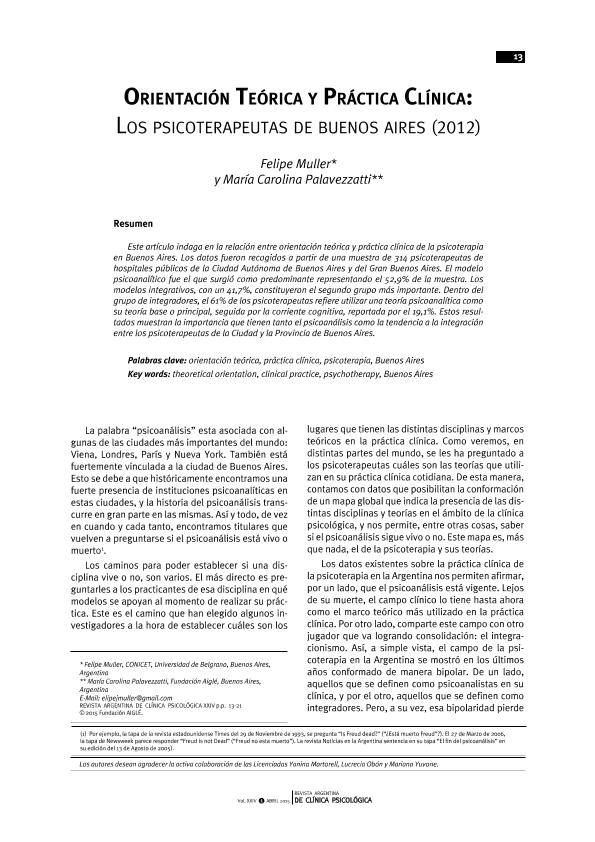
Este artículo indaga en la relación entre orientación teórica y práctica clínica de la psicoterapia en Buenos Aires. Los datos fueron recogidos a partir de una muestra de 314 psicoterapeutas de hospitales públicos de la Ciudad Autónoma de Buenos Aires y del Gran Buenos Aires. El modelo psicoanalítico fue el que surgió como predominante representando el 52,9% de la muestra. Los modelos integrativos, con un 41,7%, constituyeron el segundo grupo más importante. Dentro del grupo de integradores, el 61% de los psicoterapeutas refiere utilizar una teoría psicoanalítica como su teoría base o principal, seguida por la corriente cognitiva, reportada por el 19,1%. Estos resultados muestran la importancia que tienen tanto el psicoanálisis como la tendencia a la integración entre los psicoterapeutas de la Ciudad y la Provincia de Buenos Aires. The aim of this article is to provide information about the relationship between theoretical orientation and clinical practice in Buenos Aires. Data was gathered from a sample of 314 psychotherapists in hospitals of the City of Buenos Aires and Gran Buenos Aires. The psychoanalytic model emerged as the predominant model, representing 52.9% of the sample. Integrative models, with 41.7% of the sample, were the second largest group. Within the group of integrationists, 61% of psychotherapists reported using psychoanalytic theory as the main theory, followed by a cognitive theory, reported by 19.1%. These results reveal both the importance of psychoanalysis in Buenos Aires, and the trend towards integrationism.
Orientación teórica y practica clínica: Los psicoterapeutas de Buenos Aires

Fecha de publicación:
04/2015
Editorial:
Fundacion Aigle
Revista:
Revista Argentina de Clinica Psicologica
ISSN:
0327-6716
Idioma:
Español
Tipo de recurso:
Artículo publicado
Clasificación temática:
Resumen
Palabras clave:
Orientación Teórica
,
Práctica Clínica
,
Psicoterapia
,
Buenos Aires
Archivos asociados

Tamaño:
276.5Kb
Formato:
PDF
Licencia
 Excepto donde se diga explícitamente, este item se publica bajo la siguiente descripción:
Creative Commons Attribution-NonCommercial-ShareAlike 2.5 Unported (CC BY-NC-SA 2.5)
Excepto donde se diga explícitamente, este item se publica bajo la siguiente descripción:
Creative Commons Attribution-NonCommercial-ShareAlike 2.5 Unported (CC BY-NC-SA 2.5)
Identificadores
Colecciones
Articulos(SEDE CENTRAL)
Articulos de SEDE CENTRAL
Articulos de SEDE CENTRAL
Citación
Muller, Felipe Juan; Palavezzatti, Carolina; Orientación teórica y practica clínica: Los psicoterapeutas de Buenos Aires; Fundacion Aigle; Revista Argentina de Clinica Psicologica; XXIV; 1; 4-2015; 13-21
Compartir

