Artículo
Slab-derived components in the subcontinental lithospheric mantle beneath Chilean Patagonia: Geochemistry and Sr–Nd–Pb isotopes of mantle xenoliths and host basalt
Jalowitzki, Tiago; Gervasoni, Fernanda; Conceição, Rommulo V.; Orihashi, Yuji; Bertotto, Gustavo Walter ; Sumino, Hirochika; Schilling, Manuel E.; Nagao, Keisuke; Morata, Diego; Sylvester, Paul
; Sumino, Hirochika; Schilling, Manuel E.; Nagao, Keisuke; Morata, Diego; Sylvester, Paul
Fecha de publicación:
11/2017
Editorial:
Elsevier Science
Revista:
Lithos
ISSN:
0024-4937
Idioma:
Inglés
Tipo de recurso:
Artículo publicado
Clasificación temática:
Resumen
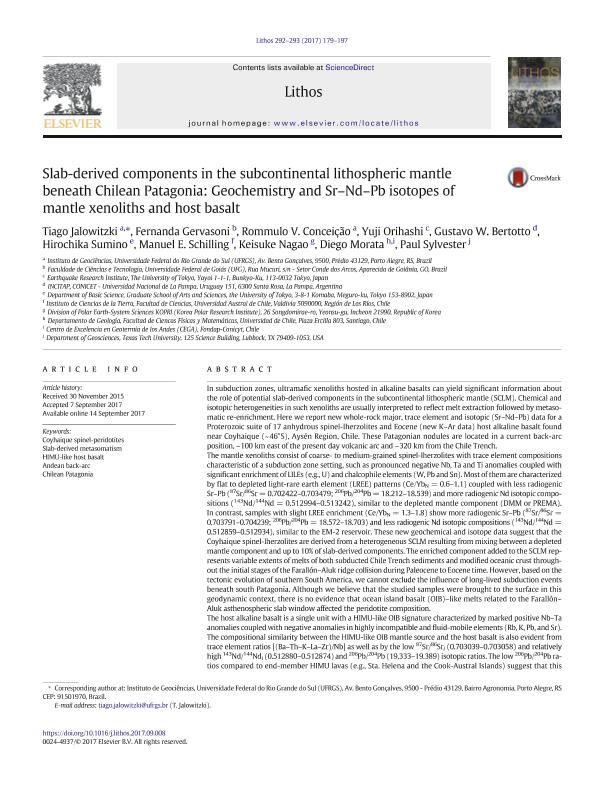
In subduction zones, ultramafic xenoliths hosted in alkaline basalts can yield significant information about the role of potential slab-derived components in the subcontinental lithospheric mantle (SCLM). Chemical and isotopic heterogeneities in such xenoliths are usually interpreted to reflect melt extraction followed by metasomatic re-enrichment. Here we report new whole-rock major, trace element and isotopic (Sr?Nd?Pb) data for a Proterozoic suite of 17 anhydrous spinel-lherzolites and Eocene (new K?Ar data) host alkaline basalt found near Coyhaique (~46°S), Aysén Region, Chile. These Patagonian nodules are located in a current back-arc position, ~100 km east of the present day volcanic arc and ~320 km from the Chile Trench.The mantle xenoliths consist of coarse- to medium-grained spinel-lherzolites with trace element compositions characteristic of a subduction zone setting, such as pronounced negative Nb, Ta and Ti anomalies coupled with significant enrichment of LILEs (e.g., U) and chalcophile elements (W, Pb and Sn). Most of them are characterized by flat to depleted light-rare earth element (LREE) patterns (Ce/YbN = 0.6?1.1) coupled with less radiogenic Sr?Pb (87Sr/86Sr=0.702422?0.703479; 206Pb/204Pb=18.212?18.539) and more radiogenic Nd isotopic compositions (143Nd/144Nd = 0.512994?0.513242), similar to the depleted mantle component (DMM or PREMA). In contrast, samples with slight LREE enrichment (Ce/YbN=1.3?1.8) show more radiogenic Sr?Pb (87Sr/86Sr=0.703791?0.704239; 206Pb/204Pb =18.572?18.703) and less radiogenic Nd isotopic compositions (143Nd/144Nd=0.512859?0.512934), similar to the EM-2 reservoir. These new geochemical and isotope data suggest that the Coyhaique spinel-lherzolites are derived from a heterogeneous SCLM resulting from mixing between a depleted mantle component and up to 10% of slab-derived components. The enriched component added to the SCLM represents variable extents of melts of both subducted Chile Trench sediments and modified oceanic crust throughoutthe initial stages of the Farallón?Aluk ridge collision during Paleocene to Eocene time. However, based on the tectonic evolution of southern South America, we cannot exclude the influence of long-lived subduction events beneath south Patagonia. Although we believe that the studied samples were brought to the surface in this geodynamic context, there is no evidence that ocean island basalt (OIB)?like melts related to the Farallón?Aluk asthenospheric slab window affected the peridotite composition.The host alkaline basalt is a single unit with a HIMU-like OIB signature characterized by marked positive Nb?Ta anomalies coupledwith negative anomalies in highly incompatible and fluid-mobile elements (Rb, K, Pb, and Sr).The compositional similarity between the HIMU-like OIB mantle source and the host basalt is also evident from trace element ratios [(Ba?Th?K?La?Zr)/Nb] as well as by the low 87Sr/86Sri (0.703039?0.703058) and relatively high 143Nd/144Ndi (0.512880?0.512874) and 206Pb/204Pb (19.333?19.389) isotopic ratios. The low206Pb/204Pb ratios compared to end-member HIMU lavas (e.g., Sta. Helena and the Cook-Austral Islands) suggest that this region was modified by processes associated with a prolonged period of subduction related to the Andean orogenesis and the recycling of several oceanic plates beneath the continent, following the Mesozoic breakup of Gondwana or an even older subduction-related event with young recycling ages (b2 Ga).
Archivos asociados

Tamaño:
3.145Mb
Formato:
PDF
Licencia
 Excepto donde se diga explícitamente, este item se publica bajo la siguiente descripción:
Creative Commons Attribution-NonCommercial-ShareAlike 2.5 Unported (CC BY-NC-SA 2.5)
Excepto donde se diga explícitamente, este item se publica bajo la siguiente descripción:
Creative Commons Attribution-NonCommercial-ShareAlike 2.5 Unported (CC BY-NC-SA 2.5)
Identificadores
Colecciones
Articulos(INCITAP)
Articulos de INST.D/CS D/L/TIERRA Y AMBIENTALES D/L/PAMPA
Articulos de INST.D/CS D/L/TIERRA Y AMBIENTALES D/L/PAMPA
Citación
Jalowitzki, Tiago; Gervasoni, Fernanda; Conceição, Rommulo V.; Orihashi, Yuji; Bertotto, Gustavo Walter; et al.; Slab-derived components in the subcontinental lithospheric mantle beneath Chilean Patagonia: Geochemistry and Sr–Nd–Pb isotopes of mantle xenoliths and host basalt; Elsevier Science; Lithos; 292-293; 11-2017; 179-197
Compartir


Altmétricas