Artículo
Oligarchic planetesimal accretion and giant planet formation

Fecha de publicación:
12/2007
Editorial:
EDP Sciences
Revista:
Astronomy and Astrophysics
ISSN:
0004-6361
Idioma:
Inglés
Tipo de recurso:
Artículo publicado
Clasificación temática:
Resumen
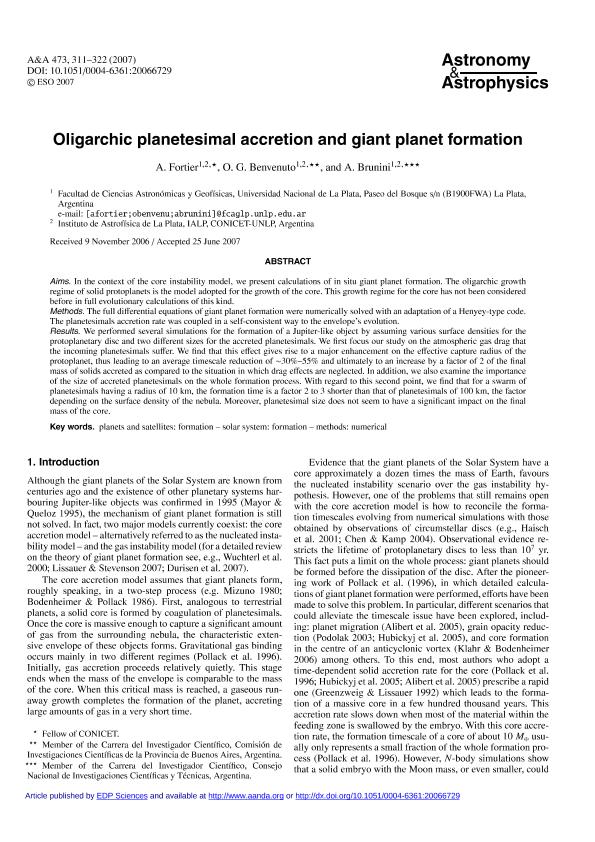
Aims. In the context of the core instability model, we present calculations of in situ giant planet formation. The oligarchic growth regime of solid protoplanets is the model adopted for the growth of the core. This growth regime for the core has not been considered before in full evolutionary calculations of this kind. Methods. The full differential equations of giant planet formation were numerically solved with an adaptation of a Henyey-type code. The planetesimals accretion rate was coupled in a self-consistent way to the envelope’s evolution. Results. We performed several simulations for the formation of a Jupiter-like object by assuming various surface densities for the protoplanetary disc and two different sizes for the accreted planetesimals. We first focus our study on the atmospheric gas drag that the incoming planetesimals suffer. We find that this effect gives rise to a major enhancement on the effective capture radius of the protoplanet, thus leading to an average timescale reduction of ∼30%–55% and ultimately to an increase by a factor of 2 of the final mass of solids accreted as compared to the situation in which drag effects are neglected. In addition, we also examine the importance of the size of accreted planetesimals on the whole formation process. With regard to this second point, we find that for a swarm of planetesimals having a radius of 10 km, the formation time is a factor 2 to 3 shorter than that of planetesimals of 100 km, the factor depending on the surface density of the nebula. Moreover, planetesimal size does not seem to have a significant impact on the final mass of the core.
Archivos asociados

Tamaño:
379.8Kb
Formato:
PDF
Licencia
 Excepto donde se diga explícitamente, este item se publica bajo la siguiente descripción:
Creative Commons Attribution-NonCommercial-ShareAlike 2.5 Unported (CC BY-NC-SA 2.5)
Excepto donde se diga explícitamente, este item se publica bajo la siguiente descripción:
Creative Commons Attribution-NonCommercial-ShareAlike 2.5 Unported (CC BY-NC-SA 2.5)
Identificadores
Colecciones
Articulos(IALP)
Articulos de INST.DE ASTROFISICA LA PLATA
Articulos de INST.DE ASTROFISICA LA PLATA
Citación
Fortier, Andrea; Benvenuto, Omar Gustavo; Brunini, Adrian; Oligarchic planetesimal accretion and giant planet formation; EDP Sciences; Astronomy and Astrophysics; 473; 1; 12-2007; 311-322
Compartir


Altmétricas