Artículo
Hypothermia Prevents Retinal Damage Generated by Optic Nerve Trauma in the Rat
Rey Funes, Manuel; Larráyoz, Ignacio M.; Contartese, Daniela Soledad; Soliño, Manuel; Sarotto, Anibal; Bustelo Tejada, Martin ; Bruno, Martin; Dorfman, Verónica Berta
; Loidl, Cesar Fabian
; Martínez, Alfredo
; Bruno, Martin; Dorfman, Verónica Berta
; Loidl, Cesar Fabian
; Martínez, Alfredo
; Bruno, Martin; Dorfman, Verónica Berta
; Loidl, Cesar Fabian
; Martínez, Alfredo
Fecha de publicación:
12/2017
Editorial:
Nature Publishing Group
Revista:
Scientific Reports
ISSN:
2045-2322
Idioma:
Inglés
Tipo de recurso:
Artículo publicado
Clasificación temática:
Resumen
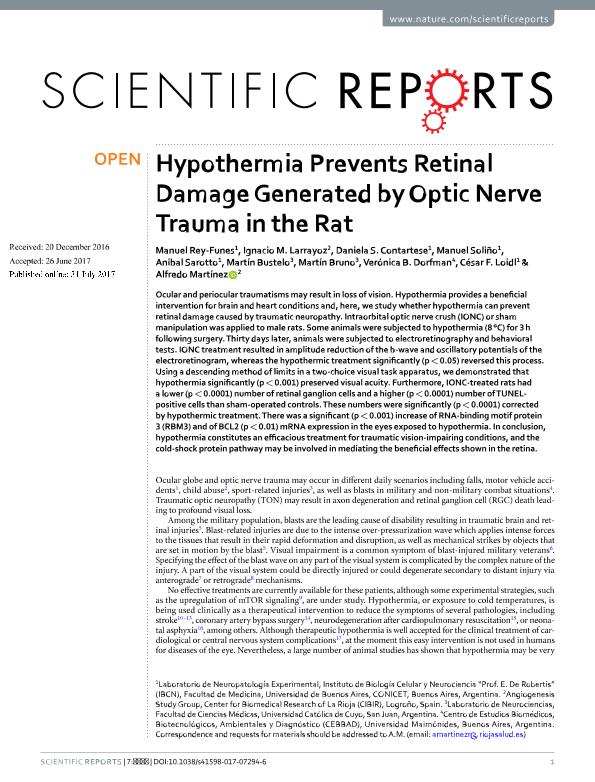
Ocular and periocular traumatisms may result in loss of vision. Hypothermia provides a beneficial intervention for brain and heart conditions and, here, we study whether hypothermia can prevent retinal damage caused by traumatic neuropathy. Intraorbital optic nerve crush (IONC) or sham manipulation was applied to male rats. Some animals were subjected to hypothermia (8 °C) for 3 h following surgery. Thirty days later, animals were subjected to electroretinography and behavioral tests. IONC treatment resulted in amplitude reduction of the b-wave and oscillatory potentials of the electroretinogram, whereas the hypothermic treatment significantly (p < 0.05) reversed this process. Using a descending method of limits in a two-choice visual task apparatus, we demonstrated that hypothermia significantly (p < 0.001) preserved visual acuity. Furthermore, IONC-treated rats had a lower (p < 0.0001) number of retinal ganglion cells and a higher (p < 0.0001) number of TUNEL-positive cells than sham-operated controls. These numbers were significantly (p < 0.0001) corrected by hypothermic treatment. There was a significant (p < 0.001) increase of RNA-binding motif protein 3 (RBM3) and of BCL2 (p < 0.01) mRNA expression in the eyes exposed to hypothermia. In conclusion, hypothermia constitutes an efficacious treatment for traumatic vision-impairing conditions, and the cold-shock protein pathway may be involved in mediating the beneficial effects shown in the retina.
Palabras clave:
Retina
,
Hypothermia
,
Optic Nerve Crush
Archivos asociados

Tamaño:
3.086Mb
Formato:
PDF
Licencia
 Excepto donde se diga explícitamente, este item se publica bajo la siguiente descripción:
Creative Commons Attribution-NonCommercial-ShareAlike 2.5 Unported (CC BY-NC-SA 2.5)
Excepto donde se diga explícitamente, este item se publica bajo la siguiente descripción:
Creative Commons Attribution-NonCommercial-ShareAlike 2.5 Unported (CC BY-NC-SA 2.5)
Identificadores
Colecciones
Articulos(SEDE CENTRAL)
Articulos de SEDE CENTRAL
Articulos de SEDE CENTRAL
Citación
Rey Funes, Manuel; Larráyoz, Ignacio M.; Contartese, Daniela Soledad; Soliño, Manuel; Sarotto, Anibal; et al.; Hypothermia Prevents Retinal Damage Generated by Optic Nerve Trauma in the Rat; Nature Publishing Group; Scientific Reports; 7; 1; 12-2017; 6966-6976
Compartir


Altmétricas