Artículo
Quantum chemical and kinetic study of the CCl 2 self-recombination reaction

Fecha de publicación:
12/2017
Editorial:
Elsevier
Revista:
Computational and Theoretical Chemistry
ISSN:
2210-271X
Idioma:
Inglés
Tipo de recurso:
Artículo publicado
Clasificación temática:
Resumen
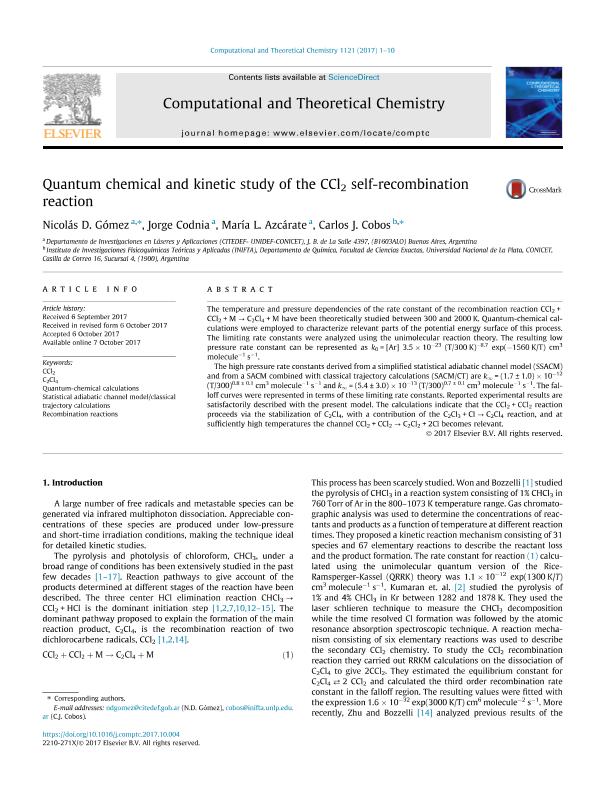
The temperature and pressure dependencies of the rate constant of the recombination reaction CCl2 + CCl2 + M → C2Cl4 + M have been theoretically studied between 300 and 2000 K. Quantum-chemical calculations were employed to characterize relevant parts of the potential energy surface of this process. The limiting rate constants were analyzed using the unimolecular reaction theory. The resulting low pressure rate constant can be represented as k0 = [Ar] 3.5 × 10⁻²³ (T/300 K)−8.7 exp(−1560 K/T) cm3 molecule−1 s−1.
The high pressure rate constants derived from a simplified statistical adiabatic channel model (SSACM) and from a SACM combined with classical trajectory calculations (SACM/CT) are k∞ = (1.7 ± 1.0) × 10−12 (T/300)0.8 ± 0.1 cm3 molecule−1 s−1 and k∞ = (5.4 ± 3.0) × 10−13 (T/300)0.7 ± 0.1 cm3 molecule−1 s−1. The falloff curves were represented in terms of these limiting rate constants. Reported experimental results are satisfactorily described with the present model. The calculations indicate that the CCl2 + CCl2 reaction proceeds via the stabilization of C2Cl4, with a contribution of the C2Cl3 + Cl → C2Cl4 reaction, and at sufficiently high temperatures the channel CCl2 + CCl2 → C2Cl2 + 2Cl becomes relevant.
Archivos asociados

Tamaño:
979.3Kb
Formato:
PDF
Licencia
 Excepto donde se diga explícitamente, este item se publica bajo la siguiente descripción:
Atribución-NoComercial-SinDerivadas 2.5 Argentina (CC BY-NC-ND 2.5 AR)
Excepto donde se diga explícitamente, este item se publica bajo la siguiente descripción:
Atribución-NoComercial-SinDerivadas 2.5 Argentina (CC BY-NC-ND 2.5 AR)
Identificadores
Colecciones
Articulos(UNIDEF)
Articulos de UNIDAD DE INVESTIGACION Y DESARROLLO ESTRATEGICOS PARA LA DEFENSA
Articulos de UNIDAD DE INVESTIGACION Y DESARROLLO ESTRATEGICOS PARA LA DEFENSA
Citación
Gómez, Nicolás Damián; Codnia, Jorge; Azcárate, María Laura; Cobos, Carlos Jorge; Quantum chemical and kinetic study of the CCl 2 self-recombination reaction; Elsevier; Computational and Theoretical Chemistry; 1121; 12-2017; 1-10
Compartir


Altmétricas