Mostrar el registro sencillo del ítem
dc.contributor.author
Alabarces, Pablo Alejandro
dc.contributor.author
Trotta, Felipe
dc.date.available
2018-04-09T17:14:50Z
dc.date.issued
2017-10
dc.identifier.citation
Alabarces, Pablo Alejandro; Trotta, Felipe; Introduction to the Special Issue: Music and Subalternity through the Popular and Periphery, or How to Use Popular Music for Several Debates at the same Time; Equinox Publishing; Journal of World Popular Music; 4; 2; 10-2017; 142-151
dc.identifier.issn
2052-4900
dc.identifier.uri
http://hdl.handle.net/11336/41333
dc.description.abstract
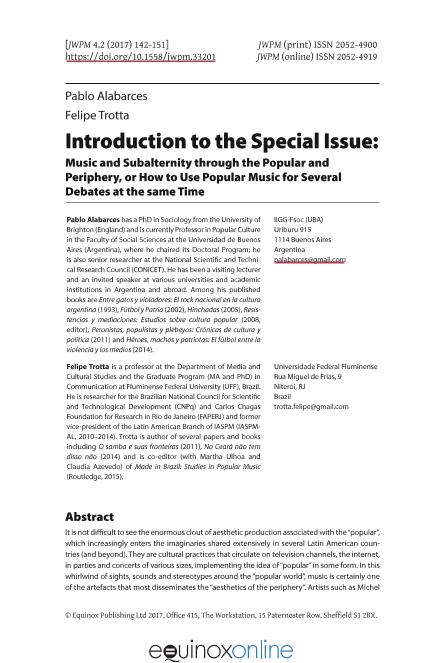
It is not difficult to see the enormous clout of aesthetic production associated with the “popular”, which increasingly enters the imaginaries shared extensively in several Latin American countries (and beyond). They are cultural practices that circulate on television channels, the internet, in parties and concerts of various sizes, implementing the idea of “popular” in some form. In this whirlwind of sights, sounds and stereotypes around the “popular world”, music is certainly one of the artefacts that most disseminates the “aesthetics of the periphery”. Artists such as Michel Teló, Aviões do Forró, Mr. Catra, Damas Grátis, Pibes Chorros, Don Omar and Calle 13 are linked to ways of saying, acting and thinking of the periphery (in its various social and territorial meanings), and circulate around the industry of world culture implementing sounds and thoughts that frequently collide with intellectualized aspects of life and discourse. In Latin America, some musical practices highlight heated debates about ethics and aesthetics, dealing with thoughts on the geographical and social hierarchy of our societies. This special issue, including its introduction, intends to present some of these discussions, focusing on three key categories in Latin American debates: popular, subalternity and periphery (in the complex meaning of social and territorial separation, but also in production from beyond the centre of the Western world: in the music scene, and also in academia).
dc.format
application/pdf
dc.language.iso
eng
dc.publisher
Equinox Publishing
dc.rights
info:eu-repo/semantics/openAccess
dc.rights.uri
https://creativecommons.org/licenses/by-nc-sa/2.5/ar/
dc.subject
Argentina
dc.subject
Brazil
dc.subject
Class
dc.subject
Subalternity
dc.subject.classification
Otras Sociología
dc.subject.classification
Sociología
dc.subject.classification
CIENCIAS SOCIALES
dc.title
Introduction to the Special Issue: Music and Subalternity through the Popular and Periphery, or How to Use Popular Music for Several Debates at the same Time
dc.type
info:eu-repo/semantics/article
dc.type
info:ar-repo/semantics/artículo
dc.type
info:eu-repo/semantics/publishedVersion
dc.date.updated
2018-04-06T13:56:21Z
dc.identifier.eissn
2052-4919
dc.journal.volume
4
dc.journal.number
2
dc.journal.pagination
142-151
dc.journal.pais
Reino Unido
dc.journal.ciudad
Sheffield
dc.description.fil
Fil: Alabarces, Pablo Alejandro. Universidad de Buenos Aires. Facultad de Ciencias Sociales. Instituto de Investigaciones ; Argentina. Consejo Nacional de Investigaciones Científicas y Técnicas; Argentina
dc.description.fil
Fil: Trotta, Felipe. Universidade Federal Fluminense; Brasil
dc.journal.title
Journal of World Popular Music
dc.relation.alternativeid
info:eu-repo/semantics/altIdentifier/doi/http://dx.doi.org/10.1558/jwpm.33201
dc.relation.alternativeid
info:eu-repo/semantics/altIdentifier/url/https://journals.equinoxpub.com/index.php/JWPM/article/view/33201
Archivos asociados

Tamaño:
247.6Kb
Formato:
PDF