Artículo
Two measurement methods of leaf dry matter content produce similar results in a broad range of species

Fecha de publicación:
05/2007
Editorial:
Oxford University Press
Revista:
Annals of Botany
ISSN:
0305-7364
e-ISSN:
1095-8290
Idioma:
Inglés
Tipo de recurso:
Artículo publicado
Clasificación temática:
Resumen
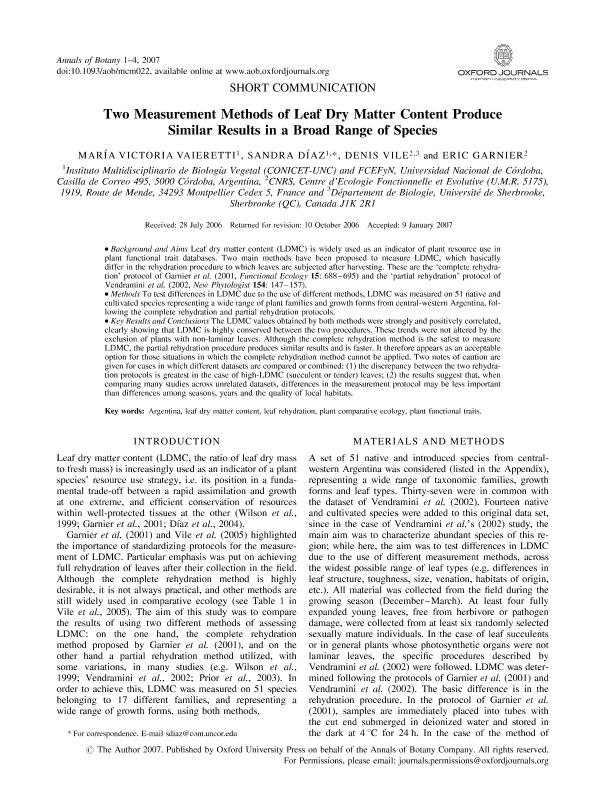
Background and Aims Leaf dry matter content (LDMC) is widely used as an indicator of plant resource use in plant functional trait databases. Two main methods have been proposed to measure LDMC, which basically differ in the rehydration procedure to which leaves are subjected after harvesting. These are the ‘complete rehydration’
protocol of Garnier et al. (2001, Functional Ecology 15: 688–695) and the ‘partial rehydration’ protocol of Vendramini et al. (2002, New Phytologist 154: 147–157).
† Methods To test differences in LDMC due to the use of different methods, LDMC was measured on 51 native and cultivated species representing a wide range of plant families and growth forms from central-western Argentina, following
the complete rehydration and partial rehydration protocols.
†Key Results and Conclusions The LDMC values obtained by both methods were strongly and positively correlated, clearly showing that LDMC is highly conserved between the two procedures. These trends were not altered by the exclusion of plants with non-laminar leaves. Although the complete rehydration method is the safest to measure LDMC, the partial rehydration procedure produces similar results and is faster. It therefore appears as an acceptable option for those situations in which the complete rehydration method cannot be applied. Two notes of caution are
given for cases in which different datasets are compared or combined: (1) the discrepancy between the two rehydration protocols is greatest in the case of high-LDMC (succulent or tender) leaves; (2) the results suggest that, when comparing many studies across unrelated datasets, differences in the measurement protocol may be less important than differences among seasons, years and the quality of local habitats.
Palabras clave:
Argentina
,
Leaf Dry Matter Content
,
Plant Traits
Archivos asociados

Tamaño:
110.3Kb
Formato:
PDF
Licencia
 Excepto donde se diga explícitamente, este item se publica bajo la siguiente descripción:
Creative Commons Attribution-NonCommercial-ShareAlike 2.5 Unported (CC BY-NC-SA 2.5)
Excepto donde se diga explícitamente, este item se publica bajo la siguiente descripción:
Creative Commons Attribution-NonCommercial-ShareAlike 2.5 Unported (CC BY-NC-SA 2.5)
Identificadores
Colecciones
Articulos(IMBIV)
Articulos de INST.MULTIDISCIPL.DE BIOLOGIA VEGETAL (P)
Articulos de INST.MULTIDISCIPL.DE BIOLOGIA VEGETAL (P)
Citación
Vaieretti, Maria Victoria; Díaz, Sandra Myrna; Vile, Denis; Garnier, Eric; Two measurement methods of leaf dry matter content produce similar results in a broad range of species; Oxford University Press; Annals of Botany; 99; 5; 5-2007; 955-958
Compartir


Altmétricas