Artículo
The diversity, ecology and evolution of extrafloral nectaries: Current perspectives and future challenges

Fecha de publicación:
06/2013
Editorial:
Oxford University Press
Revista:
Annals of Botany
ISSN:
0305-7364
Idioma:
Inglés
Tipo de recurso:
Artículo publicado
Clasificación temática:
Resumen
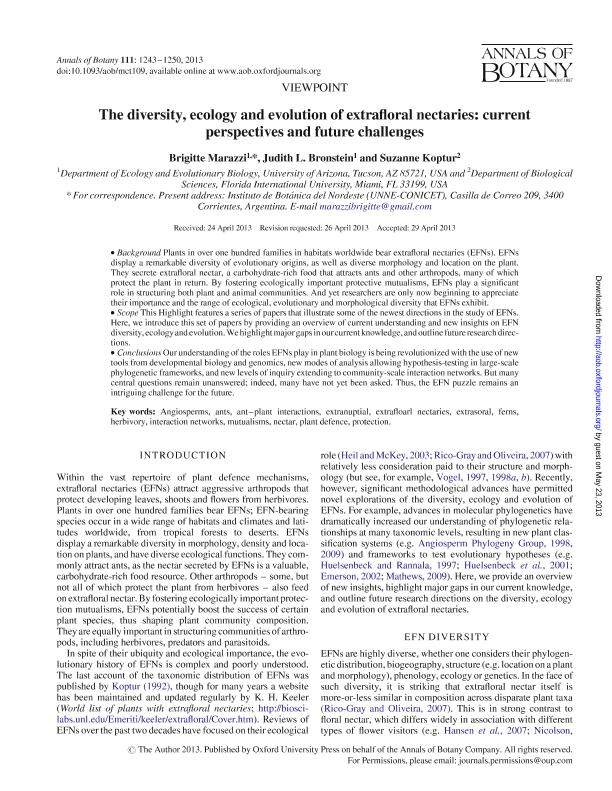
Background - Plants in over one hundred families in habitats worldwide bear extrafloral nectaries (EFNs). EFNs display a remarkable diversity of evolutionary origins, as well as diverse morphology and location on the plant. They secrete extrafloral nectar, a carbohydrate-rich food that attracts ants and other arthropods, many of which protect the plant in return. By fostering ecologically important protective mutualisms, EFNs play a significant role in structuring both plant and animal communities. And yet researchers are only now beginning to appreciate their importance and the range of ecological, evolutionary and morphological diversity that EFNs exhibit. Scope - This Highlight features a series of papers that illustrate some of the newest directions in the study of EFNs. Here, we introduce this set of papers by providing an overview of current understanding and new insights on EFN diversity, ecology and evolution. We highlight major gaps in our current knowledge, and outline future research directions. Conclusions - Our understanding of the roles EFNs play in plant biology is being revolutionized with the use of new tools from developmental biology and genomics, new modes of analysis allowing hypothesis-testing in large-scale phylogenetic frameworks, and new levels of inquiry extending to community-scale interaction networks. But many central questions remain unanswered; indeed, many have not yet been asked. Thus, the EFN puzzle remains an intriguing challenge for the future.
Archivos asociados

Tamaño:
188.3Kb
Formato:
PDF
Licencia
 Excepto donde se diga explícitamente, este item se publica bajo la siguiente descripción:
Creative Commons Attribution-NonCommercial-ShareAlike 2.5 Unported (CC BY-NC-SA 2.5)
Excepto donde se diga explícitamente, este item se publica bajo la siguiente descripción:
Creative Commons Attribution-NonCommercial-ShareAlike 2.5 Unported (CC BY-NC-SA 2.5)
Identificadores
Colecciones
Articulos(IBONE)
Articulos de INST.DE BOTANICA DEL NORDESTE (I)
Articulos de INST.DE BOTANICA DEL NORDESTE (I)
Citación
Marazzi, Brigitte; Bronstein, Judith L.; Koptur, Suzanne; The diversity, ecology and evolution of extrafloral nectaries: Current perspectives and future challenges; Oxford University Press; Annals of Botany; 111; 6; 6-2013; 1243-1250
Compartir

