Artículo
Introducing simple detection of bioavailable arsenic at Rafaela (Santa Fe Province, Argentina) using the ARSOlux biosensor
Siegfried, Konrad; Hahn Tomer, Sonja; Koelsch, Andreas; Osterwalder, Eva; Mattusch, Juergen; Staerk, Hans Joachim; Meichtry, Jorge Martin ; De Seta, Graciela E.; Reina, Fernando D.; Panigatti, Maria Cecilia; Litter, Marta Irene
; Harms, Hauke
; De Seta, Graciela E.; Reina, Fernando D.; Panigatti, Maria Cecilia; Litter, Marta Irene
; Harms, Hauke
; De Seta, Graciela E.; Reina, Fernando D.; Panigatti, Maria Cecilia; Litter, Marta Irene
; Harms, Hauke
Fecha de publicación:
05/2015
Editorial:
Molecular Diversity Preservation International
Revista:
International Journal of Environmental Research and Public Health
ISSN:
1660-4601
Idioma:
Inglés
Tipo de recurso:
Artículo publicado
Clasificación temática:
Resumen
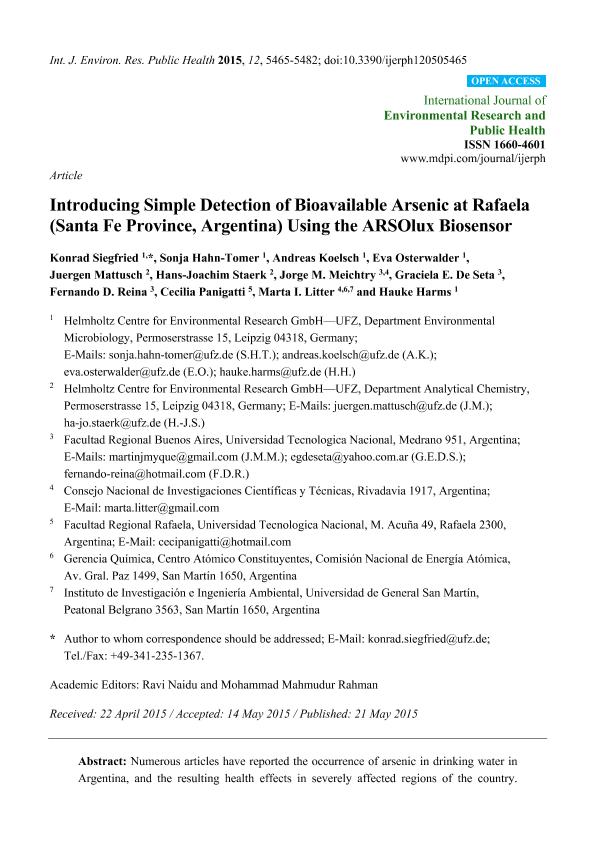
Numerous articles have reported the occurrence of arsenic in drinking water in Argentina, and the resulting health effects in severely affected regions of the country. Arsenic in drinking water in Argentina is largely naturally occurring due to elevated background content of the metalloid in volcanic sediments, although, in some regions, mining can contribute. While the origin of arsenic release has been discussed extensively, the problem of drinking water contamination has not yet been solved. One key step in progress towards mitigation of problems related with the consumption of As-containing water is the availability of simple detection tools. A chemical test kit and the ARSOlux biosensor were evaluated as simple analytical tools for field measurements of arsenic in the groundwater of Rafaela (Santa Fe, Argentina), and the results were compared with ICP-MS and HPLC-ICP-MS measurements. A survey of the groundwater chemistry was performed to evaluate possible interferences with the field tests. The results showed that the ARSOlux biosensor performed better than the chemical field test, that the predominant species of arsenic in the study area was arsenate and that arsenic concentration in the studied samples had a positive correlation with fluoride and vanadium, and a negative one with calcium and iron.
Palabras clave:
Argentina
,
Bioavailable Arsenic
,
Biosensor
,
Chaco Pampean Plain
,
Ground Water
Archivos asociados

Tamaño:
879.5Kb
Formato:
PDF
Licencia
 Excepto donde se diga explícitamente, este item se publica bajo la siguiente descripción:
Creative Commons Attribution 2.5 Unported (CC BY 2.5)
Excepto donde se diga explícitamente, este item se publica bajo la siguiente descripción:
Creative Commons Attribution 2.5 Unported (CC BY 2.5)
Identificadores
Colecciones
Articulos(SEDE CENTRAL)
Articulos de SEDE CENTRAL
Articulos de SEDE CENTRAL
Citación
Siegfried, Konrad; Hahn Tomer, Sonja; Koelsch, Andreas; Osterwalder, Eva; Mattusch, Juergen; et al.; Introducing simple detection of bioavailable arsenic at Rafaela (Santa Fe Province, Argentina) using the ARSOlux biosensor; Molecular Diversity Preservation International; International Journal of Environmental Research and Public Health; 12; 5; 5-2015; 5465-5482
Compartir


Altmétricas