Artículo
Surface modification of titanium by anodic oxidation in phosphoric acid at low potentials: Part 2. In vitro and in vivo study
Gomez Sanchez, Andrea Valeria ; Shreiner, W.; Ballarre, Josefina
; Cisilino, Adrian Pablo
; Duffo, Gustavo Sergio
; Cere, Silvia
; Shreiner, W.; Ballarre, Josefina
; Cisilino, Adrian Pablo
; Duffo, Gustavo Sergio
; Cere, Silvia
; Shreiner, W.; Ballarre, Josefina
; Cisilino, Adrian Pablo
; Duffo, Gustavo Sergio
; Cere, Silvia
Fecha de publicación:
12/05/2013
Editorial:
John Wiley & Sons Ltd
Revista:
Surface And Interface Analysis
ISSN:
0142-2421
Idioma:
Inglés
Tipo de recurso:
Artículo publicado
Clasificación temática:
Resumen
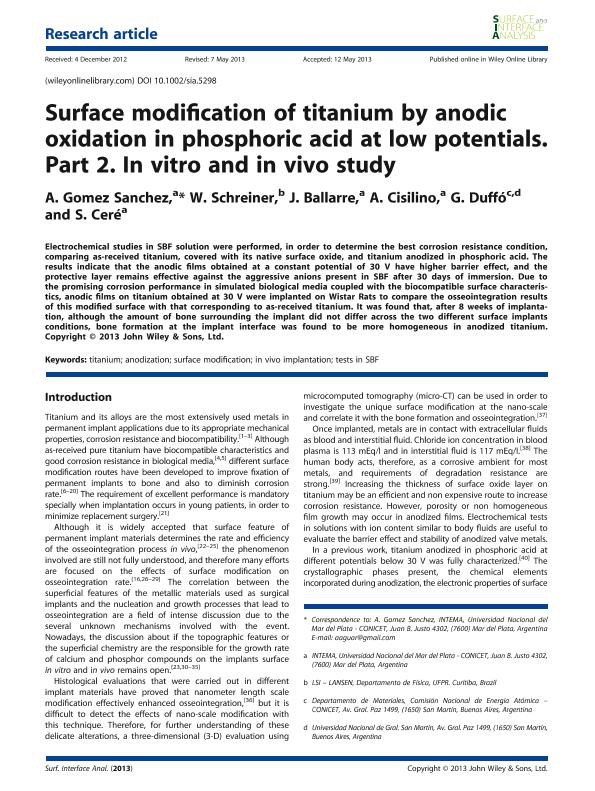
Electrochemical studies in SBF solution were performed, in order to determine the best corrosion resistance condition,comparing as-received titanium, covered with its native surface oxide, and titanium anodized in phosphoric acid. The results indicate that the anodic films obtained at a constant potential of 30 V have higher barrier effect, and the protective layer remains effective against the aggressive anions present in SBF after 30 days of immersion. Due to the promising corrosion performance in simulated biological media coupled with the biocompatible surface characteristics, anodic films on titanium obtained at 30 V were implanted on Wistar Rats to compare the osseointegration results of this modified surface with that corresponding to as-received titanium. It was found that, after 8 weeks of implantation, although the amount of bone surrounding the implant did not differ across the two different surface implants conditions, bone formation at the implant interface was found to be more homogeneous in anodized titanium.
Palabras clave:
Titanium
,
Anodization
,
Surface Modification
,
In Vivo Implantation
Archivos asociados

Tamaño:
967.5Kb
Formato:
PDF
Licencia
 Excepto donde se diga explícitamente, este item se publica bajo la siguiente descripción:
Creative Commons Attribution-NonCommercial-ShareAlike 2.5 Unported (CC BY-NC-SA 2.5)
Excepto donde se diga explícitamente, este item se publica bajo la siguiente descripción:
Creative Commons Attribution-NonCommercial-ShareAlike 2.5 Unported (CC BY-NC-SA 2.5)
Identificadores
Colecciones
Articulos(CCT - MAR DEL PLATA)
Articulos de CTRO.CIENTIFICO TECNOL.CONICET - MAR DEL PLATA
Articulos de CTRO.CIENTIFICO TECNOL.CONICET - MAR DEL PLATA
Articulos(INTEMA)
Articulos de INST.DE INV.EN CIENCIA Y TECNOL.MATERIALES (I)
Articulos de INST.DE INV.EN CIENCIA Y TECNOL.MATERIALES (I)
Articulos(SEDE CENTRAL)
Articulos de SEDE CENTRAL
Articulos de SEDE CENTRAL
Citación
Gomez Sanchez, Andrea Valeria; Shreiner, W.; Ballarre, Josefina; Cisilino, Adrian Pablo; Duffo, Gustavo Sergio; et al.; Surface modification of titanium by anodic oxidation in phosphoric acid at low potentials: Part 2. In vitro and in vivo study; John Wiley & Sons Ltd; Surface And Interface Analysis; 45; 9; 12-5-2013; 1395-1401
Compartir


Altmétricas