Artículo
Influence of the rearing system on yolk corticosterone concentration in captive Greater Rheas (Rhea americana)
Della Costa, Natalia Soledad ; Marin, Raul Hector
; Busso, Juan Manuel
; Hansen, Cristian; Navarro, Joaquin Luis
; Martella, Monica Beatriz
; Marin, Raul Hector
; Busso, Juan Manuel
; Hansen, Cristian; Navarro, Joaquin Luis
; Martella, Monica Beatriz
; Marin, Raul Hector
; Busso, Juan Manuel
; Hansen, Cristian; Navarro, Joaquin Luis
; Martella, Monica Beatriz
Fecha de publicación:
05/2016
Editorial:
Wiley-liss, Inc
Revista:
Zoo Biology
ISSN:
1098-2361
Idioma:
Inglés
Tipo de recurso:
Artículo publicado
Clasificación temática:
Resumen
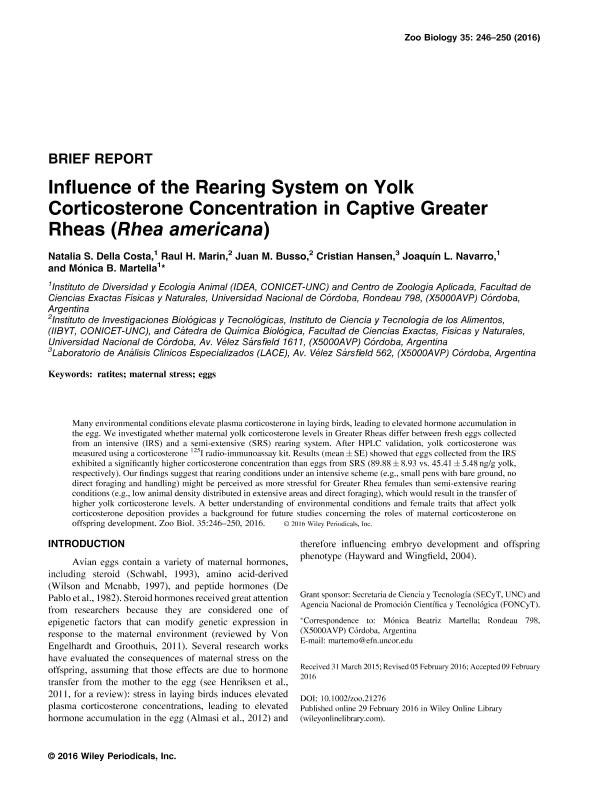
Many environmental conditions elevate plasma corticosterone in laying birds, leading to elevated hormone accumulation in the egg. We investigated whether maternal yolk corticosterone levels in Greater Rheas differ between fresh eggs collected from an intensive (IRS) and a semi-extensive (SRS) rearing system. After HPLC validation, yolk corticosterone was measured using a corticosterone (125) I radio-immunoassay kit. Results (mean ± SE) showed that eggs collected from the IRS exhibited a significantly higher corticosterone concentration than eggs from SRS (89.88 ± 8.93 vs. 45.41 ± 5.48 ng/g yolk, respectively). Our findings suggest that rearing conditions under an intensive scheme (e.g., small pens with bare ground, no direct foraging and handling) might be perceived as more stressful for Greater Rhea females than semi-extensive rearing conditions (e.g., low animal density distributed in extensive areas and direct foraging), which would result in the transfer of higher yolk corticosterone levels. A better understanding of environmental conditions and female traits that affect yolk corticosterone deposition provides a background for future studies concerning the roles of maternal corticosterone on offspring development.
Palabras clave:
Eggs
,
Maternal Stress
,
Ratites
Archivos asociados

Tamaño:
176.7Kb
Formato:
PDF
Licencia
 Excepto donde se diga explícitamente, este item se publica bajo la siguiente descripción:
Creative Commons Attribution-NonCommercial-ShareAlike 2.5 Unported (CC BY-NC-SA 2.5)
Excepto donde se diga explícitamente, este item se publica bajo la siguiente descripción:
Creative Commons Attribution-NonCommercial-ShareAlike 2.5 Unported (CC BY-NC-SA 2.5)
Identificadores
Colecciones
Articulos(IDEA)
Articulos de INSTITUTO DE DIVERSIDAD Y ECOLOGIA ANIMAL
Articulos de INSTITUTO DE DIVERSIDAD Y ECOLOGIA ANIMAL
Articulos(IIBYT)
Articulos de INSTITUTO DE INVESTIGACIONES BIOLOGICAS Y TECNOLOGICAS
Articulos de INSTITUTO DE INVESTIGACIONES BIOLOGICAS Y TECNOLOGICAS
Citación
Della Costa, Natalia Soledad; Marin, Raul Hector; Busso, Juan Manuel; Hansen, Cristian; Navarro, Joaquin Luis; et al.; Influence of the rearing system on yolk corticosterone concentration in captive Greater Rheas (Rhea americana); Wiley-liss, Inc; Zoo Biology; 35; 3; 5-2016; 246-250
Compartir


Altmétricas