Mostrar el registro sencillo del ítem
dc.contributor.author
de Ridder, Dirk
dc.contributor.author
Vanneste, Sven
dc.contributor.author
Weisz, Nathan
dc.contributor.author
Londero, Alain
dc.contributor.author
Schlee, Winnie
dc.contributor.author
Elgoyhen, Ana Belen
dc.contributor.author
Langguth, Berthold
dc.date.available
2016-02-01T20:36:08Z
dc.date.issued
2013-04-15
dc.identifier.citation
de Ridder, Dirk; Vanneste, Sven; Weisz, Nathan; Londero, Alain; Schlee, Winnie; et al.; An integrative model of auditory phantom perception: tinnitus as a unified percept of interacting separable subnetworks; Elsevier; Neuroscience and Biobehavioral Reviews; 44; 15-4-2013; 16-32
dc.identifier.issn
0149-7634
dc.identifier.uri
http://hdl.handle.net/11336/3952
dc.description.abstract
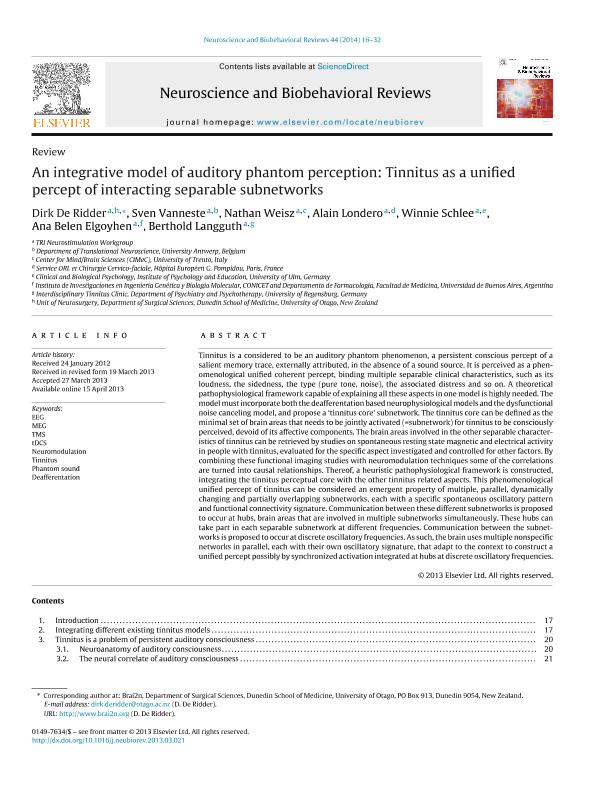
Tinnitus is a considered to be an auditory phantom phenomenon, a persistent conscious percept of a salient memory trace, externally attributed, in the absence of a sound source. It is perceived as a phenomenological unified coherent percept, binding multiple separable clinical characteristics, such as its loudness, the sidedness, the type (pure tone, noise), the associated distress and so on. A theoretical pathophysiological framework capable of explaining all these aspects in one model is highly needed. The model must incorporate both the deafferentation based neurophysiological models and the dysfunctional noise canceling model, and propose a ‘tinnitus core’ subnetwork. The tinnitus core can be defined as the minimal set of brain areas that needs to be jointly activated (=subnetwork) for tinnitus to be consciously perceived, devoid of its affective components. The brain areas involved in the other separable characteristics of tinnitus can be retrieved by studies on spontaneous resting state magnetic and electrical activity in people with tinnitus, evaluated for the specific aspect investigated and controlled for other factors. By combining these functional imaging studies with neuromodulation techniques some of the correlations are turned into causal relationships. Thereof, a heuristic pathophysiological framework is constructed, integrating the tinnitus perceptual core with the other tinnitus related aspects. This phenomenological unified percept of tinnitus can be considered an emergent property of multiple, parallel, dynamically changing and partially overlapping subnetworks, each with a specific spontaneous oscillatory pattern and functional connectivity signature. Communication between these different subnetworks is proposed to occur at hubs, brain areas that are involved in multiple subnetworks simultaneously. These hubs can take part in each separable subnetwork at different frequencies. Communication between the subnetworks is proposed to occur at discrete oscillatory frequencies. As such, the brain uses multiple nonspecific networks in parallel, each with their own oscillatory signature, that adapt to the context to construct a unified percept possibly by synchronized activation integrated at hubs at discrete oscillatory frequencies.
dc.format
application/pdf
dc.language.iso
eng
dc.publisher
Elsevier
dc.relation
Applied Neuroscience: Models, methods, theories, reviews. A Society of Applied Neuroscience (SAN) special issue
dc.rights
info:eu-repo/semantics/openAccess
dc.rights.uri
https://creativecommons.org/licenses/by-nc-nd/2.5/ar/
dc.subject
Tinnitus
dc.subject
Phantom Percept
dc.subject
Phantom Sound
dc.subject
Eeg
dc.subject
Meg
dc.subject
Tms
dc.subject
Neuromodulation
dc.subject
Deafferentation
dc.subject.classification
Neurología Clínica
dc.subject.classification
Medicina Clínica
dc.subject.classification
CIENCIAS MÉDICAS Y DE LA SALUD
dc.title
An integrative model of auditory phantom perception: tinnitus as a unified percept of interacting separable subnetworks
dc.type
info:eu-repo/semantics/article
dc.type
info:ar-repo/semantics/artículo
dc.type
info:eu-repo/semantics/publishedVersion
dc.date.updated
2016-03-30 10:35:44.97925-03
dc.journal.volume
44
dc.journal.pagination
16-32
dc.journal.pais
Países Bajos
dc.journal.ciudad
Amsterdam
dc.description.fil
Fil: de Ridder, Dirk. TRI Neurostimulation Workgroup; Alemania. University of Otago. Dunedin School of Medicine. Department of Surgical Sciences. Unit of Neurosurgery; Nueva Zelanda
dc.description.fil
Fil: Vanneste, Sven. TRI Neurostimulation Workgroup; Alemania. University Antwerp. Department of Translational Neuroscience; Bélgica
dc.description.fil
Fil: Weisz, Nathan. TRI Neurostimulation Workgroup; Alemania. Center for Mind/Brain Sciences; Italia
dc.description.fil
Fil: Londero, Alain. TRI Neurostimulation Workgroup; Alemania. Hôpital Européen G. Pompidou. Service ORL et Chirurgie Cervico-faciale; Francia
dc.description.fil
Fil: Schlee, Winnie. TRI Neurostimulation Workgroup; Alemania. University of Ulm. Institute of Psychology and Education. Clinical and Biological Psychology; Alemania
dc.description.fil
Fil: Elgoyhen, Ana Belen. Consejo Nacional de Investigaciones Científicas y Técnicas. Instituto de Investigaciones en Ingeniería Genética y Biología Molecular; Argentina. TRI Neurostimulation Workgroup; Alemania
dc.description.fil
Fil: Langguth, Berthold. TRI Neurostimulation Workgroup; Alemania. University of Regensburg. Department of Psychiatry and Psychotherapy. Interdisciplinary Tinnitus Clinic; Alemania
dc.journal.title
Neuroscience and Biobehavioral Reviews
dc.relation.alternativeid
info:eu-repo/semantics/altIdentifier/url/http://www.sciencedirect.com/science/article/pii/S014976341300081X
dc.relation.alternativeid
info:eu-repo/semantics/altIdentifier/doi/http://dx.doi.org/10.1016/j.neubiorev.2013.03.021
Archivos asociados

Tamaño:
1.667Mb
Formato:
PDF