Artículo
The genomic sequence of Exiguobacterium chiriqhucha str. N139 reveals a species that thrives in cold waters and extreme environmental conditions
Gutierrez, Ana; Vargas Chaves, Carlos; Reyes Prieto, Mariana; Ordoñez, Omar Federico ; Santos-García, Diego; Rosas-Pérez, Tania; Valdivia-Anistro, Jorge; Rebollar, Eria A.; Saralegui, Andrés; Moya, Andrés; Merino, Enrique; Farias, Maria Eugenia
; Latorre, Amparo; Souza, Valeria
; Santos-García, Diego; Rosas-Pérez, Tania; Valdivia-Anistro, Jorge; Rebollar, Eria A.; Saralegui, Andrés; Moya, Andrés; Merino, Enrique; Farias, Maria Eugenia
; Latorre, Amparo; Souza, Valeria
; Santos-García, Diego; Rosas-Pérez, Tania; Valdivia-Anistro, Jorge; Rebollar, Eria A.; Saralegui, Andrés; Moya, Andrés; Merino, Enrique; Farias, Maria Eugenia
; Latorre, Amparo; Souza, Valeria
Fecha de publicación:
04/2017
Editorial:
PeerJ Inc.
Revista:
PeerJ
ISSN:
2167-8359
Idioma:
Inglés
Tipo de recurso:
Artículo publicado
Clasificación temática:
Resumen
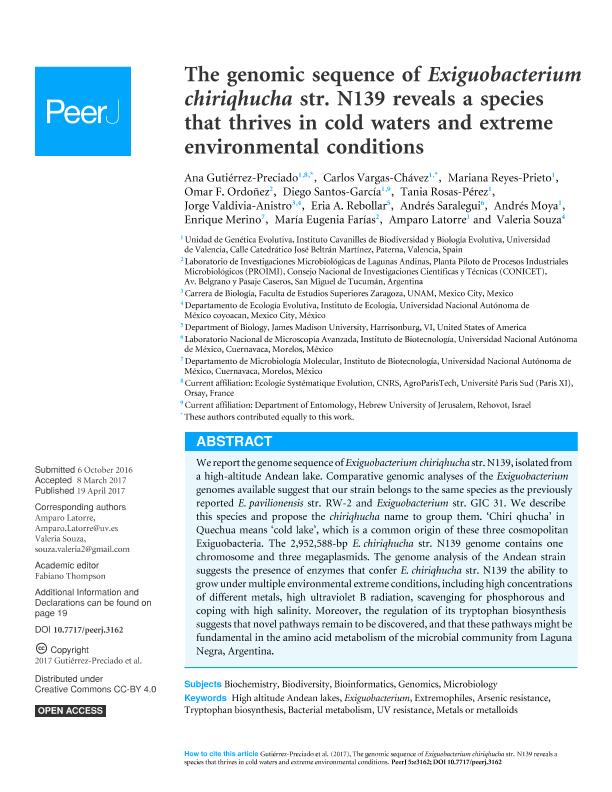
We report the genome sequence of Exiguobacterium chiriqhucha str. N139, isolated from a high-altitude Andean lake. Comparative genomic analyses of the Exiguobacterium genomes available suggest that our strain belongs to the same species as the previously reported E. pavilionensis str. RW-2 and Exiguobacterium
str. GIC 31. We describe this species and propose the chiriqhucha name to group them. ‘Chiri qhucha’ in Quechua means ‘cold lake’, which is a common origin of these three cosmopolitan Exiguobacteria. The 2,952,588-bp E. chiriqhucha
str. N139 genome contains one chromosome and three megaplasmids. The genome analysis of the Andean strain suggests the presence of enzymes that confer E. chiriqhucha str. N139 the ability to grow under multiple environmental extreme conditions, including high concentrations of different metals, high ultraviolet B radiation, scavenging for phosphorous and coping with high salinity. Moreover, the regulation of its tryptophan biosynthesis suggests that novel pathways remain to be discovered, and that these pathways might be fundamental in the amino acid metabolism of the microbial community from Laguna Negra, Argentina.
Palabras clave:
Exiguobacterium
,
Megaplasmid
,
Genome
Archivos asociados

Tamaño:
6.645Mb
Formato:
PDF
Licencia
 Excepto donde se diga explícitamente, este item se publica bajo la siguiente descripción:
Creative Commons Attribution 2.5 Unported (CC BY 2.5)
Excepto donde se diga explícitamente, este item se publica bajo la siguiente descripción:
Creative Commons Attribution 2.5 Unported (CC BY 2.5)
Identificadores
Colecciones
Articulos(PROIMI)
Articulos de PLANTA PILOTO DE PROC.IND.MICROBIOLOGICOS (I)
Articulos de PLANTA PILOTO DE PROC.IND.MICROBIOLOGICOS (I)
Citación
Gutierrez, Ana; Vargas Chaves, Carlos; Reyes Prieto, Mariana; Ordoñez, Omar Federico; Santos-García, Diego; et al.; The genomic sequence of Exiguobacterium chiriqhucha str. N139 reveals a species that thrives in cold waters and extreme environmental conditions; PeerJ Inc.; PeerJ; 5; 4-2017; 1-27
Compartir


Altmétricas