Artículo
Use of pure and mixed culture of diazinon-degrading Streptomyces to remove other organophosphorus pesticides
Briceño, G.; Schalchli, H.; Mutis, A.; Benimeli, Claudia Susana ; Palma, G.; Tortella, G. R.; Diez, M. C.
; Palma, G.; Tortella, G. R.; Diez, M. C.
Fecha de publicación:
10/2016
Editorial:
Elsevier
Revista:
International Biodeterioration and Biodegradation
ISSN:
0964-8305
Idioma:
Inglés
Tipo de recurso:
Artículo publicado
Clasificación temática:
Resumen
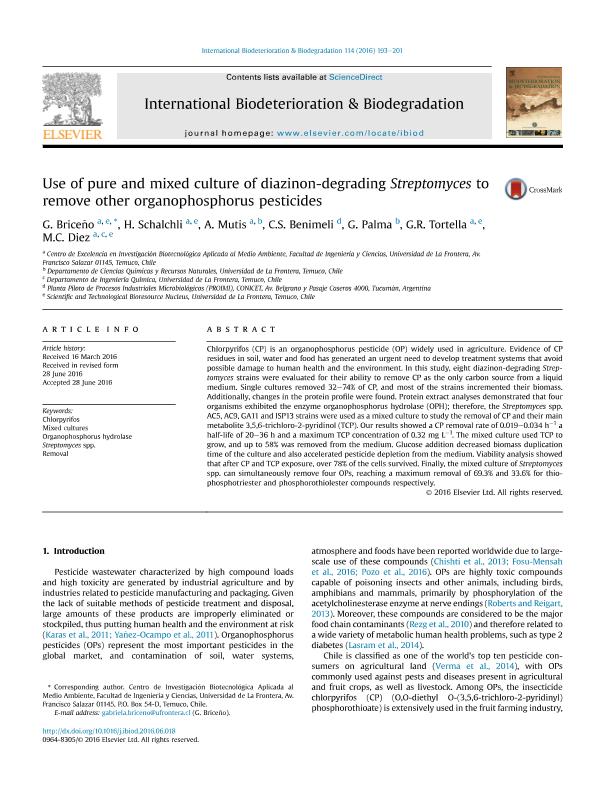
Chlorpyrifos (CP) is an organophosphorus pesticide (OP) widely used in agriculture. Evidence of CP residues in soil, water and food has generated an urgent need to develop treatment systems that avoid possible damage to human health and the environment. In this study, eight diazinon-degrading Streptomyces strains were evaluated for their ability to remove CP as the only carbon source from a liquid medium. Single cultures removed 32–74% of CP, and most of the strains incremented their biomass. Additionally, changes in the protein profile were found. Protein extract analyses demonstrated that four organisms exhibited the enzyme organophosphorus hydrolase (OPH); therefore, the Streptomyces spp. AC5, AC9, GA11 and ISP13 strains were used as a mixed culture to study the removal of CP and their main metabolite 3,5,6-trichloro-2-pyridinol (TCP). Our results showed a CP removal rate of 0.019–0.034 h−1 a half-life of 20–36 h and a maximum TCP concentration of 0.32 mg L−1. The mixed culture used TCP to grow, and up to 58% was removed from the medium. Glucose addition decreased biomass duplication time of the culture and also accelerated pesticide depletion from the medium. Viability analysis showed that after CP and TCP exposure, over 78% of the cells survived. Finally, the mixed culture of Streptomyces spp. can simultaneously remove four OPs, reaching a maximum removal of 69.3% and 33.6% for thiophosphotriester and phosphorothiolester compounds respectively.
Archivos asociados

Tamaño:
907.4Kb
Formato:
PDF
Licencia
 Excepto donde se diga explícitamente, este item se publica bajo la siguiente descripción:
Creative Commons Attribution-NonCommercial-ShareAlike 2.5 Unported (CC BY-NC-SA 2.5)
Excepto donde se diga explícitamente, este item se publica bajo la siguiente descripción:
Creative Commons Attribution-NonCommercial-ShareAlike 2.5 Unported (CC BY-NC-SA 2.5)
Identificadores
Colecciones
Articulos(PROIMI)
Articulos de PLANTA PILOTO DE PROC.IND.MICROBIOLOGICOS (I)
Articulos de PLANTA PILOTO DE PROC.IND.MICROBIOLOGICOS (I)
Citación
Briceño, G.; Schalchli, H.; Mutis, A.; Benimeli, Claudia Susana; Palma, G.; et al.; Use of pure and mixed culture of diazinon-degrading Streptomyces to remove other organophosphorus pesticides; Elsevier; International Biodeterioration and Biodegradation; 114; 10-2016; 193-201
Compartir


Altmétricas