Artículo
Linear viscoelasticity of blends of polybutadiene and highly hydrogenated polybutadiene

Fecha de publicación:
01/2000
Editorial:
Journal Rheology Amer Inst Physics
Revista:
Journal of Rheology
ISSN:
0148-6055
Idioma:
Inglés
Tipo de recurso:
Artículo publicado
Clasificación temática:
Resumen
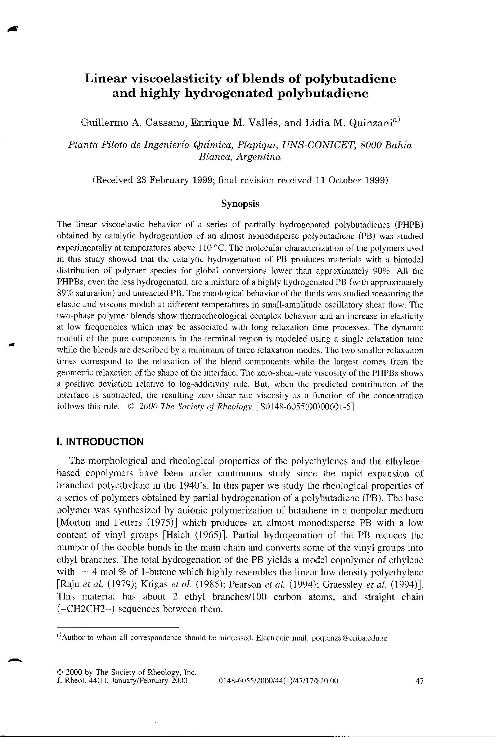
The linear viscoelastic behavior of a series of partially hydrogenated polybutadienes (PHPB) obtained by catalytic hydrogenation of an almost monodisperse polybutadiene (PB) was studied experimentally at temperatures above 110°C. The molecular characterization of the polymers used in this study showed that the catalytic hydrogenation of PB produces materials with a bimodal distribution of polymer species for global conversions lower than approximately 90%. All the PHPBs, even the less hydrogenated, are a mixture of a highly hydrogenated PB (with approximately 89% saturation) and unreacted PB. The rheological behavior of the fluids was studied measuring the elastic and viscous moduli at different temperatures in small-amplitude oscillatory shear flow. The two-phase polymer blends show thermorheological complex behavior and an increase in elasticity at low frequencies which may be associated with long relaxation time processes. The dynamic moduli of the pure components in the terminal region is modeled using a single relaxation time while the blends are described by a minimum of three relaxation modes. The two smaller relaxation times correspond to the relaxation of the blend components while the largest comes from the geometric relaxation of the shape of the interface. The zero-shear-rate viscosity of the PHPBs shows a positive deviation relative to log-additivity rule. But, when the predicted contribution of the interface is subtracted, the resulting zero-shear-rate viscosity as a function of the concentration follows this rule. © 2000 The Society of Rheology.
Palabras clave:
Polybutadiene
,
Hydrogenation
,
Linear Viscoelasticity
,
Blends
Archivos asociados

Tamaño:
7.463Mb
Formato:
PDF
Licencia
 Excepto donde se diga explícitamente, este item se publica bajo la siguiente descripción:
Creative Commons Attribution-NonCommercial-ShareAlike 2.5 Unported (CC BY-NC-SA 2.5)
Excepto donde se diga explícitamente, este item se publica bajo la siguiente descripción:
Creative Commons Attribution-NonCommercial-ShareAlike 2.5 Unported (CC BY-NC-SA 2.5)
Identificadores
Colecciones
Articulos(PLAPIQUI)
Articulos de PLANTA PILOTO DE INGENIERIA QUIMICA (I)
Articulos de PLANTA PILOTO DE INGENIERIA QUIMICA (I)
Citación
Cassano, Guillermo A.; Valles, Enrique Marcelo; Quinzani, Lidia Maria; Linear viscoelasticity of blends of polybutadiene and highly hydrogenated polybutadiene; Journal Rheology Amer Inst Physics; Journal of Rheology; 44; 1; 1-2000; 47-63
Compartir


Altmétricas