Artículo
Comparison of Frequency Bands Using Spectral Entropy for Epileptic Seizure Prediction

Fecha de publicación:
05/2013
Editorial:
Hindawi Publishing Corporation
Revista:
ISRN Neurology
ISSN:
2090-5505
Idioma:
Inglés
Tipo de recurso:
Artículo publicado
Clasificación temática:
Resumen
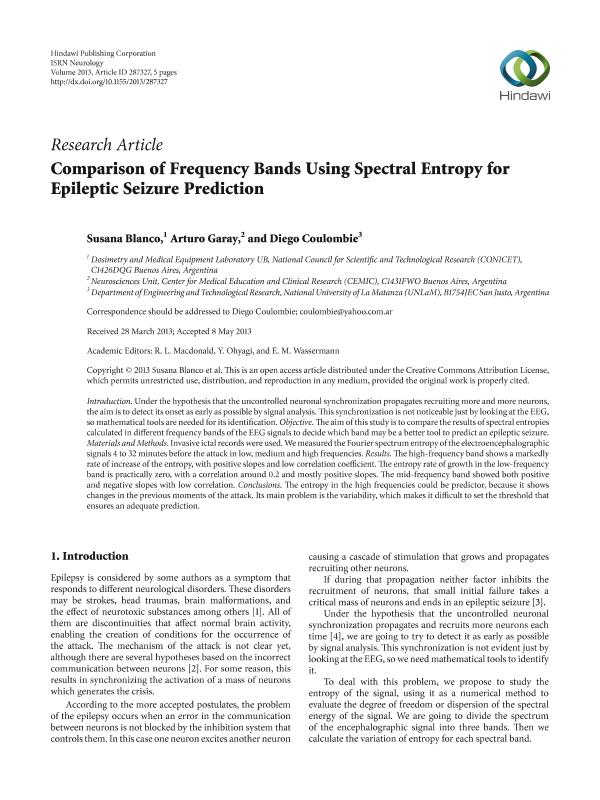
Under the hypothesis that the uncontrolled neuronal synchronization propagates recruiting more and more neurons, the aim is to detect its onset as early as possible by signal analysis. This synchronization is not noticeable just by looking at the EEG, so mathematical tools are needed for its identification. Objective. The aim of this study is to compare the results of spectral entropies calculated in different frequency bands of the EEG signals to decide which band may be a better tool to predict an epileptic seizure. Materials and Methods. Invasive ictal records were used. We measured the Fourier spectrum entropy of the electroencephalographic signals 4 to 32 minutes before the attack in low, medium and high frequencies. Results. The high-frequency band shows a markedly rate of increase of the entropy, with positive slopes and low correlation coefficient. The entropy rate of growth in the low-frequency band is practically zero, with a correlation around 0.2 and mostly positive slopes. The mid-frequency band showed both positive and negative slopes with low correlation. Conclusions. The entropy in the high frequencies could be predictor, because it shows changes in the previous moments of the attack. Its main problem is the variability, which makes it difficult to set the threshold that ensures an adequate prediction.
Palabras clave:
Epilepsy
,
Detaction
,
Signal Processing
Archivos asociados

Tamaño:
1.990Mb
Formato:
PDF
Licencia
 Excepto donde se diga explícitamente, este item se publica bajo la siguiente descripción:
Creative Commons Attribution 2.5 Unported (CC BY 2.5)
Excepto donde se diga explícitamente, este item se publica bajo la siguiente descripción:
Creative Commons Attribution 2.5 Unported (CC BY 2.5)
Identificadores
Colecciones
Articulos(SEDE CENTRAL)
Articulos de SEDE CENTRAL
Articulos de SEDE CENTRAL
Citación
Blanco, Susana Alicia Ana; Garay, Arturo; Coulombie, Diego; Comparison of Frequency Bands Using Spectral Entropy for Epileptic Seizure Prediction; Hindawi Publishing Corporation; ISRN Neurology; 2013; 5-2013; 287327-287327
Compartir


Altmétricas