Mostrar el registro sencillo del ítem
dc.contributor.author
Althaus, Leandro Gabriel
dc.contributor.author
Serenelli, A. M.
dc.contributor.author
Corsico, Alejandro Hugo
dc.contributor.author
Montgomery, M. H.
dc.date.available
2018-02-26T16:47:58Z
dc.date.issued
2003-06
dc.identifier.citation
Althaus, Leandro Gabriel; Serenelli, A. M.; Corsico, Alejandro Hugo; Montgomery, M. H.; New evolutionary models for massive ZZ Ceti stars, I : first results for their pulsational properties; EDP Sciences; Astronomy and Astrophysics; 404; 6-2003; 593-609
dc.identifier.issn
0004-6361
dc.identifier.uri
http://hdl.handle.net/11336/37095
dc.description.abstract
Chaotic orbits suffer significant changes as a result of small perturbations. One can thus wonder whether the dynamical friction suffered by a satellite on a regular orbit, and interacting with the stars of a galaxy, will be different if the bulk of the stars of the galaxy are in regular or chaotic orbits. In order to check that idea, we investigated the orbital decay (caused by dynamical friction) of a rigid satellite moving within a larger stellar system (a galaxy) whose potential is nonintegrable. We performed numerical experiments using two kinds of triaxial galaxy models: (1) the triaxial generalization of Dehnen's spherical mass model (Dehnen; Merritt & Fridman); (2) a modified Satoh model (Satoh; Carpintero, Muzzio, & Wachlin). The percentages of chaotic orbits present in these models were increased by perturbing them. In the first case, a central compact object (black hole) was introduced; in the second case, the perturbation was produced by allowing the galaxy to move on a circular orbit in a logarithmic potential. The equations of motion were integrated with a non-self-consistent code. Our results show that the presence of chaotic orbits does not affect significantly the orbital decay of the satellite.
dc.format
application/pdf
dc.language.iso
eng
dc.publisher
EDP Sciences
dc.rights
info:eu-repo/semantics/openAccess
dc.rights.uri
https://creativecommons.org/licenses/by-nc-sa/2.5/ar/
dc.subject
Evolution of Stars
dc.subject
Abundances
dc.subject
Interior Stars
dc.subject
White Dwarfs
dc.subject
Oscillations of Stars
dc.subject.classification
Astronomía
dc.subject.classification
Ciencias Físicas
dc.subject.classification
CIENCIAS NATURALES Y EXACTAS
dc.title
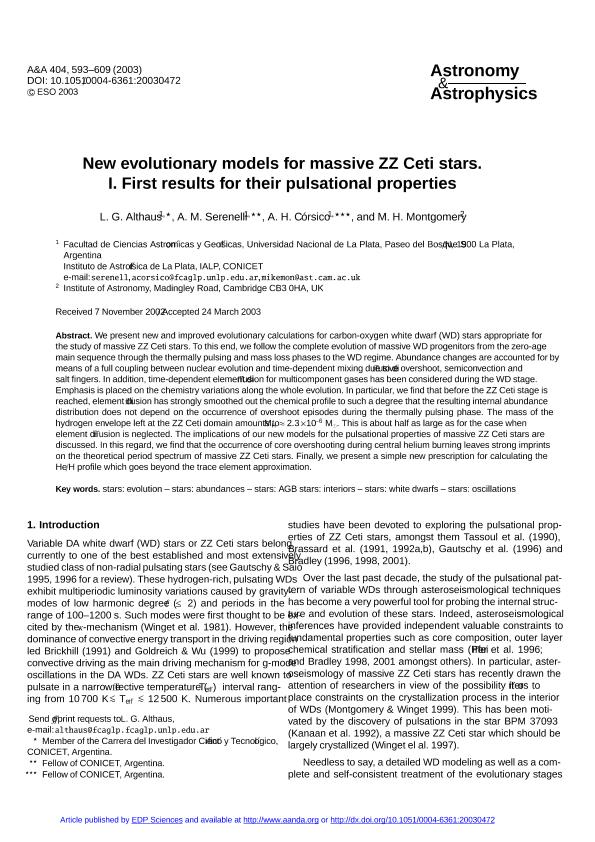
New evolutionary models for massive ZZ Ceti stars, I : first results for their pulsational properties
dc.type
info:eu-repo/semantics/article
dc.type
info:ar-repo/semantics/artículo
dc.type
info:eu-repo/semantics/publishedVersion
dc.date.updated
2018-02-19T16:57:03Z
dc.journal.volume
404
dc.journal.pagination
593-609
dc.journal.pais
Francia
dc.journal.ciudad
Les Ulis, France
dc.description.fil
Fil: Althaus, Leandro Gabriel. Universidad Nacional de la Plata. Facultad de Ciencias Astronómicas y Geofísicas; Argentina
dc.description.fil
Fil: Serenelli, A. M.. Universidad Nacional de la Plata. Facultad de Ciencias Astronómicas y Geofísicas; Argentina
dc.description.fil
Fil: Corsico, Alejandro Hugo. Universidad Nacional de la Plata. Facultad de Ciencias Astronómicas y Geofísicas; Argentina
dc.description.fil
Fil: Montgomery, M. H.. Institute of Astronomy; Reino Unido
dc.journal.title
Astronomy and Astrophysics
dc.relation.alternativeid
info:eu-repo/semantics/altIdentifier/doi/http://dx.doi.org/10.1051/0004-6361:20030472
dc.relation.alternativeid
info:eu-repo/semantics/altIdentifier/url/https://www.aanda.org/articles/aa/abs/2003/23/aah4325/aah4325.html
Archivos asociados

Tamaño:
1.003Mb
Formato:
PDF