Artículo
The scattered disk population as a source of Oort cloud comets: evaluation of its current and past role in populating the Oort cloud

Fecha de publicación:
12/2004
Editorial:
Academic Press Inc Elsevier Science
Revista:
Icarus
ISSN:
0019-1035
Idioma:
Inglés
Tipo de recurso:
Artículo publicado
Clasificación temática:
Resumen
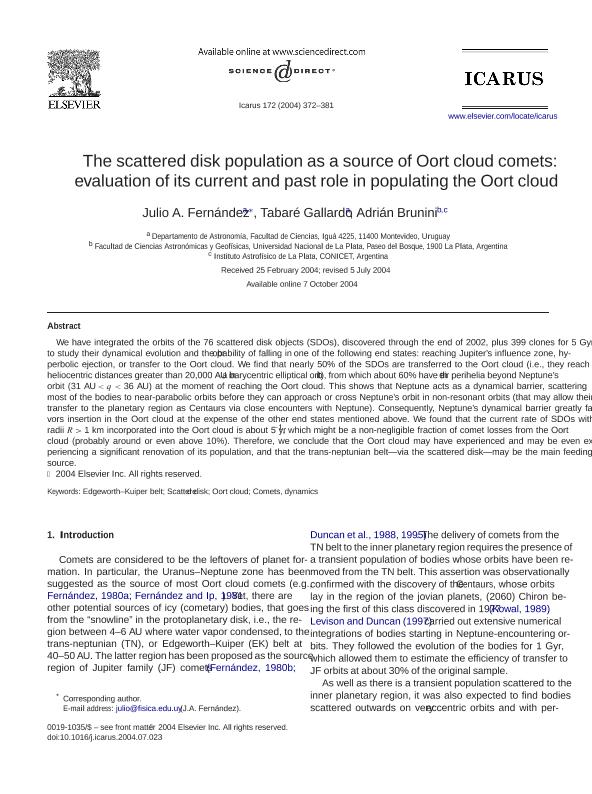
We have integrated the orbits of the 76 scattered disk objects (SDOs), discovered through the end of 2002, plus 399 clones for 5 Gyr to study their dynamical evolution and the probability of falling in one of the following end states: reaching Jupiter's influence zone, hyperbolic ejection, or transfer to the Oort cloud. We find that nearly 50% of the SDOs are transferred to the Oort cloud (i.e., they reach heliocentric distances greater than 20,000 AU in a barycentric elliptical orbit), from which about 60% have their perihelia beyond Neptune's orbit (31 AU<q<36 AU) at the moment of reaching the Oort cloud. This shows that Neptune acts as a dynamical barrier, scattering most of the bodies to near-parabolic orbits before they can approach or cross Neptune's orbit in non-resonant orbits (that may allow their transfer to the planetary region as Centaurs via close encounters with Neptune). Consequently, Neptune's dynamical barrier greatly favors insertion in the Oort cloud at the expense of the other end states mentioned above. We found that the current rate of SDOs with radii R>1 km incorporated into the Oort cloud is about 5 yr−1, which might be a non-negligible fraction of comet losses from the Oort cloud (probably around or even above 10%). Therefore, we conclude that the Oort cloud may have experienced and may be even experiencing a significant renovation of its population, and that the trans-neptunian belt—via the scattered disk—may be the main feeding source.
Palabras clave:
Edgeworth–Kuiper Belt
,
Scattered Disks
,
Oort Cloud
,
Comets
,
Dynamics
Archivos asociados

Tamaño:
295.5Kb
Formato:
PDF
Licencia
 Excepto donde se diga explícitamente, este item se publica bajo la siguiente descripción:
Creative Commons Attribution-NonCommercial-ShareAlike 2.5 Unported (CC BY-NC-SA 2.5)
Excepto donde se diga explícitamente, este item se publica bajo la siguiente descripción:
Creative Commons Attribution-NonCommercial-ShareAlike 2.5 Unported (CC BY-NC-SA 2.5)
Identificadores
Colecciones
Articulos(IALP)
Articulos de INST.DE ASTROFISICA LA PLATA
Articulos de INST.DE ASTROFISICA LA PLATA
Citación
Fernández, Julio A.; Gallardo, Tabaré; Brunini, Adrian; The scattered disk population as a source of Oort cloud comets: evaluation of its current and past role in populating the Oort cloud; Academic Press Inc Elsevier Science; Icarus; 172; 2; 12-2004; 372-381
Compartir


Altmétricas