Artículo
Immune complexes in chronic Chagas disease patients are formed by exovesicles from Trypanosoma cruzi carrying the conserved MASP N-terminal region
Díaz Lozano, Isabel María; De Pablos, Luis Miguel; Longhi, Silvia Andrea ; Zago, María Paola
; Schijman, Alejandro Gabriel
; Osuna, Antonio
; Zago, María Paola
; Schijman, Alejandro Gabriel
; Osuna, Antonio
; Zago, María Paola
; Schijman, Alejandro Gabriel
; Osuna, Antonio
Fecha de publicación:
03/2017
Editorial:
Nature Publishing Group
Revista:
Scientific Reports
ISSN:
2045-2322
Idioma:
Inglés
Tipo de recurso:
Artículo publicado
Clasificación temática:
Resumen
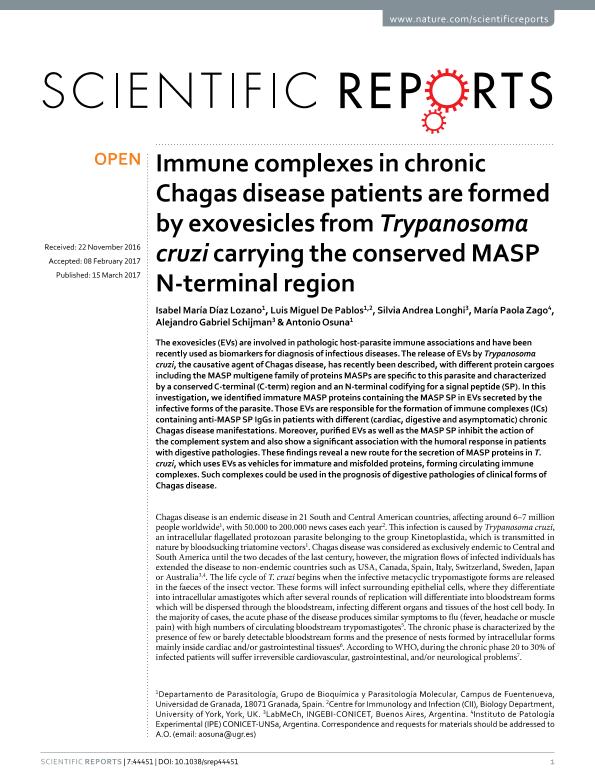
The exovesicles (EVs) are involved in pathologic host-parasite immune associations and have been recently used as biomarkers for diagnosis of infectious diseases. The release of EVs by Trypanosoma cruzi, the causative agent of Chagas disease, has recently been described, with different protein cargoes including the MASP multigene family of proteins MASPs are specific to this parasite and characterized by a conserved C-terminal (C-term) region and an N-terminal codifying for a signal peptide (SP). In this investigation, we identified immature MASP proteins containing the MASP SP in EVs secreted by the infective forms of the parasite. Those EVs are responsible for the formation of immune complexes (ICs) containing anti-MASP SP IgGs in patients with different (cardiac, digestive and asymptomatic) chronic Chagas disease manifestations. Moreover, purified EVs as well as the MASP SP inhibit the action of the complement system and also show a significant association with the humoral response in patients with digestive pathologies. These findings reveal a new route for the secretion of MASP proteins in T. cruzi, which uses EVs as vehicles for immature and misfolded proteins, forming circulating immune complexes. Such complexes could be used in the prognosis of digestive pathologies of clinical forms of Chagas disease.
Palabras clave:
Trypanosoma Cruzi
,
Exovesicles
,
Masp
Archivos asociados

Tamaño:
2.188Mb
Formato:
PDF
Licencia
 Excepto donde se diga explícitamente, este item se publica bajo la siguiente descripción:
Creative Commons Attribution-NonCommercial-ShareAlike 2.5 Unported (CC BY-NC-SA 2.5)
Excepto donde se diga explícitamente, este item se publica bajo la siguiente descripción:
Creative Commons Attribution-NonCommercial-ShareAlike 2.5 Unported (CC BY-NC-SA 2.5)
Identificadores
Colecciones
Articulos(IPE)
Articulos de INST.DE PATOLOGIA EXPERIMENTAL
Articulos de INST.DE PATOLOGIA EXPERIMENTAL
Citación
Díaz Lozano, Isabel María; De Pablos, Luis Miguel; Longhi, Silvia Andrea; Zago, María Paola; Schijman, Alejandro Gabriel; et al.; Immune complexes in chronic Chagas disease patients are formed by exovesicles from Trypanosoma cruzi carrying the conserved MASP N-terminal region; Nature Publishing Group; Scientific Reports; 7; 3-2017
Compartir


Altmétricas