Artículo
Lateralization of brain activity during motor planning of proximal and distal gestures

Fecha de publicación:
10/2014
Editorial:
Elsevier Science
Revista:
Behavioural Brain Research
ISSN:
0166-4328
Idioma:
Inglés
Tipo de recurso:
Artículo publicado
Clasificación temática:
Resumen
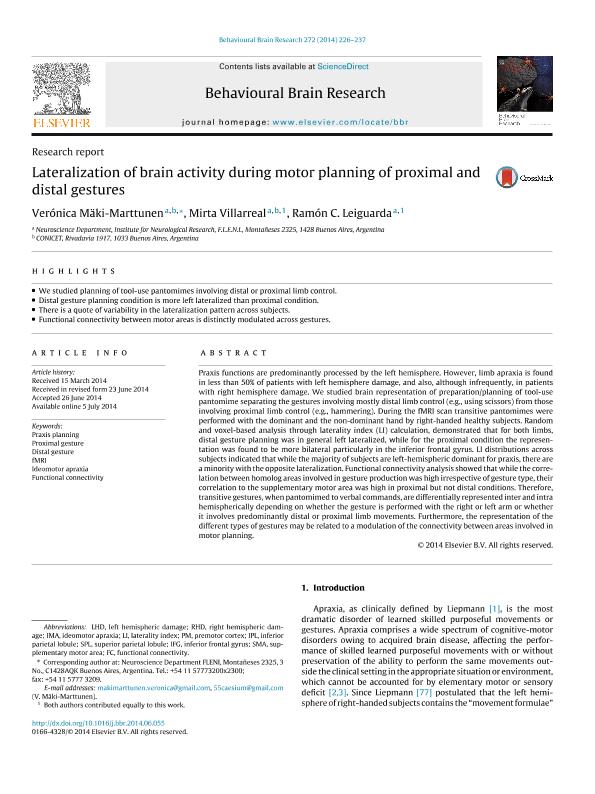
Praxis functions are predominantly processed by the left hemisphere. However, limb apraxia is found in less than 50% of patients with left hemisphere damage, and also, although infrequently, in patients with right hemisphere damage. We studied brain representation of preparation/planning of tool-use pantomime separating the gestures involving mostly distal limb control (e.g., using scissors) from those involving proximal limb control (e.g., hammering). During the fMRI scan transitive pantomimes were performed with the dominant and the non-dominant hand by right-handed healthy subjects. Random and voxel-based analysis through laterality index (LI) calculation, demonstrated that for both limbs, distal gesture planning was in general left lateralized, while for the proximal condition the representation was found to be more bilateral particularly in the inferior frontal gyrus. LI distributions across subjects indicated that while the majority of subjects are left-hemispheric dominant for praxis, there are a minority with the opposite lateralization. Functional connectivity analysis showed that while the correlation between homolog areas involved in gesture production was high irrespective of gesture type, their correlation to the supplementary motor area was high in proximal but not distal conditions. Therefore, transitive gestures, when pantomimed to verbal commands, are differentially represented inter and intra hemispherically depending on whether the gesture is performed with the right or left arm or whether it involves predominantly distal or proximal limb movements. Furthermore, the representation of the different types of gestures may be related to a modulation of the connectivity between areas involved in motor planning.
Archivos asociados

Tamaño:
2.298Mb
Formato:
PDF
Licencia
 Excepto donde se diga explícitamente, este item se publica bajo la siguiente descripción:
Creative Commons Attribution-NonCommercial-ShareAlike 2.5 Unported (CC BY-NC-SA 2.5)
Excepto donde se diga explícitamente, este item se publica bajo la siguiente descripción:
Creative Commons Attribution-NonCommercial-ShareAlike 2.5 Unported (CC BY-NC-SA 2.5)
Identificadores
Colecciones
Articulos(SEDE CENTRAL)
Articulos de SEDE CENTRAL
Articulos de SEDE CENTRAL
Citación
Mäki Marttunen, Verónica; Villarreal, Mirta Fabiana; Leiguarda, Ramón Carlos; Lateralization of brain activity during motor planning of proximal and distal gestures; Elsevier Science; Behavioural Brain Research; 272; 10-2014; 226-237
Compartir


Altmétricas