Mostrar el registro sencillo del ítem
dc.contributor.author
Noce, Esteban Leopoldo
dc.date.available
2018-02-01T19:59:41Z
dc.date.issued
2014-04
dc.identifier.citation
Noce, Esteban Leopoldo; Paganismo e identidad cristiana en el corpus de Cromacio de Aquileya; École Française de Rome; Mélanges de l'École Française de Rome pour le Moyen Âge; 126; 1; 4-2014; 345-390
dc.identifier.issn
0223-5102
dc.identifier.uri
http://hdl.handle.net/11336/35421
dc.description.abstract
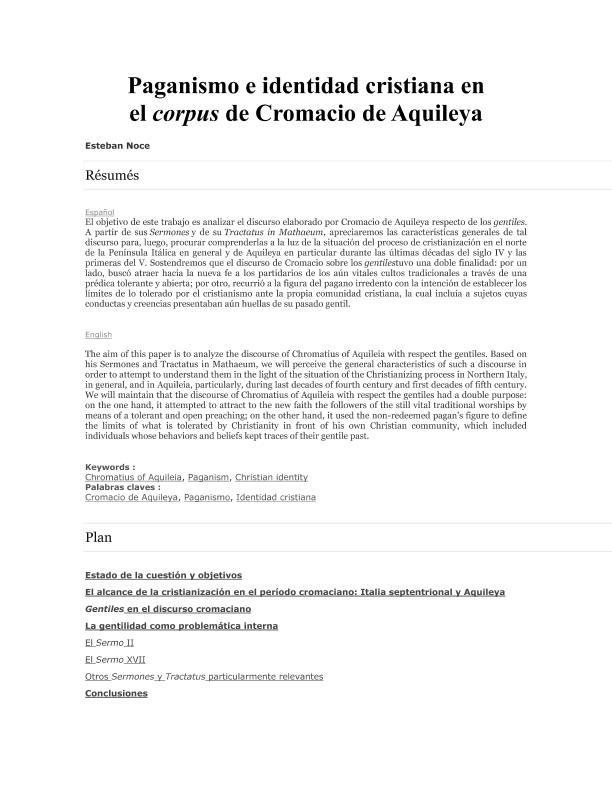
El objetivo de este trabajo es analizar el discurso elaborado por Cromacio de Aquileya respecto de los gentiles. A partir de sus Sermones y de su Tractatus in Mathaeum, apreciaremos las características generales de tal discurso para, luego, procurar comprenderlas a la luz de la situación del proceso de cristianización en el norte de la Península Itálica en general y de Aquileya en particular durante las últimas décadas del siglo IV y las primeras del V. Sostendremos que el discurso de Cromacio sobre los gentiles tuvo una doble finalidad: por un lado, buscó atraer hacia la nueva fe a los partidarios de los aún vitales cultos tradicionales a través de una prédica tolerante y abierta; por otro, recurrió a la figura del pagano irredento con la intención de establecer los límites de lo tolerado por el cristianismo ante la propia comunidad cristiana, la cual incluía a sujetos cuyas conductas y creencias presentaban aún huellas de su pasado gentil.
dc.description.abstract
The aim of this paper is to analyze the discourse of Chromatius of Aquileia with respect the gentiles. Based on his Sermones and Tractatus in Mathaeum, we will perceive the general characteristics of such a discourse in order to attempt to understand them in the light of the situation of the Christianizing process in Northern Italy, in general, and in Aquileia, particularly, during last decades of fourth century and first decades of fifth century. We will maintain that the discourse of Chromatius of Aquileia with respect the gentiles had a double purpose: on the one hand, it attempted to attract to the new faith the followers of the still vital traditional worships by means of a tolerant and open preaching; on the other hand, it used the non-redeemed pagan’s figure to define the limits of what is tolerated by Christianity in front of his own Christian community, which included individuals whose behaviors and beliefs kept traces of their gentile past.
dc.format
application/pdf
dc.language.iso
spa
dc.publisher
École Française de Rome
dc.rights
info:eu-repo/semantics/openAccess
dc.rights.uri
https://creativecommons.org/licenses/by-nc-sa/2.5/ar/
dc.subject
Cromacio de Aquileya
dc.subject
Paganismo
dc.subject
Identidad Cristiana
dc.subject.classification
Historia
dc.subject.classification
Historia y Arqueología
dc.subject.classification
HUMANIDADES
dc.title
Paganismo e identidad cristiana en el corpus de Cromacio de Aquileya
dc.type
info:eu-repo/semantics/article
dc.type
info:ar-repo/semantics/artículo
dc.type
info:eu-repo/semantics/publishedVersion
dc.date.updated
2018-01-30T20:32:35Z
dc.journal.volume
126
dc.journal.number
1
dc.journal.pagination
345-390
dc.journal.pais
Italia
dc.journal.ciudad
Roma
dc.description.fil
Fil: Noce, Esteban Leopoldo. Consejo Nacional de Investigaciones Científicas y Técnicas; Argentina. Universidad de Buenos Aires. Facultad de Filosofía y Letras; Argentina
dc.journal.title
Mélanges de l'École Française de Rome pour le Moyen Âge
dc.relation.alternativeid
info:eu-repo/semantics/altIdentifier/url/http://journals.openedition.org/mefrm/1900
Archivos asociados

Tamaño:
685.2Kb
Formato:
PDF