Artículo
Toxic Effects of Antiparasitic Pesticides Used by the Salmon Industry in the Marine Amphipod Monocorophium insidiosum
Tucca, Felipe; Diaz Jaramillo, Mauricio Javier ; Cruz, Gabriel; Silva, Jeannette; Bay Schmith, Enrique; Chiang, Gustavo; Barra, Ricardo
; Cruz, Gabriel; Silva, Jeannette; Bay Schmith, Enrique; Chiang, Gustavo; Barra, Ricardo
Fecha de publicación:
08/2014
Editorial:
Springer
Revista:
Archives of Environmental Contamination and Toxicology
ISSN:
0090-4341
Idioma:
Inglés
Tipo de recurso:
Artículo publicado
Clasificación temática:
Resumen
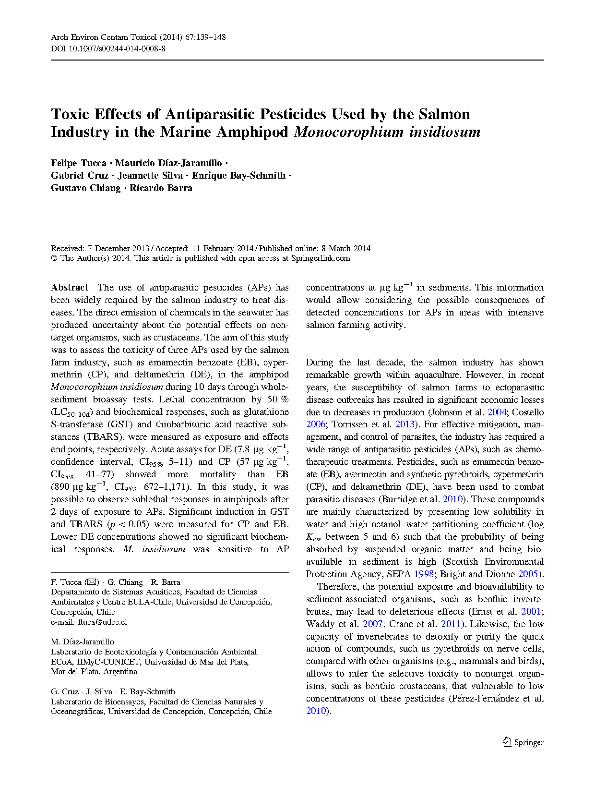
The use of antiparasitic pesticides (APs) has been widely required by the salmon industry to treat diseases. The direct emission of chemicals in the seawater has produced uncertainty about the potential effects on nontarget organisms, such as crustaceans. The aim of this study was to assess the toxicity of three APs used by the salmon farm industry, such as emamectin benzoate (EB), cypermethrin (CP), and deltamethrin (DE), in the amphipod Monocorophium insidiosum during 10 days through whole-sediment bioassay tests. Lethal concentration by 50 % (LC50–10d) and biochemical responses, such as glutathione S-transferase (GST) and thiobarbituric acid reactive substances (TBARS), were measured as exposure and effects end points, respectively. Acute assays for DE (7.8 μg kg−1, confidence interval, CI95% 5–11) and CP (57 μg kg−1, CI95% 41–77) showed more mortality than EB (890 μg kg−1, CI95% 672–1,171). In this study, it was possible to observe sublethal responses in amphipods after 2 days of exposure to APs. Significant induction in GST and TBARS (p < 0.05) were measured for CP and EB. Lower DE concentrations showed no significant biochemical responses. M. insidiosum was sensitive to AP concentrations at μg kg−1 in sediments. This information would allow considering the possible consequences of detected concentrations for APs in areas with intensive salmon farming activity.
Palabras clave:
Antiparasitic Pesticides
,
Cypermethrin
,
Deltamethrin
,
Amphipod
Archivos asociados

Tamaño:
1.080Mb
Formato:
PDF
Licencia
 Excepto donde se diga explícitamente, este item se publica bajo la siguiente descripción:
Creative Commons Attribution-NonCommercial-ShareAlike 2.5 Unported (CC BY-NC-SA 2.5)
Excepto donde se diga explícitamente, este item se publica bajo la siguiente descripción:
Creative Commons Attribution-NonCommercial-ShareAlike 2.5 Unported (CC BY-NC-SA 2.5)
Identificadores
Colecciones
Articulos(IIMYC)
Articulos de INSTITUTO DE INVESTIGACIONES MARINAS Y COSTERAS
Articulos de INSTITUTO DE INVESTIGACIONES MARINAS Y COSTERAS
Citación
Tucca, Felipe; Diaz Jaramillo, Mauricio Javier; Cruz, Gabriel; Silva, Jeannette; Bay Schmith, Enrique; et al.; Toxic Effects of Antiparasitic Pesticides Used by the Salmon Industry in the Marine Amphipod Monocorophium insidiosum; Springer; Archives of Environmental Contamination and Toxicology; 67; 2; 8-2014; 139-148
Compartir


Altmétricas