Artículo
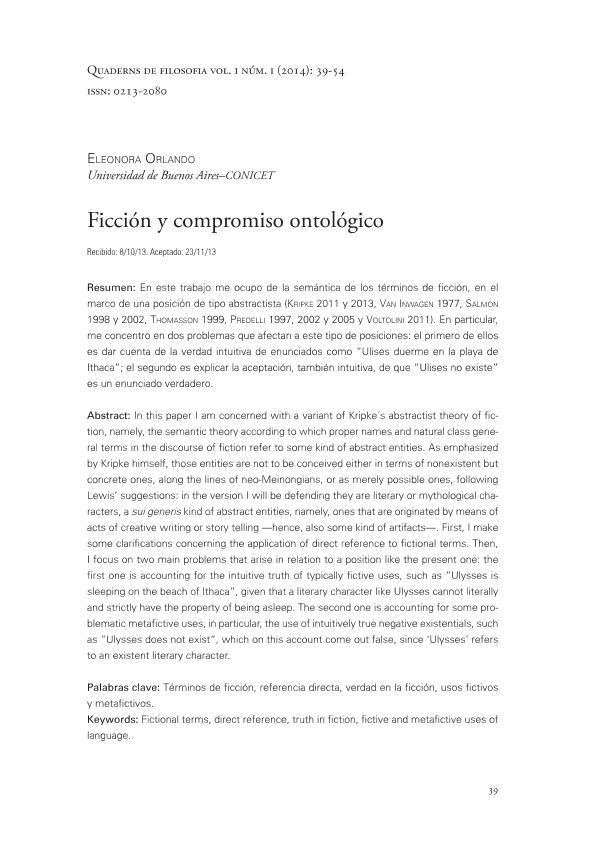
En este trabajo me ocupo de la semántica de los términos de ficción, en el marco de una posición de tipo abstractista (KRIPKE 2011 y 2013, VAN INWAGEN 1977, SALMON 1998 y 2002, THOMASSON 1999, PREDELLI 1997, 2002 y 2005 y VOLTOLINI 2011). En particular, me concentro en dos problemas que afectan a este tipo de posiciones: el primero de ellos es dar cuenta de la verdad intuitiva de enunciados como "Ulises duerme en la playa de Ithaca"; el segundo es explicar la aceptación, también intuitiva, de que "Ulises no existe" es un enunciado verdadero. In this paper I am concerned with a variant of Kripke´s abstractist theory of fiction, namely, the semantic theory according to which proper names and natural class general terms in the discourse of fiction refer to some kind of abstract entities. As emphasized by Kripke himself, those entities are not to be conceived either in terms of nonexistent but concrete ones, along the lines of neo-Meinongians, or as merely possible ones, following Lewis’ suggestions: in the version I will be defending they are literary or mythological characters, a sui generis kind of abstract entities, namely, ones that are originated by means of acts of creative writing or story telling —hence, also some kind of artifacts—. First, I make some clarifications concerning the application of direct reference to fictional terms. Then, I focus on two main problems that arise in relation to a position like the present one: the first one is accounting for the intuitive truth of typically fictive uses, such as “Ulysses is sleeping on the beach of Ithaca”, given that a literary character like Ulysses cannot literally and strictly have the property of being asleep. The second one is accounting for some problematic metafictive uses, in particular, the use of intuitively true negative existentials, such as “Ulysses does not exist”, which on this account come out false, since ‘Ulysses’ refers to an existent literary character.
Ficción y compromiso ontológico

Fecha de publicación:
02/2014
Editorial:
Universitat de València. Facultat de Filosofia i Ciències de l'Educació. Departament de Filosofia
Revista:
Quaderns de Filosofia
ISSN:
2341-1414
Idioma:
Español
Tipo de recurso:
Artículo publicado
Clasificación temática:
Resumen
Archivos asociados

Tamaño:
125.3Kb
Formato:
PDF
Licencia
 Excepto donde se diga explícitamente, este item se publica bajo la siguiente descripción:
Atribución-NoComercial-SinDerivadas 2.5 Argentina (CC BY-NC-ND 2.5 AR)
Excepto donde se diga explícitamente, este item se publica bajo la siguiente descripción:
Atribución-NoComercial-SinDerivadas 2.5 Argentina (CC BY-NC-ND 2.5 AR)
Identificadores
Colecciones
Articulos(SEDE CENTRAL)
Articulos de SEDE CENTRAL
Articulos de SEDE CENTRAL
Citación
Orlando, Eleonora Eva; Ficción y compromiso ontológico; Universitat de València. Facultat de Filosofia i Ciències de l'Educació. Departament de Filosofia; Quaderns de Filosofia; 1; 1; 2-2014; 39-54
Compartir


Altmétricas