Artículo
Thermal and geodynamic contributions to the elevation of the Altiplano-Puna plateau

Fecha de publicación:
10/2014
Editorial:
Elsevier Science
Revista:
Physics of the Earth and Planetary Interiors
ISSN:
0031-9201
Idioma:
Inglés
Tipo de recurso:
Artículo publicado
Clasificación temática:
Resumen
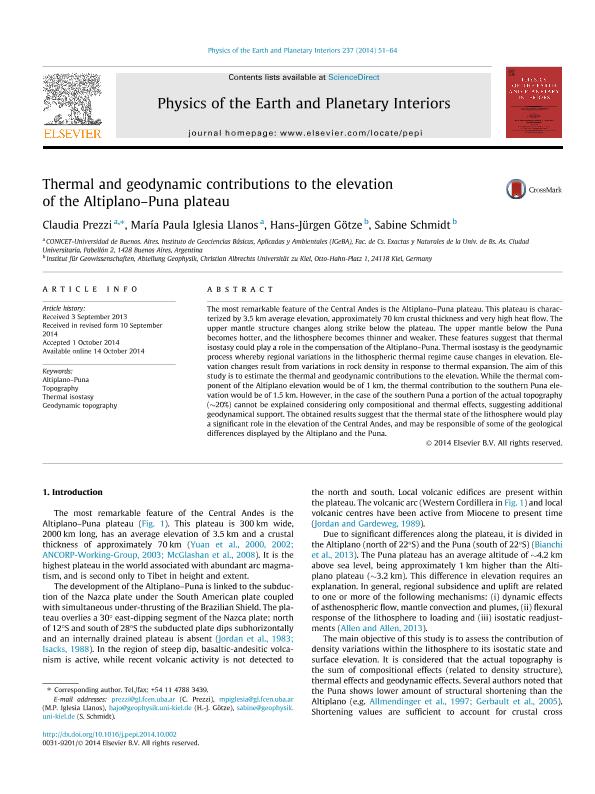
The most remarkable feature of the Central Andes is the Altiplano–Puna plateau. This plateau is characterized by 3.5 km average elevation, approximately 70 km crustal thickness and very high heat flow. The upper mantle structure changes along strike below the plateau. The upper mantle below the Puna becomes hotter, and the lithosphere becomes thinner and weaker. These features suggest that thermal isostasy could play a role in the compensation of the Altiplano–Puna. Thermal isostasy is the geodynamic process whereby regional variations in the lithospheric thermal regime cause changes in elevation. Elevation changes result from variations in rock density in response to thermal expansion. The aim of this study is to estimate the thermal and geodynamic contributions to the elevation. While the thermal component of the Altiplano elevation would be of 1 km, the thermal contribution to the southern Puna elevation would be of 1.5 km. However, in the case of the southern Puna a portion of the actual topography (∼20%) cannot be explained considering only compositional and thermal effects, suggesting additional geodynamical support. The obtained results suggest that the thermal state of the lithosphere would play a significant role in the elevation of the Central Andes, and may be responsible of some of the geological differences displayed by the Altiplano and the Puna.
Palabras clave:
Thermal Isostasy
,
Lithospheric Delamination
,
Geodynamic Topography
Archivos asociados

Tamaño:
3.220Mb
Formato:
PDF
Licencia
 Excepto donde se diga explícitamente, este item se publica bajo la siguiente descripción:
Atribución-NoComercial-SinDerivadas 2.5 Argentina (CC BY-NC-ND 2.5 AR)
Excepto donde se diga explícitamente, este item se publica bajo la siguiente descripción:
Atribución-NoComercial-SinDerivadas 2.5 Argentina (CC BY-NC-ND 2.5 AR)
Identificadores
Colecciones
Articulos(IGEBA)
Articulos de INSTITUTO DE GEOCIENCIAS BASICAS, APLICADAS Y AMBIENTALES DE BS. AS
Articulos de INSTITUTO DE GEOCIENCIAS BASICAS, APLICADAS Y AMBIENTALES DE BS. AS
Citación
Iglesia Llanos, Maria Paula; Götze, Hans Jürgen; Prezzi, Claudia Beatriz; Schmidt, Sabine; Thermal and geodynamic contributions to the elevation of the Altiplano-Puna plateau; Elsevier Science; Physics of the Earth and Planetary Interiors; 237; 10-2014; 51-64
Compartir


Altmétricas