Artículo
Phosphate ions as effective inhibitors for carbon steel in carbonated solutions contaminated with chloride ions

Fecha de publicación:
30/10/2016
Editorial:
Pergamon-Elsevier Science Ltd.
Revista:
Electrochimica Acta
ISSN:
0013-4686
Idioma:
Inglés
Tipo de recurso:
Artículo publicado
Clasificación temática:
Resumen
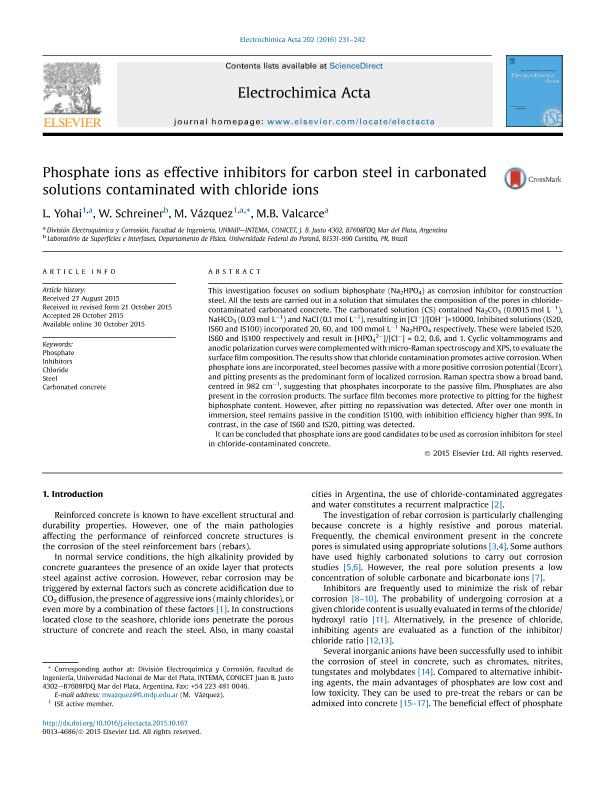
This investigation focuses on sodium biphosphate (Na2HPO4) as corrosion inhibitor for construction steel. All the tests are carried out in a solution that simulates the composition of the pores in chloride-contaminated carbonated concrete. The carbonated solution (CS) contained Na2CO3 (0.0015 mol L-1), NaHCO3 (0.03 mol L-1) and NaCl (0.1 mol L-1), resulting in [Cl-]/[OH-]=10000. Inhibited solutions (IS20, IS60 and IS100) incorporated 20, 60, and 100 mmol L-1 Na2HPO4 respectively. These were labeled IS20, IS60 and IS100 respectively and result in [HPO42-]/[Cl-] = 0.2, 0.6, and 1. Cyclic voltammograms and anodic polarization curves were complemented with micro-Raman spectroscopy and XPS, to evaluate the surface film composition. The results show that chloride contamination promotes active corrosion. When phosphate ions are incorporated, steel becomes passive with a more positive corrosion potential (Ecorr), and pitting presents as the predominant form of localized corrosion. Raman spectra show a broad band, centred in 982 cm-1, suggesting that phosphates incorporate to the passive film. Phosphates are also present in the corrosion products. The surface film becomes more protective to pitting for the highest biphosphate content. However, after pitting no repassivation was detected. After over one month in immersion, steel remains passive in the condition IS100, with inhibition efficiency higher than 99%. In contrast, in the case of IS60 and IS20, pitting was detected.It can be concluded that phosphate ions are good candidates to be used as corrosion inhibitors for steel in chloride-contaminated concrete.
Palabras clave:
Phosphate
,
Inhibitors
,
Chloride
,
Steel
,
Carbonated Concrete
Archivos asociados

Tamaño:
2.938Mb
Formato:
PDF
Licencia
 Excepto donde se diga explícitamente, este item se publica bajo la siguiente descripción:
Creative Commons Attribution-NonCommercial-ShareAlike 2.5 Unported (CC BY-NC-SA 2.5)
Excepto donde se diga explícitamente, este item se publica bajo la siguiente descripción:
Creative Commons Attribution-NonCommercial-ShareAlike 2.5 Unported (CC BY-NC-SA 2.5)
Identificadores
Colecciones
Articulos(INTEMA)
Articulos de INST.DE INV.EN CIENCIA Y TECNOL.MATERIALES (I)
Articulos de INST.DE INV.EN CIENCIA Y TECNOL.MATERIALES (I)
Citación
Yohai del Cerro, Lucía; Schreiner, Wido H.; Vazquez, Marcela Vivian; Valcarce, María Beatriz; Phosphate ions as effective inhibitors for carbon steel in carbonated solutions contaminated with chloride ions; Pergamon-Elsevier Science Ltd.; Electrochimica Acta; 202; 30-10-2016; 231-242
Compartir


Altmétricas