Mostrar el registro sencillo del ítem
dc.contributor.author
Lori, Gladys
dc.contributor.author
Malbrán, Ismael
dc.contributor.author
Mourelos, Cecilia Alejandra
dc.date.available
2018-01-12T14:29:39Z
dc.date.issued
2014-10
dc.identifier.citation
Lori, Gladys; Mourelos, Cecilia Alejandra; Malbrán, Ismael; First Report of Fusarium Wilt of Basil Caused by Fusarium oxysporum f. sp. basilici in Argentina; American Phytopathological Society; Plant Disease; 98; 10; 10-2014; 1432-1432
dc.identifier.issn
0191-2917
dc.identifier.uri
http://hdl.handle.net/11336/33049
dc.description.abstract
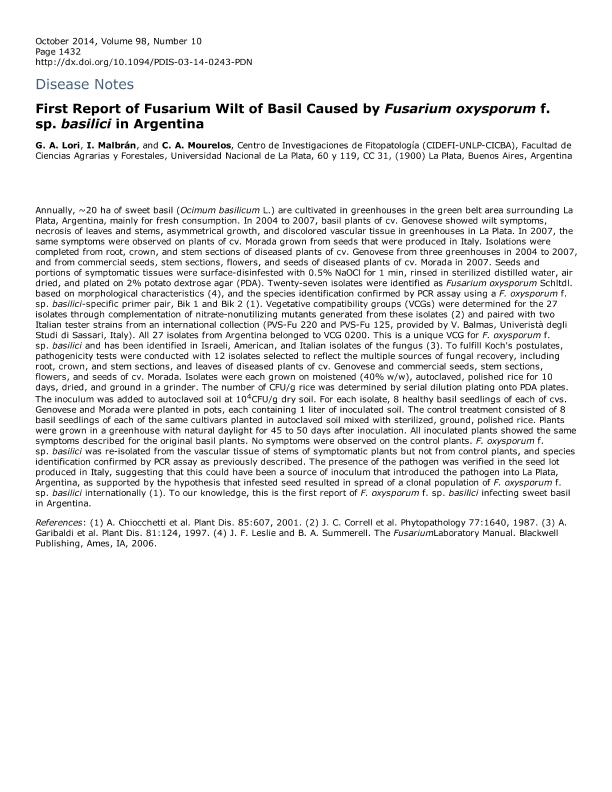
ArgentinaAnnually, ~20 ha of sweet basil (Ocimum basilicumL.) are cultivated in greenhouses in the green belt area surrounding LaPlata, Argentina, mainly for fresh consumption. In 2004 to 2007, basil plants of cv. Genovese showed wilt symptoms,necrosis of leaves and stems, asymmetrical growth, and discolored vascular tissue in greenhouses in La Plata. In 2007, thesame symptoms were observed on plants of cv. Morada grown from seeds that were produced in Italy. Isolations werecompleted from root, crown, and stem sections of diseased plants of cv. Genovese from three greenhouses in 2004 to 2007,and from commercial seeds, stem sections, flowers, and seeds of diseased plants of cv. Morada in 2007. Seeds andportions of symptomatic tissues were surfacedisinfested with 0.5% NaOCl for 1 min, rinsed in sterilized distilled water, airdried, and plated on 2% potato dextrose agar (PDA). Twentyseven isolates were identified asFusarium oxysporumSchltdl.based on morphological characteristics (4), and the species identification confirmed by PCR assay using aF. oxysporumf.sp.basilicispecific primer pair, Bik 1 and Bik 2 (1). Vegetative compatibility groups (VCGs) were determined for the 27isolates through complementation of nitratenonutilizing mutants generated from these isolates (2) and paired with twoItalian tester strains from an international collection (PVSFu 220 and PVSFu 125, provided by V. Balmas, Univeristà degliStudi di Sassari, Italy). All 27 isolates from Argentina belonged to VCG 0200. This is a unique VCG forF. oxysporumf.sp.basiliciand has been identified in Israeli, American, and Italian isolates of the fungus (3). To fulfill Koch's postulates,pathogenicity tests were conducted with 12 isolates selected to reflect the multiple sources of fungal recovery, includingroot, crown, and stem sections, and leaves of diseased plants of cv. Genovese and commercial seeds, stem sections,flowers, and seeds of cv. Morada. Isolates were each grown on moistened (40% w/w), autoclaved, polished rice for 10days, dried, and ground in a grinder. The number of CFU/g rice was determined by serial dilution plating onto PDA plates.The inoculum was added to autoclaved soil at 104CFU/g dry soil. For each isolate, 8 healthy basil seedlings of each of cvs.Genovese and Morada were planted in pots, each containing 1 liter of inoculated soil. The control treatment consisted of 8basil seedlings of each of the same cultivars planted in autoclaved soil mixed with sterilized, ground, polished rice. Plantswere grown in a greenhouse with natural daylight for 45 to 50 days after inoculation. All inoculated plants showed the samesymptoms described for the original basil plants. No symptoms were observed on the control plants.F. oxysporumf.sp.basiliciwas reisolated from the vascular tissue of stems of symptomatic plants but not from control plants, and speciesidentification confirmed by PCR assay as previously described. The presence of the pathogen was verified in the seed lotproduced in Italy, suggesting that this could have been a source of inoculum that introduced the pathogen into La Plata,Argentina, as supported by the hypothesis that infested seed resulted in spread of a clonal population ofF. oxysporumf.sp.basiliciinternationally (1). To our knowledge, this is the first report ofF. oxysporumf. sp.basiliciinfecting sweet basilin Argentina.
dc.format
application/pdf
dc.language.iso
eng
dc.publisher
American Phytopathological Society
dc.rights
info:eu-repo/semantics/openAccess
dc.rights.uri
https://creativecommons.org/licenses/by-nc-sa/2.5/ar/
dc.subject
Fungi And Oomycetes
dc.subject
Herbaceous/Flowering Plants
dc.subject
Epidemiology
dc.subject.classification
Agricultura
dc.subject.classification
Agricultura, Silvicultura y Pesca
dc.subject.classification
CIENCIAS AGRÍCOLAS
dc.title
First Report of Fusarium Wilt of Basil Caused by Fusarium oxysporum f. sp. basilici in Argentina
dc.type
info:eu-repo/semantics/article
dc.type
info:ar-repo/semantics/artículo
dc.type
info:eu-repo/semantics/publishedVersion
dc.date.updated
2018-01-10T16:52:51Z
dc.journal.volume
98
dc.journal.number
10
dc.journal.pagination
1432-1432
dc.journal.pais
Estados Unidos
dc.journal.ciudad
St. Paul
dc.description.fil
Fil: Lori, Gladys. Universidad Nacional de la Plata. Facultad de Ciencias Agrarias y Forestales. Departamento de Ciencias Biológicas. Centro de Investigaciones de Fitopatología. Provincia de Buenos Aires. Gobernación. Comision de Investigaciones Científicas. Centro de Investigaciones de Fitopatología; Argentina
dc.description.fil
Fil: Malbrán, Ismael. Consejo Nacional de Investigaciones Científicas y Técnicas; Argentina. Universidad Nacional de la Plata. Facultad de Ciencias Agrarias y Forestales. Departamento de Ciencias Biológicas. Centro de Investigaciones de Fitopatología. Provincia de Buenos Aires. Gobernación. Comision de Investigaciones Científicas. Centro de Investigaciones de Fitopatología; Argentina
dc.description.fil
Fil: Mourelos, Cecilia Alejandra. Consejo Nacional de Investigaciones Científicas y Técnicas; Argentina. Universidad Nacional de la Plata. Facultad de Ciencias Agrarias y Forestales. Departamento de Ciencias Biológicas. Centro de Investigaciones de Fitopatología. Provincia de Buenos Aires. Gobernación. Comision de Investigaciones Científicas. Centro de Investigaciones de Fitopatología; Argentina
dc.journal.title
Plant Disease
dc.relation.alternativeid
info:eu-repo/semantics/altIdentifier/url/http://apsjournals.apsnet.org/doi/abs/10.1094/PDIS-03-14-0243-PDN
dc.relation.alternativeid
info:eu-repo/semantics/altIdentifier/doi/http://dx.doi.org/10.1094/PDIS-03-14-0243-PDN
Archivos asociados

Tamaño:
72.13Kb
Formato:
PDF