Artículo
Recent advances in the synthesis of stannanes and the scope of theirposterior chemical transformations

Fecha de publicación:
01/2014
Editorial:
Elsevier Science Sa
Revista:
Journal of Organometallic Chemistry
ISSN:
0022-328X
Idioma:
Inglés
Tipo de recurso:
Artículo publicado
Clasificación temática:
Resumen
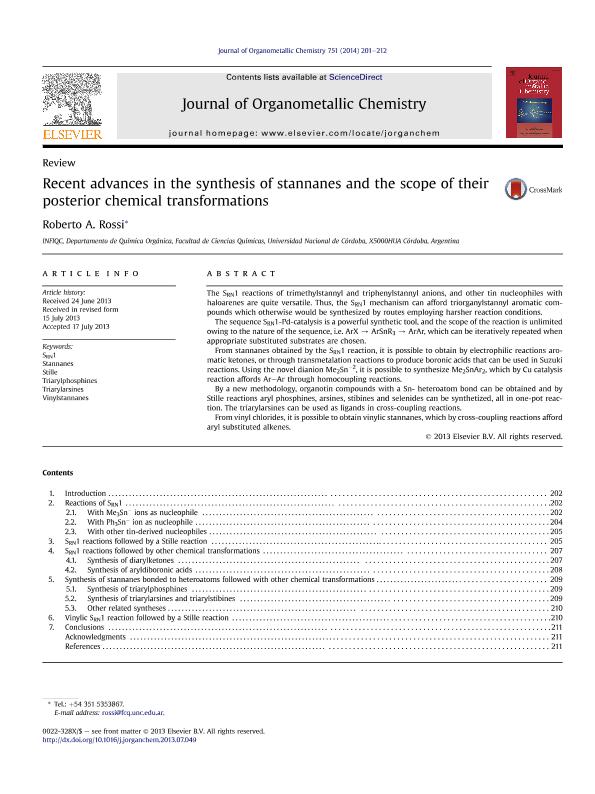
The SRN1 reactions of trimethylstannyl and triphenylstannyl anions, and other tin nucleophiles with haloarenes are quite versatile. Thus, the SRN1 mechanism can afford triorganylstannyl aromatic compounds which otherwise would be synthesized by routes employing harsher reaction conditions. The sequence SRN1-Pd-catalysis is a powerful synthetic tool, and the scope of the reaction is unlimited owing to the nature of the sequence, i.e. ArX → ArSnR3 → ArAr, which can be iteratively repeated when appropriate substituted substrates are chosen. From stannanes obtained by the SRN1 reaction, it is possible to obtain by electrophilic reactions aromatic ketones, or through transmetalation reactions to produce boronic acids that can be used in Suzuki reactions. Using the novel dianion Me2Sn−2, it is possible to synthesize Me2SnAr2, which by Cu catalysis reaction affords Ar–Ar through homocoupling reactions. By a new methodology, organotin compounds with a Sn- heteroatom bond can be obtained and by Stille reactions aryl phosphines, arsines, stibines and selenides can be synthetized, all in one-pot reaction. The triarylarsines can be used as ligands in cross-coupling reactions. From vinyl chlorides, it is possible to obtain vinylic stannanes, which by cross-coupling reactions afford aryl substituted alkenes.
Palabras clave:
Srn1
,
Stannanes
,
Stille
,
Triarylphosphines
,
Triarylarsines
,
Vinylstannane
Archivos asociados

Tamaño:
1.674Mb
Formato:
PDF
Licencia
 Excepto donde se diga explícitamente, este item se publica bajo la siguiente descripción:
Creative Commons Attribution-NonCommercial-ShareAlike 2.5 Unported (CC BY-NC-SA 2.5)
Excepto donde se diga explícitamente, este item se publica bajo la siguiente descripción:
Creative Commons Attribution-NonCommercial-ShareAlike 2.5 Unported (CC BY-NC-SA 2.5)
Identificadores
Colecciones
Articulos(INFIQC)
Articulos de INST.DE INVESTIGACIONES EN FISICO- QUIMICA DE CORDOBA
Articulos de INST.DE INVESTIGACIONES EN FISICO- QUIMICA DE CORDOBA
Citación
Recent advances in the synthesis of stannanes and the scope of theirposterior chemical transformations; Elsevier Science Sa; Journal of Organometallic Chemistry; 751; 1-2014; 201-212
Compartir


Altmétricas