Artículo
Pore formation, polymerization, hemolytic and leukotoxic effects of a new Enterobacter cloacae toxin neutralized by antiserum

Fecha de publicación:
04/2005
Editorial:
Elsevier Gmbh
Revista:
Microbiological Research
ISSN:
0944-5013
Idioma:
Inglés
Tipo de recurso:
Artículo publicado
Clasificación temática:
Resumen
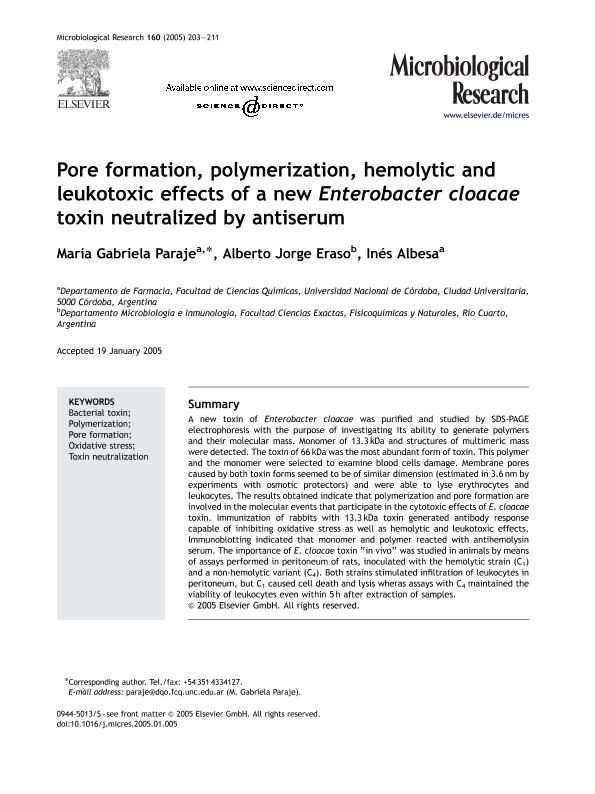
A new toxin of Enterobacter cloacae was purified and studied by SDS-PAGE electrophoresis with the purpose of investigating its ability to generate polymers and their molecular mass. Monomer of 13.3 kDa and structures of multimeric mass were detected. The toxin of 66 kDa was the most abundant form of toxin. This polymer and the monomer were selected to examine blood cells damage. Membrane pores caused by both toxin forms seemed to be of similar dimension (estimated in 3.6 nm by experiments with osmotic protectors) and were able to lyse erythrocytes and leukocytes. The results obtained indicate that polymerization and pore formation are involved in the molecular events that participate in the cytotoxic effects of E. cloacae toxin. Immunization of rabbits with 13.3kDa toxin generated antibody response capable of inhibiting oxidative stress as well as hemolytic and leukotoxic effects. Immunoblotting indicated that monomer and polymer reacted with antihemolysin serum. The importance of E. cloacae toxin "in vivo" was studied in animals by means of assays performed in peritoneum of rats, inoculated with the hemolytic strain (C1) and a non-hemolytic variant (C4). Both strains stimulated infiltration of leukocytes in peritoneum, but C1 caused cell death and lysis wheras assays with C4 maintained the viability of leukocytes even within 5 h after extraction of samples.
Palabras clave:
Bacterial Toxin
,
Polymerization
,
Pore Formation
Archivos asociados

Tamaño:
407.1Kb
Formato:
PDF
Licencia
 Excepto donde se diga explícitamente, este item se publica bajo la siguiente descripción:
Creative Commons Attribution-NonCommercial-ShareAlike 2.5 Unported (CC BY-NC-SA 2.5)
Excepto donde se diga explícitamente, este item se publica bajo la siguiente descripción:
Creative Commons Attribution-NonCommercial-ShareAlike 2.5 Unported (CC BY-NC-SA 2.5)
Identificadores
Colecciones
Articulos(IMBIV)
Articulos de INST.MULTIDISCIPL.DE BIOLOGIA VEGETAL (P)
Articulos de INST.MULTIDISCIPL.DE BIOLOGIA VEGETAL (P)
Citación
Albesa, Inés; Eraso, Alberto Jorge; Paraje, María Gabriela; Pore formation, polymerization, hemolytic and leukotoxic effects of a new Enterobacter cloacae toxin neutralized by antiserum; Elsevier Gmbh; Microbiological Research; 160; 2; 4-2005; 203-211
Compartir


Altmétricas