Artículo
Production of aromatic compounds in the heavy naphtha and light LCO ranges: Catalytic cracking of C10 naphthenic-aromatics and aromatics

Fecha de publicación:
11/2014
Editorial:
Wiley
Revista:
Journal of Chemical Technology and Biotechnology
ISSN:
0268-2575
e-ISSN:
1097-4660
Idioma:
Inglés
Tipo de recurso:
Artículo publicado
Clasificación temática:
Resumen
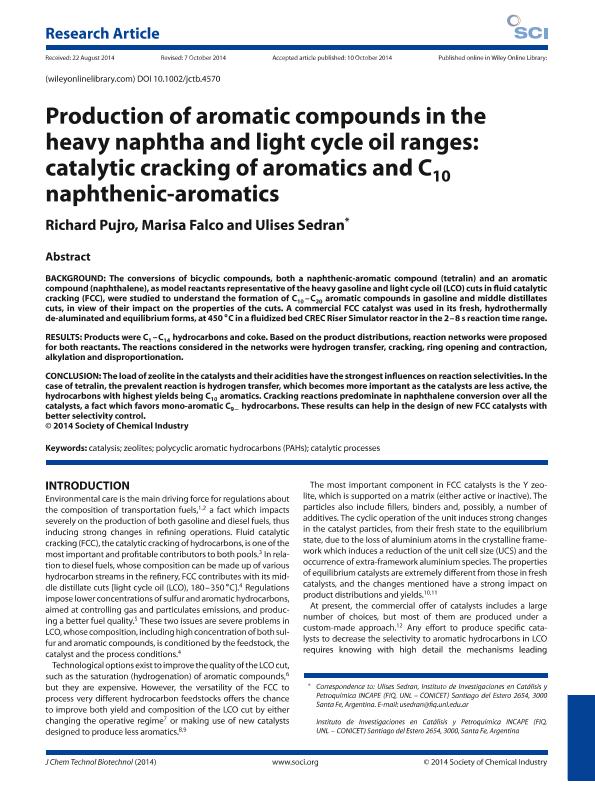
BACKGROUND: The conversions of bicyclic compounds, both a naphthenic-aromatic compound (tetralin) and an aromatic compound (naphthalene), as model reactants representative of the heavy gasoline and light cycle oil (LCO) cuts in fluid catalytic cracking (FCC), were studied to understand the formation of C10–C20 aromatic compounds in gasoline and middle distillates cuts, in view of their impact on the properties of the cuts. A commercial FCC catalyst was used in its fresh, hydrothermally de-aluminated and equilibrium forms, at 450 °C in a fluidized bed CREC Riser Simulator reactor in the 2–8 s reaction time range.
RESULTS: Products were C1–C14 hydrocarbons and coke. Based on the product distributions, reaction networks were proposed for both reactants. The reactions considered in the networks were hydrogen transfer, cracking, ring opening and contraction, alkylation and disproportionation.
CONCLUSION: The load of zeolite in the catalysts and their acidities have the strongest influences on reaction selectivities. In the case of tetralin, the prevalent reaction is hydrogen transfer, which becomes more important as the catalysts are less active, the hydrocarbons with highest yields being C10 aromatics. Cracking reactions predominate in naphthalene conversion over all the catalysts, a fact which favors mono-aromatic C9− hydrocarbons. These results can help in the design of new FCC catalysts with better selectivity control.
Archivos asociados

Tamaño:
811.3Kb
Formato:
PDF
Licencia
 Excepto donde se diga explícitamente, este item se publica bajo la siguiente descripción:
Creative Commons Attribution-NonCommercial-ShareAlike 2.5 Unported (CC BY-NC-SA 2.5)
Excepto donde se diga explícitamente, este item se publica bajo la siguiente descripción:
Creative Commons Attribution-NonCommercial-ShareAlike 2.5 Unported (CC BY-NC-SA 2.5)
Identificadores
Colecciones
Articulos(INCAPE)
Articulos de INST.DE INVEST.EN CATALISIS Y PETROQUIMICA "ING. JOSE MIGUEL PARERA"
Articulos de INST.DE INVEST.EN CATALISIS Y PETROQUIMICA "ING. JOSE MIGUEL PARERA"
Citación
Sedran, Ulises Anselmo; Falco, Marisa Guadalupe; Pujro Tarquino, Richard Alfonzo; Production of aromatic compounds in the heavy naphtha and light LCO ranges: Catalytic cracking of C10 naphthenic-aromatics and aromatics; Wiley; Journal of Chemical Technology and Biotechnology; 91; 2; 11-2014; 336-345
Compartir


Altmétricas