Artículo
Hydrogen peroxide in micropropagation of Lilium: A comparison with a traditional methodology

Fecha de publicación:
12/2006
Editorial:
Instituto de Histología y Embriología
Revista:
Biocell
ISSN:
0327-9545
e-ISSN:
1667-5746
Idioma:
Inglés
Tipo de recurso:
Artículo publicado
Clasificación temática:
Resumen
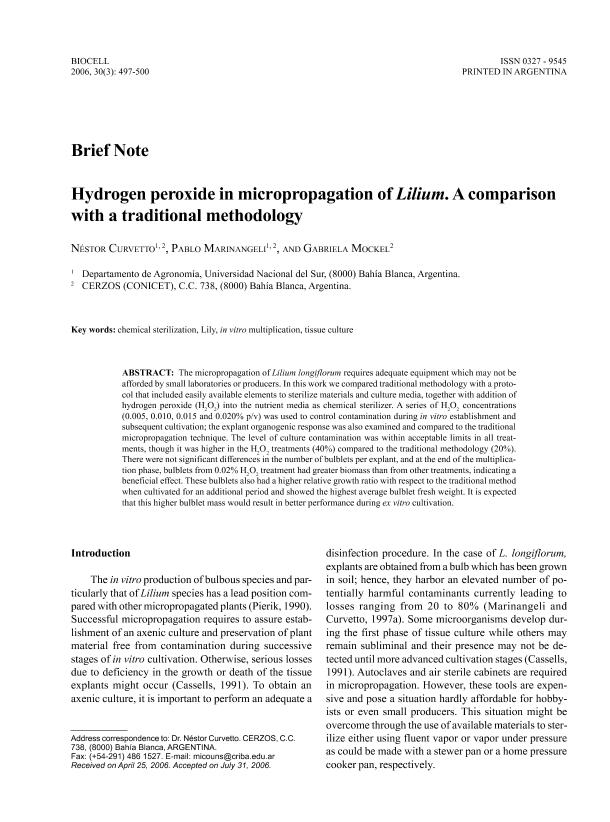
The micropropagation of Lilium longiflorum requires adequate equipment which may not be afforded by small laboratories or producers. In this work we compared traditional methodology with a protocol that included easily available elements to sterilize materials and culture media, together with addition of hydrogen peroxide (H2O2) into the nutrient media as chemical sterilizer. A series of H2O2 concentrations (0.005, 0.010, 0.015 and 0.020% p/v) was used to control contamination during in vitro establishment and subsequent cultivation; the explant organogenic response was also examined and compared to the traditional micropropagation technique. The level of culture contamination was within acceptable limits in all treatments, though it was higher in the H2O2 treatments (40%) compared to the traditional methodology (20%). There were not significant differences in the number of bulblets per explant, and at the end of the multiplication phase, bulblets from 0.02% H2O2 treatment had greater biomass than from other treatments, indicating a beneficial effect. These bulblets also had a higher relative growth ratio with respect to the traditional method when cultivated for an additional period and showed the highest average bulblet fresh weight. It is expected that this higher bulblet mass would result in better performance during ex vitro cultivation.
Palabras clave:
Chemical Sterilization
,
Lily
,
In Vitro Multiplication
,
Tissue Culture
Archivos asociados

Tamaño:
145.3Kb
Formato:
PDF
Licencia
 Excepto donde se diga explícitamente, este item se publica bajo la siguiente descripción:
Creative Commons Attribution-NonCommercial-ShareAlike 2.5 Unported (CC BY-NC-SA 2.5)
Excepto donde se diga explícitamente, este item se publica bajo la siguiente descripción:
Creative Commons Attribution-NonCommercial-ShareAlike 2.5 Unported (CC BY-NC-SA 2.5)
Identificadores
Colecciones
Articulos(CERZOS)
Articulos de CENTRO REC.NAT.RENOVABLES DE ZONA SEMIARIDA(I)
Articulos de CENTRO REC.NAT.RENOVABLES DE ZONA SEMIARIDA(I)
Citación
Curvetto, Nestor Raul; Marinangeli, Pablo Alejandro; Mockel, Gabriela Carolina; Hydrogen peroxide in micropropagation of Lilium: A comparison with a traditional methodology; Instituto de Histología y Embriología; Biocell; 30; 3; 12-2006; 497-500
Compartir

