Artículo
Plasma-CVD-coated glass beads as photocatalyst for water decontamination
Karches, Martin; Morstein, Marcus; Rudolf von Rohr, Philipp; Pozzo, Roberto Luis ; Giombi, Jose Luis
; Baltanas, Miguel Angel
; Giombi, Jose Luis
; Baltanas, Miguel Angel
; Giombi, Jose Luis
; Baltanas, Miguel Angel
Fecha de publicación:
05/2002
Editorial:
Elsevier Science
Revista:
Catalysis Today
ISSN:
0920-5861
Idioma:
Inglés
Tipo de recurso:
Artículo publicado
Clasificación temática:
Resumen
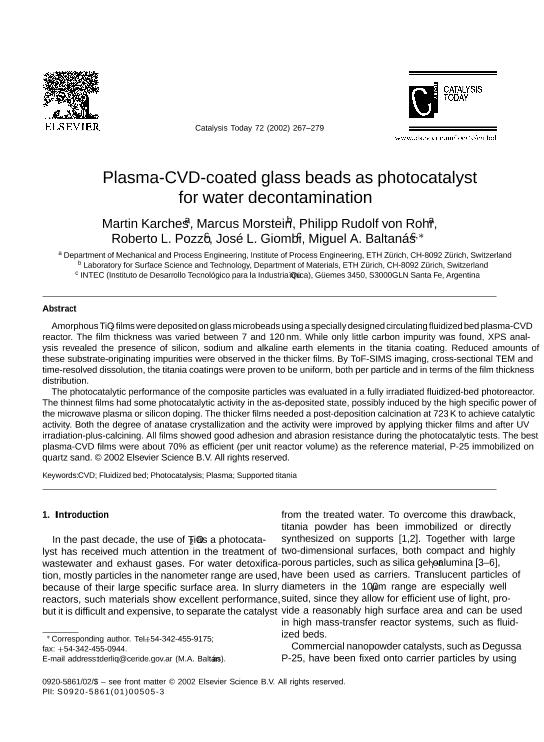
AmorphousTiO2 films were deposited on glass microbeads using a specially designed circulating fluidized bed plasma-CVD reactor. The film thickness was varied between 7 and 120 nm. While only little carbon impurity was found, XPS analysis revealed the presence of silicon, sodium and alkaline earth elements in the titania coating. Reduced amounts of these substrate-originating impurities were observed in the thicker films. By ToF-SIMS imaging, cross-sectional TEM and<br />time-resolved dissolution, the titania coatings were proven to be uniform, both per particle and in terms of the film thickness distribution.<br />The photocatalytic performance of the composite particles was evaluated in a fully irradiated fluidized-bed photoreactor. The thinnest films had some photocatalytic activity in the as-deposited state, possibly induced by the high specific power of the microwave plasma or silicon doping. The thicker films needed a post-deposition calcination at 723K to achieve catalytic activity. Both the degree of anatase crystallization and the activity were improved by applying thicker films and after UV irradiation-plus-calcining. All films showed good adhesion and abrasion resistance during the photocatalytic tests. The best plasma-CVD films were about 70% as efficient (per unit reactor volume) as the reference material, P-25 immobilized on quartz sand.
Palabras clave:
Cvd
,
Fluidized Bed
,
Photocatalysis
,
Plasma
,
Supported Titania
Archivos asociados

Tamaño:
380.7Kb
Formato:
PDF
Licencia
 Excepto donde se diga explícitamente, este item se publica bajo la siguiente descripción:
Creative Commons Attribution-NonCommercial-ShareAlike 2.5 Unported (CC BY-NC-SA 2.5)
Excepto donde se diga explícitamente, este item se publica bajo la siguiente descripción:
Creative Commons Attribution-NonCommercial-ShareAlike 2.5 Unported (CC BY-NC-SA 2.5)
Identificadores
Colecciones
Articulos(INTEC)
Articulos de INST.DE DES.TECNOL.PARA LA IND.QUIMICA (I)
Articulos de INST.DE DES.TECNOL.PARA LA IND.QUIMICA (I)
Citación
Karches, Martin; Morstein, Marcus; Rudolf von Rohr, Philipp; Pozzo, Roberto Luis; Giombi, Jose Luis; et al.; Plasma-CVD-coated glass beads as photocatalyst for water decontamination; Elsevier Science; Catalysis Today; 72; 5-2002; 267-279
Compartir


Altmétricas