Mostrar el registro sencillo del ítem
dc.contributor.author
Repizo, Guillermo Daniel
dc.contributor.author
Espariz, Martin
dc.contributor.author
Blancato, Victor Sebastian
dc.contributor.author
Suárez, Cristian Alejandro
dc.contributor.author
Esteban, Luis
dc.contributor.author
Magni, Christian
dc.date.available
2017-12-04T19:34:26Z
dc.date.issued
2014-06
dc.identifier.citation
Repizo, Guillermo Daniel; Espariz, Martin; Blancato, Victor Sebastian; Suárez, Cristian Alejandro; Esteban, Luis; et al.; Genomic comparative analysis of the environmental Enterococcus mundtii against enterococcal representative species; BioMed Central; BMC Genomics; 15; 6-2014; 489-502
dc.identifier.issn
1471-2164
dc.identifier.uri
http://hdl.handle.net/11336/29607
dc.description.abstract
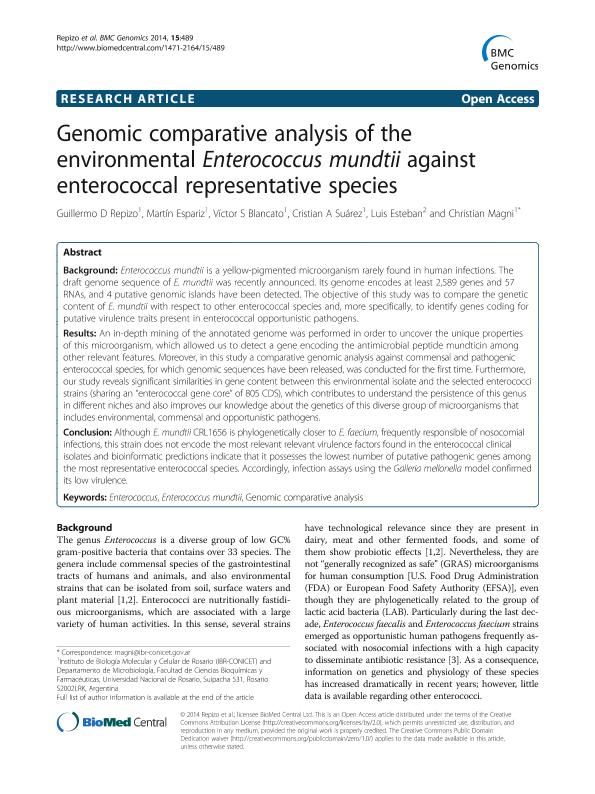
Background Enterococcus mundtii is a yellow-pigmented microorganism rarely found in human infections. The draft genome sequence of E. mundtii was recently announced. Its genome encodes at least 2,589 genes and 57 RNAs, and 4 putative genomic islands have been detected. The objective of this study was to compare the genetic content of E. mundtii with respect to other enterococcal species and, more specifically, to identify genes coding for putative virulence traits present in enterococcal opportunistic pathogens. Results An in-depth mining of the annotated genome was performed in order to uncover the unique properties of this microorganism, which allowed us to detect a gene encoding the antimicrobial peptide mundticin among other relevant features. Moreover, in this study a comparative genomic analysis against commensal and pathogenic enterococcal species, for which genomic sequences have been released, was conducted for the first time. Furthermore, our study reveals significant similarities in gene content between this environmental isolate and the selected enterococci strains (sharing an “enterococcal gene core” of 805 CDS), which contributes to understand the persistence of this genus in different niches and also improves our knowledge about the genetics of this diverse group of microorganisms that includes environmental, commensal and opportunistic pathogens. Conclusion Although E. mundtii CRL1656 is phylogenetically closer to E. faecium, frequently responsible of nosocomial infections, this strain does not encode the most relevant relevant virulence factors found in the enterococcal clinical isolates and bioinformatic predictions indicate that it possesses the lowest number of putative pathogenic genes among the most representative enterococcal species. Accordingly, infection assays using the Galleria mellonella model confirmed its low virulence
dc.format
application/pdf
dc.language.iso
eng
dc.publisher
BioMed Central
dc.rights
info:eu-repo/semantics/openAccess
dc.rights.uri
https://creativecommons.org/licenses/by-nc-sa/2.5/ar/
dc.subject
Enterococcus
dc.subject
Enterococcus Mundtii
dc.subject
Genomic Comparative Analysis
dc.subject.classification
Otras Ciencias Biológicas
dc.subject.classification
Ciencias Biológicas
dc.subject.classification
CIENCIAS NATURALES Y EXACTAS
dc.title
Genomic comparative analysis of the environmental Enterococcus mundtii against enterococcal representative species
dc.type
info:eu-repo/semantics/article
dc.type
info:ar-repo/semantics/artículo
dc.type
info:eu-repo/semantics/publishedVersion
dc.date.updated
2017-12-04T19:15:58Z
dc.journal.volume
15
dc.journal.pagination
489-502
dc.journal.pais
Reino Unido
dc.journal.ciudad
Londres
dc.description.fil
Fil: Repizo, Guillermo Daniel. Consejo Nacional de Investigaciones Científicas y Técnicas. Centro Científico Tecnológico Conicet - Rosario. Instituto de Biología Molecular y Celular de Rosario. Universidad Nacional de Rosario. Facultad de Ciencias Bioquímicas y Farmacéuticas. Instituto de Biología Molecular y Celular de Rosario; Argentina
dc.description.fil
Fil: Espariz, Martin. Consejo Nacional de Investigaciones Científicas y Técnicas. Centro Científico Tecnológico Conicet - Rosario. Instituto de Biología Molecular y Celular de Rosario. Universidad Nacional de Rosario. Facultad de Ciencias Bioquímicas y Farmacéuticas. Instituto de Biología Molecular y Celular de Rosario; Argentina
dc.description.fil
Fil: Blancato, Victor Sebastian. Consejo Nacional de Investigaciones Científicas y Técnicas. Centro Científico Tecnológico Conicet - Rosario. Instituto de Biología Molecular y Celular de Rosario. Universidad Nacional de Rosario. Facultad de Ciencias Bioquímicas y Farmacéuticas. Instituto de Biología Molecular y Celular de Rosario; Argentina
dc.description.fil
Fil: Suárez, Cristian Alejandro. Consejo Nacional de Investigaciones Científicas y Técnicas. Centro Científico Tecnológico Conicet - Rosario. Instituto de Biología Molecular y Celular de Rosario. Universidad Nacional de Rosario. Facultad de Ciencias Bioquímicas y Farmacéuticas. Instituto de Biología Molecular y Celular de Rosario; Argentina
dc.description.fil
Fil: Esteban, Luis. Universidad Nacional de Rosario. Facultad de Cs.médicas. Escuela de Cs.médicas. Cátedra de Fisiología; Argentina
dc.description.fil
Fil: Magni, Christian. Consejo Nacional de Investigaciones Científicas y Técnicas. Centro Científico Tecnológico Conicet - Rosario. Instituto de Biología Molecular y Celular de Rosario. Universidad Nacional de Rosario. Facultad de Ciencias Bioquímicas y Farmacéuticas. Instituto de Biología Molecular y Celular de Rosario; Argentina
dc.journal.title
BMC Genomics
dc.relation.alternativeid
info:eu-repo/semantics/altIdentifier/doi/http://dx.doi.org/10.1186/1471-2164-15-489
dc.relation.alternativeid
info:eu-repo/semantics/altIdentifier/url/https://bmcgenomics.biomedcentral.com/articles/10.1186/1471-2164-15-489
Archivos asociados

Tamaño:
822.0Kb
Formato:
PDF