Artículo
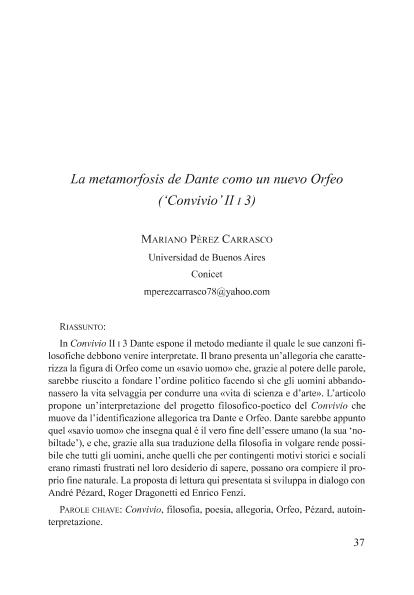
In Convivio II i 3 Dante espone il metodo mediante il quale le sue canzoni filosofiche debbono venire interpretate. Il brano presenta un’allegoria che caratterizza la figura di Orfeo come un «savio uomo» che, grazie al potere delle parole, sarebbe riuscito a fondare l’ordine politico facendo sì che gli uomini abbandonassero la vita selvaggia per condurre una «vita di scienza e d’arte». L’articolo propone un’interpretazione del progetto filosofico-poetico del Convivio che muove da l’identificazione allegorica tra Dante e Orfeo. Dante sarebbe appunto quel «savio uomo» che insegna qual è il vero fine dell’essere umano (la sua ‘nobiltade’), e che, grazie alla sua traduzione della filosofia in volgare rende possibile che tutti gli uomini, anche quelli che per contingenti motivi storici e sociali erano rimasti frustrati nel loro desiderio di sapere, possano ora compiere il proprio fine naturale. La proposta di lettura qui presentata si sviluppa in dialogo con André Pézard, Roger Dragonetti ed Enrico Fenzi. In Convivio II I 3 Dante shows the method by which he will interpret his own philosophical songs. He presents an allegory that identifies Orpheus with «lo savio uomo» who by the strength of his voice would have founded the political order, making men abandon their previous wildlife and adopt a «vita di scienza e d’arte». The article proposes an interpretation of the philosophical-poetic project of the Convivio that defends an allegorical identification between Dante and Orpheus. Dante would be the wise man showing what is the true end of man (his nobiltade) and, thanks to Convivio’s translation of philosophy into vulgar, he makes possible that those men who due to contingent socio-historical reasons were frustrated in their desire to know, could now accomplish their own natural end. Our interpretation is deployed in dialogue with André Pézard, Roger Dragonetti and Enrico Fenzi.
La metamorfosis de Dante como un nuevo Orfeo (‘Convivio’II, I, 3)

Fecha de publicación:
11/2013
Editorial:
Asociación Complutense de Dantología
Revista:
Tenzone
ISSN:
1576-9216
Idioma:
Español
Tipo de recurso:
Artículo publicado
Clasificación temática:
Resumen
Palabras clave:
Convivio
,
Filosofia
,
Poesia
,
Allegoria
,
Orfeo
,
Pézard
,
Autointerpretazione
Archivos asociados

Tamaño:
246.9Kb
Formato:
PDF
Licencia
 Excepto donde se diga explícitamente, este item se publica bajo la siguiente descripción:
Creative Commons Attribution-NonCommercial-ShareAlike 2.5 Unported (CC BY-NC-SA 2.5)
Excepto donde se diga explícitamente, este item se publica bajo la siguiente descripción:
Creative Commons Attribution-NonCommercial-ShareAlike 2.5 Unported (CC BY-NC-SA 2.5)
Identificadores
Colecciones
Articulos(SEDE CENTRAL)
Articulos de SEDE CENTRAL
Articulos de SEDE CENTRAL
Citación
Perez Carrasco, Mariano; La metamorfosis de Dante como un nuevo Orfeo (‘Convivio’II, I, 3); Asociación Complutense de Dantología; Tenzone; 14; 11-2013; 37-69
Compartir

