Artículo
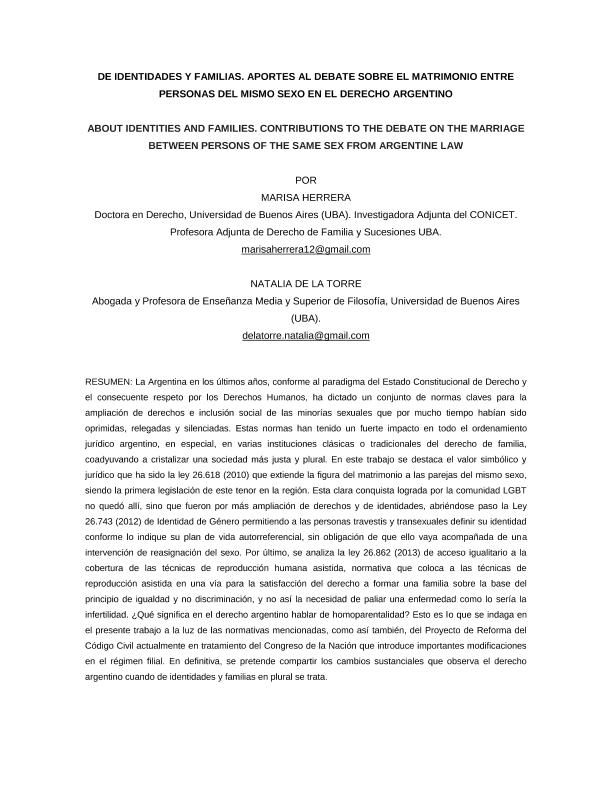
La Argentina en los últimos años, conforme al paradigma del Estado Constitucional de Derecho y el consecuente respeto por los Derechos Humanos, ha dictado un conjunto de normas claves para la ampliación de derechos e inclusión social de las minorías sexuales que por mucho tiempo habían sido oprimidas, relegadas y silenciadas. Estas normas han tenido un fuerte impacto en todo el ordenamiento jurídico argentino, en especial, en varias instituciones clásicas o tradicionales del derecho de familia, coadyuvando a cristalizar una sociedad más justa y plural. En este trabajo se destaca el valor simbólico y jurídico que ha sido la ley 26.618 (2010) que extiende la figura del matrimonio a las parejas del mismo sexo, siendo la primera legislación de este tenor en la región. Esta clara conquista lograda por la comunidad LGBT no quedó allí, sino que fueron por más ampliación de derechos y de identidades, abriéndose paso la Ley 26.743 (2012) de Identidad de Género permitiendo a las personas travestis y transexuales definir su identidad conforme lo indique su plan de vida autorreferencial, sin obligación de que ello vaya acompañada de una intervención de reasignación del sexo. Por último, se analiza la ley 26.862 (2013) de acceso igualitario a la cobertura de las técnicas de reproducción humana asistida, normativa que coloca a las técnicas de reproducción asistida en una vía para la satisfacción del derecho a formar una familia sobre la base del principio de igualdad y no discriminación, y no así la necesidad de paliar una enfermedad como lo sería la infertilidad. ¿Qué significa en el derecho argentino hablar de homoparentalidad? Esto es lo que se indaga en el presente trabajo a la luz de las normativas mencionadas, como así también, del Proyecto de Reforma del Código Civil actualmente en tratamiento del Congreso de la Nación que introduce importantes modificaciones en el régimen filial. En definitiva, se pretende compartir los cambios sustanciales que observa el derecho argentino cuando de identidades y familias en plural se trata. Argentina in recent years, as the paradigm of constitutional rule of law and the consequent respect for Human Rights has issued a set of key rules for the extension of rights and social inclusion of sexual minorities who long had been oppressed, neglected and silenced. These standards have had a strong impact on the entire Argentine legal system, especially in several classic or traditional institutions of family law, helping to crystallize a more just and plural society. This work highlights the legal and symbolic value that has been the law 26,618 (2010) figure extending marriage to same-sex couples, being the first legislation to this effect in the region. This clear victory achieved by the LGBT community was not there, but it went to extension of rights and identities, pushing through the Law 26.743 (2012) Gender Identity allowing transvestites and transgender people to define their identity as directed by their self- referential life plan, no obligation for it to be accompanied by an intervention of sex reassignment. Finally , we analyze the law 26,862 (2013) of equal access to the coverage of assisted human reproduction techniques , legislation which places assisted reproduction techniques in a way to satisfy the right to form a family on the basis of principle of equality and non-discrimination, and not as well the need to alleviate a disease as it would be infertility . What does it mean in Argentine law homoparentality talk? This is what is investigated in this paper in the light of the above-mentioned regulations, as well as the Project of Reform of the Civil Code Draft Civil Code reform currently in treatment of the National Congress which introduces important modifications in the subsidiary regime. In short, it aims to share the substantial changes which observes Argentine law when plural identities and families concerned.
De identidades y familia: aportes al debate sobre el matrimonio entre personas del mismo sexo en el Derecho argentino

Fecha de publicación:
10/2013
Editorial:
Iustel
Revista:
Revista General de Derecho Constitucional
ISSN:
1886-6212
Idioma:
Español
Tipo de recurso:
Artículo publicado
Clasificación temática:
Resumen
Palabras clave:
Matrimonio
,
Igualitario
,
Argentina
,
Derechos
Archivos asociados

Tamaño:
659.5Kb
Formato:
PDF
Licencia
 Excepto donde se diga explícitamente, este item se publica bajo la siguiente descripción:
Creative Commons Attribution-NonCommercial-ShareAlike 2.5 Unported (CC BY-NC-SA 2.5)
Excepto donde se diga explícitamente, este item se publica bajo la siguiente descripción:
Creative Commons Attribution-NonCommercial-ShareAlike 2.5 Unported (CC BY-NC-SA 2.5)
Identificadores
Colecciones
Articulos(SEDE CENTRAL)
Articulos de SEDE CENTRAL
Articulos de SEDE CENTRAL
Citación
Herrera, Marisa; de la Torre, Natalia; De identidades y familia: aportes al debate sobre el matrimonio entre personas del mismo sexo en el Derecho argentino; Iustel; Revista General de Derecho Constitucional; 10-2013; 1-55
Compartir

