Artículo
Effects of ocean acidification on fatty acid composition in the Antarctic snail Neobuccinum eatoni
Servetto, Natalia ; De Troch, Marleen; Alurralde, Gastón; Ferrero, Luciana Andrea
; de Aranzamendi, Maria Carla
; Sahade, Ricardo Jose
; De Troch, Marleen; Alurralde, Gastón; Ferrero, Luciana Andrea
; de Aranzamendi, Maria Carla
; Sahade, Ricardo Jose
; De Troch, Marleen; Alurralde, Gastón; Ferrero, Luciana Andrea
; de Aranzamendi, Maria Carla
; Sahade, Ricardo Jose
Fecha de publicación:
10/2025
Editorial:
Frontiers Media
Revista:
Frontiers In Marine Science
ISSN:
2296-7745
Idioma:
Inglés
Tipo de recurso:
Artículo publicado
Clasificación temática:
Resumen
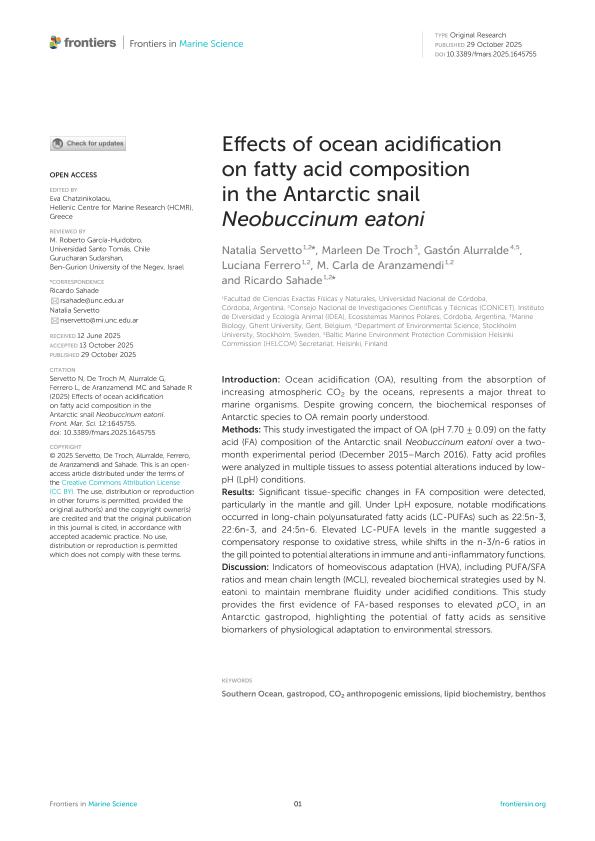
Introduction: Ocean acidification (OA), resulting from the absorption ofincreasing atmospheric CO2 by the oceans, represents a major threat tomarine organisms. Despite growing concern, the biochemical responses ofAntarctic species to OA remain poorly understood.Methods: This study investigated the impact of OA (pH 7.70 ± 0.09) on the fattyacid (FA) composition of the Antarctic snail Neobuccinum eatoni over a twomonth experimental period (December 2015–March 2016). Fatty acid profileswere analyzed in multiple tissues to assess potential alterations induced by lowpH (LpH) conditions.Results: Significant tissue-specific changes in FA composition were detected,particularly in the mantle and gill. Under LpH exposure, notable modificationsoccurred in long-chain polyunsaturated fatty acids (LC-PUFAs) such as 22:5n-3,22:6n-3, and 24:5n-6. Elevated LC-PUFA levels in the mantle suggested acompensatory response to oxidative stress, while shifts in the n-3/n-6 ratios inthe gill pointed to potential alterations in immune and anti-inflammatory functions.Discussion: Indicators of homeoviscous adaptation (HVA), including PUFA/SFAratios and mean chain length (MCL), revealed biochemical strategies used by N.eatoni to maintain membrane fluidity under acidified conditions. This studyprovides the first evidence of FA-based responses to elevated pCO₂ in anAntarctic gastropod, highlighting the potential of fatty acids as sensitivebiomarkers of physiological adaptation to environmental stressors.
Palabras clave:
OCEAN ACIDIFICATION
,
FATTY ACID COMPOSITION
,
GASTROPODA
,
ANTARCTICA
Archivos asociados

Tamaño:
1.897Mb
Formato:
PDF
Licencia
 Excepto donde se diga explícitamente, este item se publica bajo la siguiente descripción:
Creative Commons Attribution-NonCommercial-ShareAlike 2.5 Unported (CC BY-NC-SA 2.5)
Excepto donde se diga explícitamente, este item se publica bajo la siguiente descripción:
Creative Commons Attribution-NonCommercial-ShareAlike 2.5 Unported (CC BY-NC-SA 2.5)
Identificadores
Colecciones
Articulos(IDEA)
Articulos de INSTITUTO DE DIVERSIDAD Y ECOLOGIA ANIMAL
Articulos de INSTITUTO DE DIVERSIDAD Y ECOLOGIA ANIMAL
Citación
Servetto, Natalia; De Troch, Marleen; Alurralde, Gastón; Ferrero, Luciana Andrea; de Aranzamendi, Maria Carla; et al.; Effects of ocean acidification on fatty acid composition in the Antarctic snail Neobuccinum eatoni; Frontiers Media; Frontiers In Marine Science; 12; 10-2025; 1-13
Compartir


Altmétricas