Artículo
Nutritional Deficiencies and Phospholipid Metabolism

Fecha de publicación:
10/2011
Editorial:
Multidisciplinary Digital Publishing Institute
Revista:
International Journal of Molecular Sciences
ISSN:
1422-0067
Idioma:
Inglés
Tipo de recurso:
Artículo publicado
Clasificación temática:
Resumen
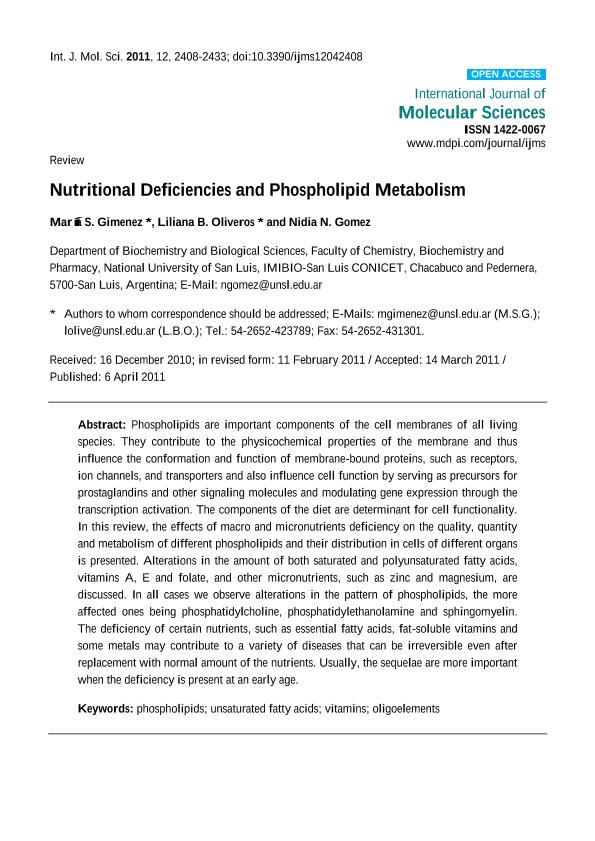
Phospholipids are important components of the cell membranes of all living species. They contribute to the physicochemical properties of the membrane and thus influence the conformation and function of membrane-bound proteins, such as receptors, ion channels, and transporters and also influence cell function by serving as precursors for prostaglandins and other signaling molecules and modulating gene expression through the transcription activation. The components of the diet are determinant for cell functionality. In this review, the effects of macro and micronutrients deficiency on the quality, quantity and metabolism of different phospholipids and their distribution in cells of different organs is presented. Alterations in the amount of both saturated and polyunsaturated fatty acids, vitamins A, E and folate, and other micronutrients, such as zinc and magnesium, are discussed. In all cases we observe alterations in the pattern of phospholipids, the more affected ones being phosphatidylcholine, phosphatidylethanolamine and sphingomyelin. The deficiency of certain nutrients, such as essential fatty acids, fat-soluble vitamins and some metals may contribute to a variety of diseases that can be irreversible even after replacement with normal amount of the nutrients. Usually, the sequelae are more important when the deficiency is present at an early age.
Palabras clave:
Phospholipids
,
Properties
,
Lung
,
Nutritions
Archivos asociados

Tamaño:
409.8Kb
Formato:
PDF
Licencia
 Excepto donde se diga explícitamente, este item se publica bajo la siguiente descripción:
Creative Commons Attribution 2.5 Unported (CC BY 2.5)
Excepto donde se diga explícitamente, este item se publica bajo la siguiente descripción:
Creative Commons Attribution 2.5 Unported (CC BY 2.5)
Identificadores
Colecciones
Articulos(IMIBIO-SL)
Articulos de INST. MULTIDICIPLINARIO DE INV. BIO. DE SAN LUIS
Articulos de INST. MULTIDICIPLINARIO DE INV. BIO. DE SAN LUIS
Citación
Gimenez, Maria Sofia; Oliveros, Liliana Beatriz; Gomez, Nidia Noemí; Nutritional Deficiencies and Phospholipid Metabolism; Multidisciplinary Digital Publishing Institute; International Journal of Molecular Sciences; 12; 4; 10-2011; 2408-2433
Compartir


Altmétricas