Artículo
Assessing the impact of the COVID-19 pandemic on recognition and testimony memory: differential effects in young and older adults
Bonilla, Matías ; Flores Kanter, Pablo Ezequiel; Vidal, Vanessa
; Jiménez, Zahira A.; León, Candela Sofía
; Urreta Benitez, Facundo Antonio
; Brusco, Luis Ignacio
; Vázquez Chenlo, Aylin; Corfdir, Yohann; Garcia Bauza, Cristian Dario
; Forcato, Cecilia
; Flores Kanter, Pablo Ezequiel; Vidal, Vanessa
; Jiménez, Zahira A.; León, Candela Sofía
; Urreta Benitez, Facundo Antonio
; Brusco, Luis Ignacio
; Vázquez Chenlo, Aylin; Corfdir, Yohann; Garcia Bauza, Cristian Dario
; Forcato, Cecilia
; Flores Kanter, Pablo Ezequiel; Vidal, Vanessa
; Jiménez, Zahira A.; León, Candela Sofía
; Urreta Benitez, Facundo Antonio
; Brusco, Luis Ignacio
; Vázquez Chenlo, Aylin; Corfdir, Yohann; Garcia Bauza, Cristian Dario
; Forcato, Cecilia
Fecha de publicación:
10/2025
Editorial:
Frontiers Media
Revista:
Frontiers in Psychology
ISSN:
1664-1078
Idioma:
Inglés
Tipo de recurso:
Artículo publicado
Clasificación temática:
Resumen
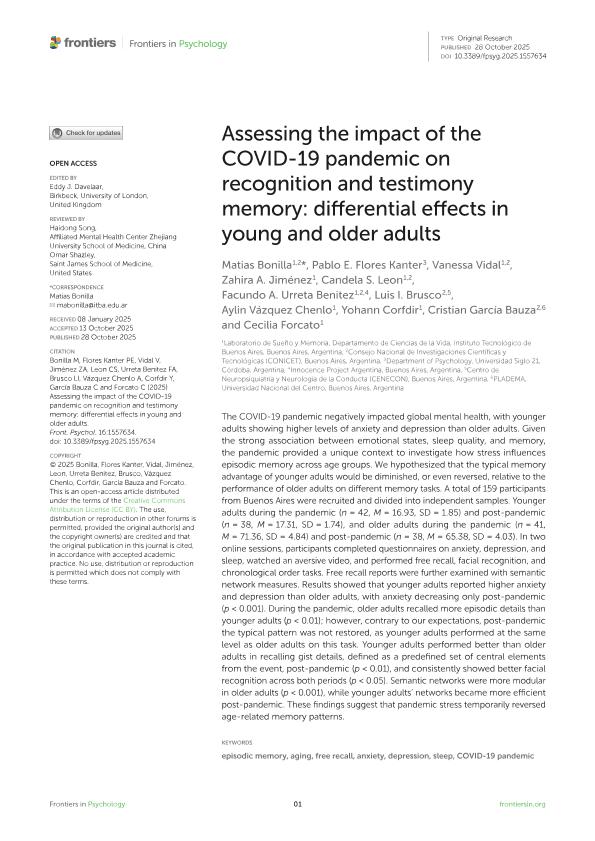
The COVID-19 pandemic negatively impacted global mental health, with younger adults showing higher levels of anxiety and depression than older adults. Given the strong association between emotional states, sleep quality, and memory, the pandemic provided a unique context to investigate how stress influences episodic memory across age groups. We hypothesized that the typical memory advantage of younger adults would be diminished, or even reversed, relative to the performance of older adults on different memory tasks. A total of 159 participants from Buenos Aires were recruited and divided into independent samples. Younger adults during the pandemic (n = 42, M = 16.93, SD = 1.85) and post-pandemic (n = 38, M = 17.31, SD = 1.74), and older adults during the pandemic (n = 41, M = 71.36, SD = 4.84) and post-pandemic (n = 38, M = 65.38, SD = 4.03). In two online sessions, participants completed questionnaires on anxiety, depression, and sleep, watched an aversive video, and performed free recall, facial recognition, and chronological order tasks. Free recall reports were further examined with semantic network measures. Results showed that younger adults reported higher anxiety and depression than older adults, with anxiety decreasing only post-pandemic (p < 0.001). During the pandemic, older adults recalled more episodic details than younger adults (p < 0.01); however, contrary to our expectations, post-pandemic the typical pattern was not restored, as younger adults performed at the same level as older adults on this task. Younger adults performed better than older adults in recalling gist details, defined as a predefined set of central elements from the event, post-pandemic (p < 0.01), and consistently showed better facial recognition across both periods (p < 0.05). Semantic networks were more modular in older adults (p < 0.001), while younger adults’ networks became more efficient post-pandemic. These findings suggest that pandemic stress temporarily reversed age-related memory patterns.
Palabras clave:
EPISODIC MEMORY
,
AGING
,
FREE RECALL
,
COVID-19
Archivos asociados

Tamaño:
1.639Mb
Formato:
PDF
Licencia
 Excepto donde se diga explícitamente, este item se publica bajo la siguiente descripción:
Creative Commons Attribution 2.5 Unported (CC BY 2.5)
Excepto donde se diga explícitamente, este item se publica bajo la siguiente descripción:
Creative Commons Attribution 2.5 Unported (CC BY 2.5)
Identificadores
Colecciones
Articulos(CCT - TANDIL)
Articulos de CTRO CIENTIFICO TECNOLOGICO CONICET - TANDIL
Articulos de CTRO CIENTIFICO TECNOLOGICO CONICET - TANDIL
Articulos(SEDE CENTRAL)
Articulos de SEDE CENTRAL
Articulos de SEDE CENTRAL
Citación
Bonilla, Matías; Flores Kanter, Pablo Ezequiel; Vidal, Vanessa; Jiménez, Zahira A.; León, Candela Sofía; et al.; Assessing the impact of the COVID-19 pandemic on recognition and testimony memory: differential effects in young and older adults; Frontiers Media; Frontiers in Psychology; 16; 10-2025; 1-15
Compartir


Altmétricas