Evento
Alien lymnaeid snails in the Western Mediterranean basin: new invaders and trematode-transmitters in the region?
Alba Menendez, Annia; Douchet, Philippe; Rey, Olivier; Faugère, Dominique; Lopez Soriano, Joaquin; Quiñonero Salgado, Sergio; Alda, Maria del Pilar ; Langand, Juliette; Bonel, Nicolás
; Pointier, Jean Pierre; Hurtrez Boussès, Sylvie; Gourbal, Benjamin; Vázquez, Antonio A.
; Langand, Juliette; Bonel, Nicolás
; Pointier, Jean Pierre; Hurtrez Boussès, Sylvie; Gourbal, Benjamin; Vázquez, Antonio A.
; Langand, Juliette; Bonel, Nicolás
; Pointier, Jean Pierre; Hurtrez Boussès, Sylvie; Gourbal, Benjamin; Vázquez, Antonio A.
Tipo del evento:
Conferencia
Nombre del evento:
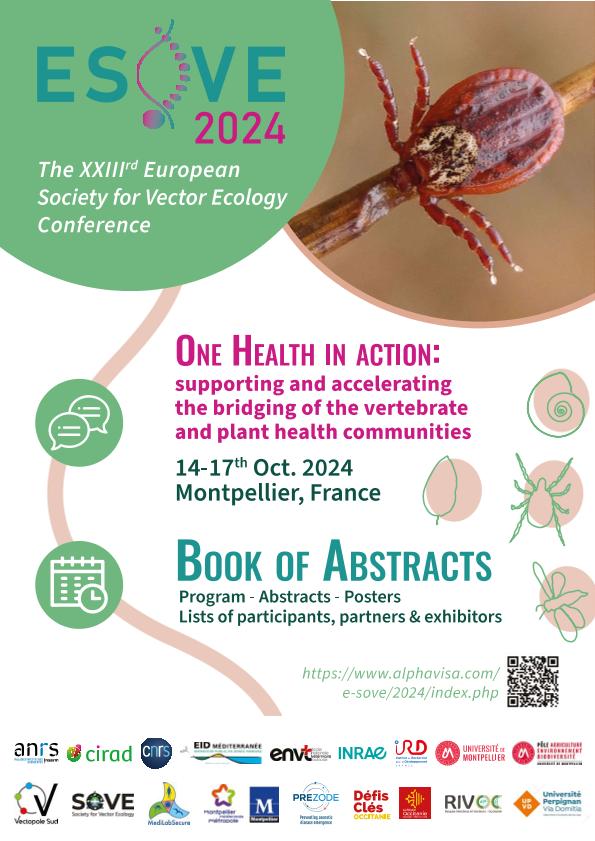
23rd European Society 46 for Vector Ecology Conference
Fecha del evento:
14/10/2024
Institución Organizadora:
Vectopole Sud;
Society for Vector Ecology;
Título de la revista:
3rd European Society 46 for Vector Ecology Conference
Editorial:
Vectopole Sud
Idioma:
Inglés
Clasificación temática:
Resumen
Biological invasions have the potential to foster the emergence of diseases, either through geographic spread or adaptive evolution. In the Western Mediterranean basin, two non-native snails have been introduced: the American Pseudosuccinea columella, to Aquitania and Corsica (France), and the Asian Orientogalba viridis, to Spanish Catalunya. Both play significant roles in transmitting the liver fluke Fasciola hepatica (Trematoda) elsewhere. This zoonotic emerging parasite circulates endemically in Europe within livestock, facilitated by a single vector species, the local snail Galba truncatula. Here, we aim to address four crucial questions: (i) Have the introduced exotic snails established and spread throughout the region? (ii) What are their ecological patterns in comparison to the local vector snail? (iii)What is their population genetic structure, and what is their history of invasion? (iv) Are they compatible with and capable of transmitting local parasites? Spatial surveys conducted within the Catalunya/Occitania region, alongside field ecology, were complemented with COI sequencing, microsatellite genotyping, and trematode metabarcoding analyses. Furthermore, laboratory populations were established to evaluate experimental compatibility with local parasites. The successful establishment of a COI haplotype of O. viridis, closely related to a Malaysian haplotype, is patented within the Ebro delta. Of particular concern is the spread of the globally invasive genotype of P. columella, known for its high compatibility with F. hepatica, in Occitania. This spread is primarily associated with hydrographic systems connected to the Canal Latéral de la Garonne/Canal du Midi. However, multiple introduction events may have occurred, as populations of these species are also documented in distant and non-connected artificial habitats, suggesting the existence of high propagule pressures. Both species exhibited high compatibility with local isolates of F. hepatica (70-100%). This comprehensive study provides a thorough overview of the invasion history and the associated risks of parasite transmission in the region driven by these exotic snails.
Archivos asociados

Tamaño:
9.640Mb
Formato:
PDF
Licencia
 Excepto donde se diga explícitamente, este item se publica bajo la siguiente descripción:
Creative Commons Attribution-NonCommercial-ShareAlike 2.5 Unported (CC BY-NC-SA 2.5)
Excepto donde se diga explícitamente, este item se publica bajo la siguiente descripción:
Creative Commons Attribution-NonCommercial-ShareAlike 2.5 Unported (CC BY-NC-SA 2.5)
Identificadores
Colecciones
Eventos(CERZOS)
Eventos de CENTRO REC.NAT.RENOVABLES DE ZONA SEMIARIDA(I)
Eventos de CENTRO REC.NAT.RENOVABLES DE ZONA SEMIARIDA(I)
Citación
Alien lymnaeid snails in the Western Mediterranean basin: new invaders and trematode-transmitters in the region?; 23rd European Society 46 for Vector Ecology Conference; Montpellier; Francia; 2024; 46-46
Compartir

