Artículo
Radiation Chemical Studies of Methionine in Aqueous Solution: Understanding the Role of Molecular Oxygen

Fecha de publicación:
12/2010
Editorial:
American Chemical Society
Revista:
Chemical Research In Toxicology (Washington)
ISSN:
0893-228X
Idioma:
Inglés
Tipo de recurso:
Artículo publicado
Clasificación temática:
Resumen
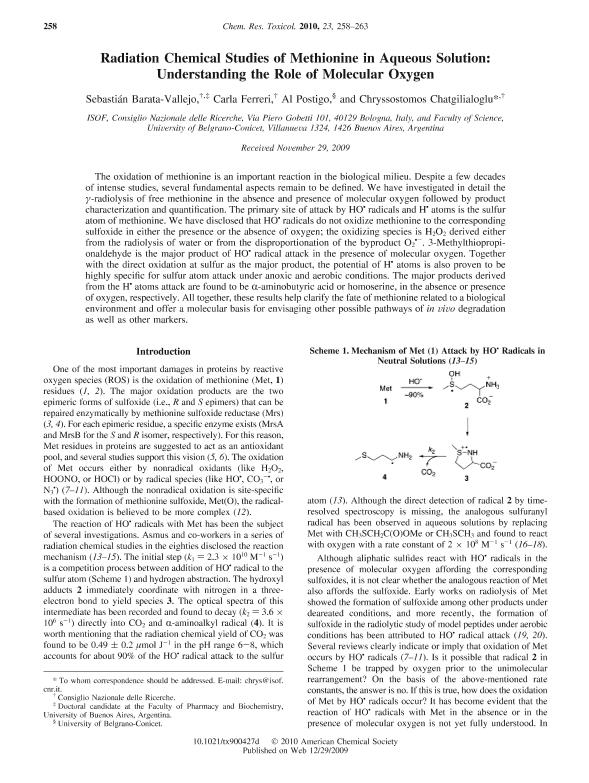
The oxidation of methionine is an important reaction in the biological milieu. Despite a few decades of intense studies, several fundamental aspects remain to be defined. We have investigated in detail the γ-radiolysis of free methionine in the absence and presence of molecular oxygen followed by product characterization and quantification. The primary site of attack by HO• radicals and H• atoms is the sulfur atom of methionine. We have disclosed that HO• radicals do not oxidize methionine to the corresponding sulfoxide in either the presence or the absence of oxygen; the oxidizing species is H2O2 derived either from the radiolysis of water or from the disproportionation of the byproduct O2•−. 3-Methylthiopropionaldehyde is the major product of HO• radical attack in the presence of molecular oxygen. Together with the direct oxidation at sulfur as the major product, the potential of H• atoms is also proven to be highly specific for sulfur atom attack under anoxic and aerobic conditions. The major products derived from the H• atoms attack are found to be α-aminobutyric acid or homoserine, in the absence or presence of oxygen, respectively. All together, these results help clarify the fate of methionine related to a biological environment and offer a molecular basis for envisaging other possible pathways of in vivo degradation as well as other markers.
Archivos asociados

Tamaño:
731.2Kb
Formato:
PDF
Licencia
 Excepto donde se diga explícitamente, este item se publica bajo la siguiente descripción:
Creative Commons Attribution-NonCommercial-ShareAlike 2.5 Unported (CC BY-NC-SA 2.5)
Excepto donde se diga explícitamente, este item se publica bajo la siguiente descripción:
Creative Commons Attribution-NonCommercial-ShareAlike 2.5 Unported (CC BY-NC-SA 2.5)
Identificadores
Colecciones
Articulos(OCA CIUDAD UNIVERSITARIA)
Articulos de OFICINA DE COORDINACION ADMINISTRATIVA CIUDAD UNIVERSITARIA
Articulos de OFICINA DE COORDINACION ADMINISTRATIVA CIUDAD UNIVERSITARIA
Citación
Barata Vallejo, Sebastian; Ferreri, Carla; Postigo, Jose Alberto; Chatgilialoglu, Chryssostomos; Radiation Chemical Studies of Methionine in Aqueous Solution: Understanding the Role of Molecular Oxygen; American Chemical Society; Chemical Research In Toxicology (Washington); 23; 1; 12-2010; 258-263
Compartir


Altmétricas