Mostrar el registro sencillo del ítem
dc.contributor.author
Moreno Gomez, Mario Fredy
dc.contributor.author
Gonzalez Oliver, Carlos Julian R.
dc.date.available
2026-01-12T13:07:29Z
dc.date.issued
2006-12
dc.identifier.citation
Moreno Gomez, Mario Fredy; Gonzalez Oliver, Carlos Julian R.; Compression creep of PM aluminum matrix composites reinforced with SiC short fibres; Elsevier Science SA; Materials Science and Engineering A: Structural Materials: Properties, Microstructure and Processing; 418; 1-2; 12-2006; 172-181
dc.identifier.issn
0921-5093
dc.identifier.uri
http://hdl.handle.net/11336/279245
dc.description.abstract
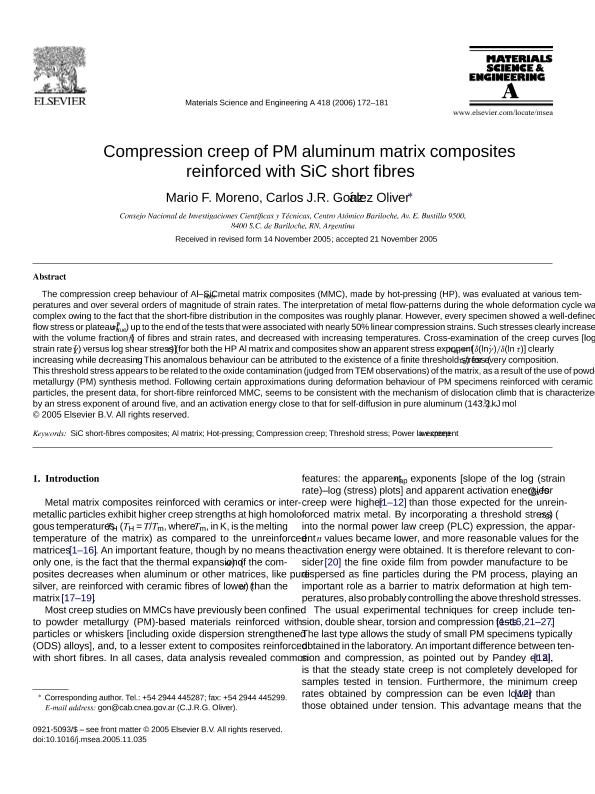
The compression creep behaviour of Al–SiCfiber metal matrix composites (MMC), made by hot-pressing (HP), was evaluated at various temperatures and over several orders of magnitude of strain rates. The interpretation of metal flow-patterns during the whole deformation cycle was complex owing to the fact that the short-fibre distribution in the composites was roughly planar. However, every specimen showed a well-defined flow stress or plateau (σp true) up to the end of the tests that were associated with nearly 50% linear compression strains. Such stresses clearly increased with the volume fraction (f) of fibres and strain rates, and decreased with increasing temperatures. Cross-examination of the creep curves [log strain rate (γ˙) versus log shear stress (τ)] for both the HP Al matrix and composites show an apparent stress exponent nap = [δ(lnγ˙)/δ(ln τ)] clearly increasing while decreasing τ. This anomalous behaviour can be attributed to the existence of a finite threshold stress (τ0) for every composition. This threshold stress appears to be related to the oxide contamination (judged from TEM observations) of the matrix, as a result of the use of powder metallurgy (PM) synthesis method. Following certain approximations during deformation behaviour of PM specimens reinforced with ceramic particles, the present data, for short-fibre reinforced MMC, seems to be consistent with the mechanism of dislocation climb that is characterized by an stress exponent of around five, and an activation energy close to that for self-diffusion in pure aluminum (143.2 kJ mol−1).
dc.format
application/pdf
dc.language.iso
eng
dc.publisher
Elsevier Science SA
dc.rights
info:eu-repo/semantics/openAccess
dc.rights.uri
https://creativecommons.org/licenses/by-nc-sa/2.5/ar/
dc.subject
SiC short-fibres composites
dc.subject
Al matrix
dc.subject
Hot-pressing
dc.subject
Compression creep
dc.subject
Threshold stress
dc.subject
Power law creep n exponent
dc.subject.classification
Física de los Materiales Condensados
dc.subject.classification
Ciencias Físicas
dc.subject.classification
CIENCIAS NATURALES Y EXACTAS
dc.title
Compression creep of PM aluminum matrix composites reinforced with SiC short fibres
dc.type
info:eu-repo/semantics/article
dc.type
info:ar-repo/semantics/artículo
dc.type
info:eu-repo/semantics/publishedVersion
dc.date.updated
2026-01-12T11:56:35Z
dc.journal.volume
418
dc.journal.number
1-2
dc.journal.pagination
172-181
dc.journal.pais
Países Bajos
dc.journal.ciudad
Amsterdam
dc.description.fil
Fil: Moreno Gomez, Mario Fredy. Comisión Nacional de Energía Atómica. Centro Atómico Bariloche; Argentina. Consejo Nacional de Investigaciones Científicas y Técnicas. Centro Científico Tecnológico Conicet - Patagonia Norte; Argentina
dc.description.fil
Fil: Gonzalez Oliver, Carlos Julian R.. Comisión Nacional de Energía Atómica. Centro Atómico Bariloche; Argentina. Consejo Nacional de Investigaciones Científicas y Técnicas. Centro Científico Tecnológico Conicet - Patagonia Norte; Argentina
dc.journal.title
Materials Science and Engineering A: Structural Materials: Properties, Microstructure and Processing
dc.relation.alternativeid
info:eu-repo/semantics/altIdentifier/url/https://www.sciencedirect.com/science/article/abs/pii/S0921509305014577
dc.relation.alternativeid
info:eu-repo/semantics/altIdentifier/doi/http://dx.doi.org/10.1016/j.msea.2005.11.035
Archivos asociados

Tamaño:
501Kb
Formato:
PDF