Artículo
Desde su origen mitológico, el eco –figura que alude al nombre de la ninfa que repite las últimas palabras pronunciadas por Narciso–, constituye un procedimiento privilegiado del lenguaje poético: estribillos, aliteraciones, anáforas, quiasmos y otras tantas figuras de la repetición revelan la cadencia iterativa –y, por ende, diferencial– de la enunciación poética. A partir de la noción de “voz ecolálica”, este trabajo propone introducir una modulación del sujeto del poema. La lectura crítica de El eco de mi madre (2010) de Tamara Kamenszain y de los estribillos de sus últimos libros, en diálogo con dos interpretaciones contemporáneas del mito de Eco (de Anne-Emmanuelle Berger [1996] y Erik Porge [2012]), nos permitirán explorar la dimensión ecolálica del sujeto del poema de acuerdo con tres ejes: (1) la temporalidad diferencial, entendida como repetición alterante; (2) la diferencia sexual, en tanto Eco se erige como contrapunto del mito de Narciso; y (3) la dimensión ética, en la medida en que el eco incorpora la voz del otrx en el acto poético. En última instancia, se trata de indagar la voz ecolálica como redefinición de la subjetividad lírica en tanto espacio de resonancia y alteridad. Since its mythological origin, the echo —a figure that alludes to the name of the nymph who repeats the last words spoken by Narcissus— has been a privileged device in poetic language: refrains, alliterations, anaphora, chiasms, and many other figures of repetition reveal the iterative —and, therefore, differential— cadence of poetic enunciation. Based on the notion of the “echolalic voice”, this work proposes to introduce a modulation of the subject of the poem. A critical reading of Tamara Kamenszain's El eco de mi madre (2010) and the refrains in her latest books, in dialogue with two contemporary interpretations of the myth of Echo (by Anne-Emmanuelle Berger [1996] and Erik Porge [2012]), will allow us to explore the echolalic dimension of the subject of the poem according to three axes: (1) differential temporality, understood as altering repetition; (2) sexual difference, insofar as Echo stands as a counterpoint to the myth of Narcissus; and (3) the ethical dimension, as the echo incorporates the voice of the other in the poetic act. Ultimately, the aim is to investigate the echolalic voice as a redefinition of lyrical subjectivity as a space of resonance and otherness.
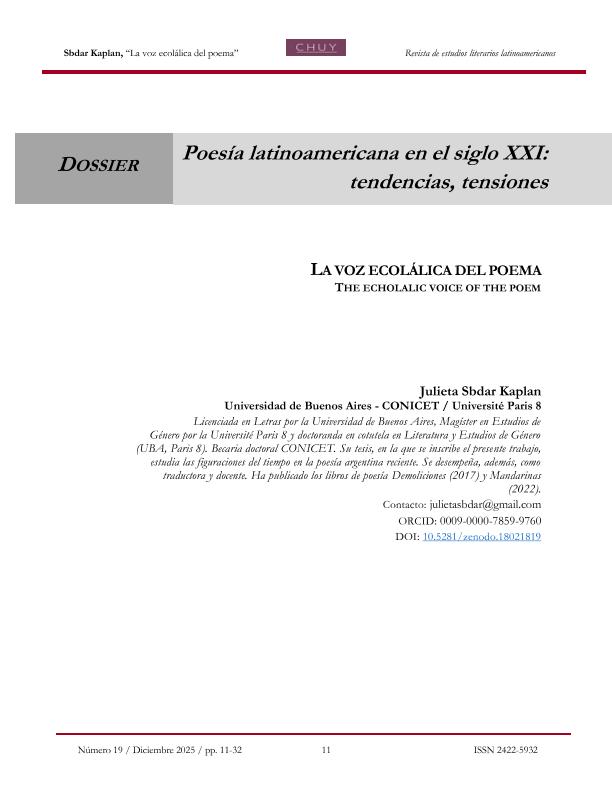
La voz ecolálica del poema
Título:
The echolalic voice of the poem

Fecha de publicación:
12/2025
Editorial:
Universidad Nacional Tres de Febrero
Revista:
Chuy
ISSN:
2422-5932
Idioma:
Español
Tipo de recurso:
Artículo publicado
Clasificación temática:
Resumen
Palabras clave:
Eco
,
Voz
,
Sujeto
,
Temporalidad
Archivos asociados

Tamaño:
391.8Kb
Formato:
PDF
Licencia
 Excepto donde se diga explícitamente, este item se publica bajo la siguiente descripción:
Creative Commons Attribution-NonCommercial-ShareAlike 2.5 Unported (CC BY-NC-SA 2.5)
Excepto donde se diga explícitamente, este item se publica bajo la siguiente descripción:
Creative Commons Attribution-NonCommercial-ShareAlike 2.5 Unported (CC BY-NC-SA 2.5)
Identificadores
Colecciones
Articulos(SEDE CENTRAL)
Articulos de SEDE CENTRAL
Articulos de SEDE CENTRAL
Citación
Sbdar Kaplan, Julieta; La voz ecolálica del poema; Universidad Nacional Tres de Febrero; Chuy; 12; 19; 12-2025; 11-32
Compartir

