Artículo
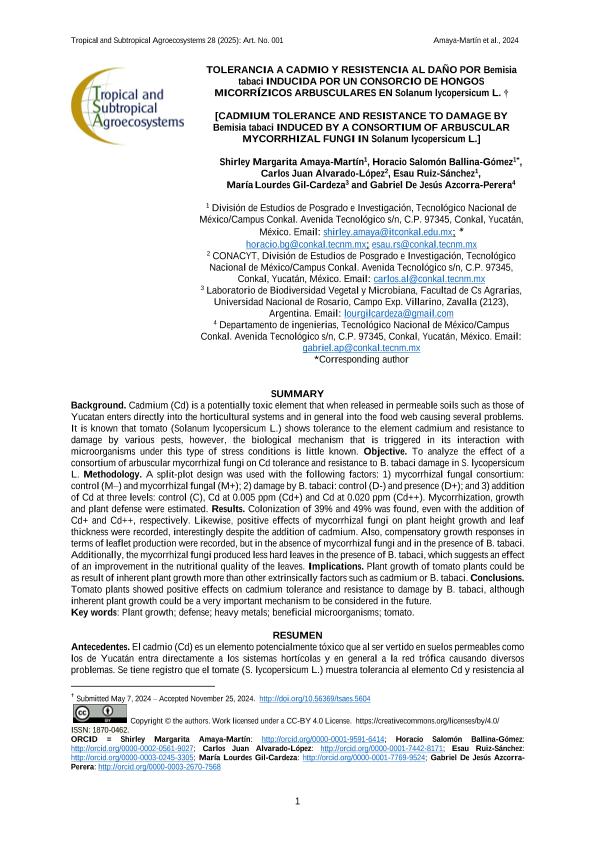
Antecedentes. El cadmio (Cd) es un elemento potencialmente tóxico que al ser vertido en suelos permeables como los de Yucatán entra directamente a los sistemas hortícolas y en general a la red trófica causando diversos problemas. Se tiene registro que el tomate (S. lycopersicum L.) muestra tolerancia al elemento Cd y resistencia al daño a diversas plagas, sin embargo, es poco conocido el mecanismo biológico que se desencadena en su interacción con microorganismos en condiciones de estrés. Objetivo. Analizar el efecto de un consorcio de hongos micorrízicos arbusculares en la tolerancia a Cd y resistencia al daño por Bemisia tabaci en S. lycopersicum L. Metodología. Se usó un diseño de parcelas sub-divididas con los siguientes factores: 1) consorcio de hongos micorrízicos: control (M–) y hongo micorrízico (M+); 2) daño por B. tabaci: control (D-) y daño (D+); y, 3) adición de Cd a tres niveles: control (C), Cd a 0.005 ppm (Cd+) y Cd a 0.020 ppm (Cd++). Se estimó la micorrización, crecimiento y defensa vegetal. Resultados. Se encontró una colonización de un 39% y 49%, aún con la adición de Cd+ y Cd++, respectivamente. Asimismo, se registraron efectos positivos de los hongos micorrízicos sobre el crecimiento en altura de las plantas y en el grosor foliar, interesantemente a pesar de la adición de Cd. También, se registraron respuestas de crecimiento compensatorio en términos de producción de foliolos, pero en ausencia de hongos micorrízicos y en presencia de B. tabaci. Adicionalmente, los hongos micorrízicos produjeron hojas menos duras en presencia de B. tabaci, lo que sugiere un efecto de una mejora en la calidad nutricional de las hojas. Implicaciones. El crecimiento de tomate podría deberse más al crecimiento inherente de la planta que a otros factores extrínsecos como el Cd o B. tabaci. Conclusiones. Las plantas de tomate mostraron efectos positivos sobre la tolerancia al Cd y la resistencia al daño de B. tabaci, aunque el crecimiento inherente de la planta podría ser un mecanismo muy importante a considerar en el futuro. Background. Cadmium (Cd) is a potentially toxic element that when released in permeable soils such as those of Yucatan enters directly into the horticultural systems and in general into the food web causing several problems. It is known that tomato (Solanum lycopersicum L.) shows tolerance to the element cadmium and resistance to damage by various pests, however, the biological mechanism that is triggered in its interaction with microorganisms under this type of stress conditions is little known. Objective. To analyze the effect of a consortium of arbuscular mycorrhizal fungi on Cd tolerance and resistance to B. tabaci damage in S. lycopersicum L. Methodology. A split-plot design was used with the following factors: 1) mycorrhizal fungal consortium: control (M–) and mycorrhizal fungal (M+); 2) damage by B. tabaci: control (D-) and presence (D+); and 3) addition of Cd at three levels: control (C), Cd at 0.005 ppm (Cd+) and Cd at 0.020 ppm (Cd++). Mycorrhization, growth and plant defense were estimated. Results. Colonization of 39% and 49% was found, even with the addition of Cd+ and Cd++, respectively. Likewise, positive effects of mycorrhizal fungi on plant height growth and leaf thickness were recorded, interestingly despite the addition of cadmium. Also, compensatory growth responses in terms of leaflet production were recorded, but in the absence of mycorrhizal fungi and in the presence of B. tabaci. Additionally, the mycorrhizal fungi produced less hard leaves in the presence of B. tabaci, which suggests an effect of an improvement in the nutritional quality of the leaves. Implications. Plant growth of tomato plants could be as result of inherent plant growth more than other extrinsically factors such as cadmium or B. tabaci. Conclusions. Tomato plants showed positive effects on cadmium tolerance and resistance to damage by B. tabaci, although inherent plant growth could be a very important mechanism to be considered in the future.
Tolerancia a Cadmio y resistencia al daño por Bemisia Tabaci inducida por un consorcio de hongos micorrízicos arbusculares en Solanum Lycopersicum l.
Título:
Cadmium tolerance and resistance to damage by Bemisia Tabaci induced by a consortium of arbuscular mycorrhizal fungi in Solanum Lycopersicum l.
Amaya Martin, Shirley Margarita; Ballina Gomez, Horacio Salomón; Alvarado López, Carlos Juan; Ruiz Sánchez, Esau; Gil Cardeza, Maria Lourdes ; Azcorra Perera, Gabriel De Jesús
; Azcorra Perera, Gabriel De Jesús
Fecha de publicación:
01/2025
Editorial:
Universidad Autónoma de Yucatán
Revista:
Tropical and Subtropical Agroecosystems
ISSN:
1870-0462
Idioma:
Español
Tipo de recurso:
Artículo publicado
Clasificación temática:
Resumen
Palabras clave:
CRECIMIENTO VEGETAL
,
DEFENSA
,
METALES PESADOS
,
MICROORGANISMOS BENÉFICOS
,
TOMATE
Archivos asociados

Tamaño:
730.7Kb
Formato:
PDF
Licencia
 Excepto donde se diga explícitamente, este item se publica bajo la siguiente descripción:
Creative Commons Attribution 2.5 Unported (CC BY 2.5)
Excepto donde se diga explícitamente, este item se publica bajo la siguiente descripción:
Creative Commons Attribution 2.5 Unported (CC BY 2.5)
Identificadores
Colecciones
Articulos(CCT - ROSARIO)
Articulos de CTRO.CIENTIFICO TECNOL.CONICET - ROSARIO
Articulos de CTRO.CIENTIFICO TECNOL.CONICET - ROSARIO
Articulos(IICAR)
Articulos de INST. DE INVESTIGACIONES EN CIENCIAS AGRARIAS DE ROSARIO
Articulos de INST. DE INVESTIGACIONES EN CIENCIAS AGRARIAS DE ROSARIO
Citación
Amaya Martin, Shirley Margarita; Ballina Gomez, Horacio Salomón; Alvarado López, Carlos Juan; Ruiz Sánchez, Esau; Gil Cardeza, Maria Lourdes; et al.; Tolerancia a Cadmio y resistencia al daño por Bemisia Tabaci inducida por un consorcio de hongos micorrízicos arbusculares en Solanum Lycopersicum l. ; Universidad Autónoma de Yucatán; Tropical and Subtropical Agroecosystems; 28; 1; 1-2025; 1-12
Compartir


Altmétricas