Artículo
Relationship between neurocognitive functioning and episode recurrences in bipolar disorder
Martino, Diego Javier ; Strejilevich, Sergio; Marengo, Eliana
; Igoa, Ana; Fassi, Guillermo; Teitelbaum, Julia; Caravotta, Pablo Gastón
; Strejilevich, Sergio; Marengo, Eliana
; Igoa, Ana; Fassi, Guillermo; Teitelbaum, Julia; Caravotta, Pablo Gastón
; Strejilevich, Sergio; Marengo, Eliana
; Igoa, Ana; Fassi, Guillermo; Teitelbaum, Julia; Caravotta, Pablo Gastón
Fecha de publicación:
12/2012
Editorial:
Elsevier Science
Revista:
Journal of Affective Disorders
ISSN:
0165-0327
Idioma:
Inglés
Tipo de recurso:
Artículo publicado
Clasificación temática:
Resumen
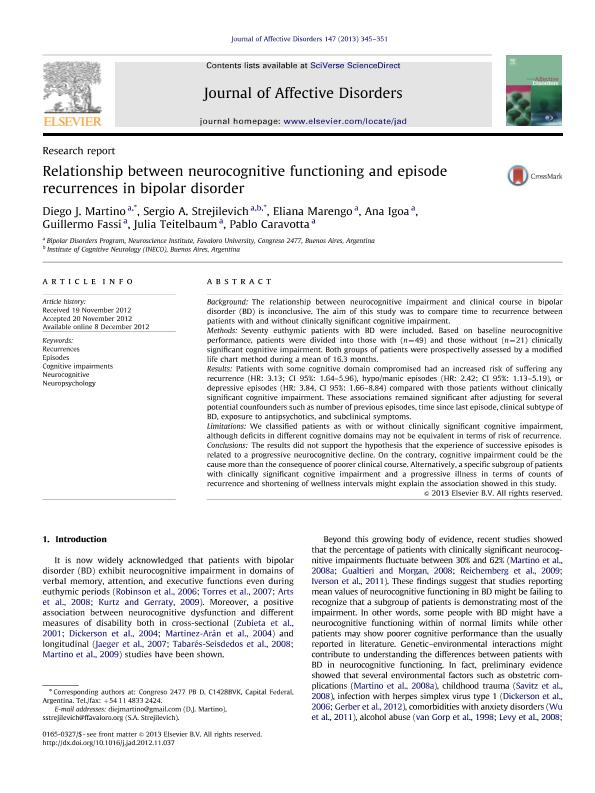
Background: The relationship between neurocognitive impairments and clinical course in bipolar disorder (BD) is inconclusive. The aim of this study was to compare time to recurrence between patients with and without clinically significant cognitive impairments. Methods: Seventy euthymic patients with BD were included. Based on baseline neurocognitive performance patients were divided as those with (n=49) and without (n=21) clinically significant cognitive impairments. Both groups of patients were prospectivelly assessed by a modified life chart method during a mean of 16.3 months. Results: Patients with some cognitive domain compromised had an increased risk of suffering any recurrence (HR: 3.13; CI95%: 1.64-5.96), hypo/mainc episodes (HR2.42; CI95%:1.13-5.19), or depressive episodes (HR; 3.84; CI95%: 1.66-8.84) compared with those patients without clinically significant cognitive impairments. These associations remained significant after adjust for several potential counfounders such as number of previous episodes, time since last episode, clinical subtype of BD, exposure to antipsychotics, and subclinical symptoms. Limitations: We clasified patients as with or without clinically significant cognitive impairments, although deficits in different cognitive domains may not be equivalent in terms of risk of recurrence. Conclusions: The results did not support the hypothesis that the experience of successive episodes is related to a progressive neurocognitive decline. Contrarily, cognitive impairments could be the cause more than the consequence of poorer clinical course. Alternativelly, a specific subgroup of patients with clinically significant cognitive impairments and a progressive illness in terms of counts of recurrences, and shortening of wellness intervals might explain the association showed in this study.
Palabras clave:
RECURRENCES
,
EPISODES
,
COGNITIVE IMPAIRMENTS
,
NEUROCOGNITIVE
Archivos asociados

Tamaño:
286.9Kb
Formato:
PDF
Licencia
 Excepto donde se diga explícitamente, este item se publica bajo la siguiente descripción:
Creative Commons Attribution-NonCommercial-ShareAlike 2.5 Unported (CC BY-NC-SA 2.5)
Excepto donde se diga explícitamente, este item se publica bajo la siguiente descripción:
Creative Commons Attribution-NonCommercial-ShareAlike 2.5 Unported (CC BY-NC-SA 2.5)
Identificadores
Colecciones
Articulos(SEDE CENTRAL)
Articulos de SEDE CENTRAL
Articulos de SEDE CENTRAL
Citación
Martino, Diego Javier; Strejilevich, Sergio; Marengo, Eliana; Igoa, Ana; Fassi, Guillermo; et al.; Relationship between neurocognitive functioning and episode recurrences in bipolar disorder; Elsevier Science; Journal of Affective Disorders; 147; 1-3; 12-2012; 345-351
Compartir


Altmétricas