Artículo
Antibacterial activity of recombinant endolysin LysNOVA-I against growing/non-growing and planktonic/biofilm cultures of Staphylococcus aureus strains
Rivero, Carla Ivanna ; Martínez, Melina María Belén
; Picinin, Nicole G.; Martins, Eduardo G.; Paolazzi, Claudio Carlos; Capozzo, Alejandra Victoria
; da Silva Oliveira, Denise; Becerra, Johana; dos Santos, Benedito M.; de Freitas Junior, Lucio H.G.; Balan, Andrea; Lincopan, Nilton; Ferreira, Rita de Cassia Café; de Souza Ferreira, Luis Carlos; Bentancor, Leticia Verónica
; Martínez, Melina María Belén
; Picinin, Nicole G.; Martins, Eduardo G.; Paolazzi, Claudio Carlos; Capozzo, Alejandra Victoria
; da Silva Oliveira, Denise; Becerra, Johana; dos Santos, Benedito M.; de Freitas Junior, Lucio H.G.; Balan, Andrea; Lincopan, Nilton; Ferreira, Rita de Cassia Café; de Souza Ferreira, Luis Carlos; Bentancor, Leticia Verónica
; Martínez, Melina María Belén
; Picinin, Nicole G.; Martins, Eduardo G.; Paolazzi, Claudio Carlos; Capozzo, Alejandra Victoria
; da Silva Oliveira, Denise; Becerra, Johana; dos Santos, Benedito M.; de Freitas Junior, Lucio H.G.; Balan, Andrea; Lincopan, Nilton; Ferreira, Rita de Cassia Café; de Souza Ferreira, Luis Carlos; Bentancor, Leticia Verónica
Fecha de publicación:
01/2026
Editorial:
Elsevier
Revista:
Journal of Global Antimicrobial Resistance
ISSN:
2213-7165
Idioma:
Inglés
Tipo de recurso:
Artículo publicado
Clasificación temática:
Resumen
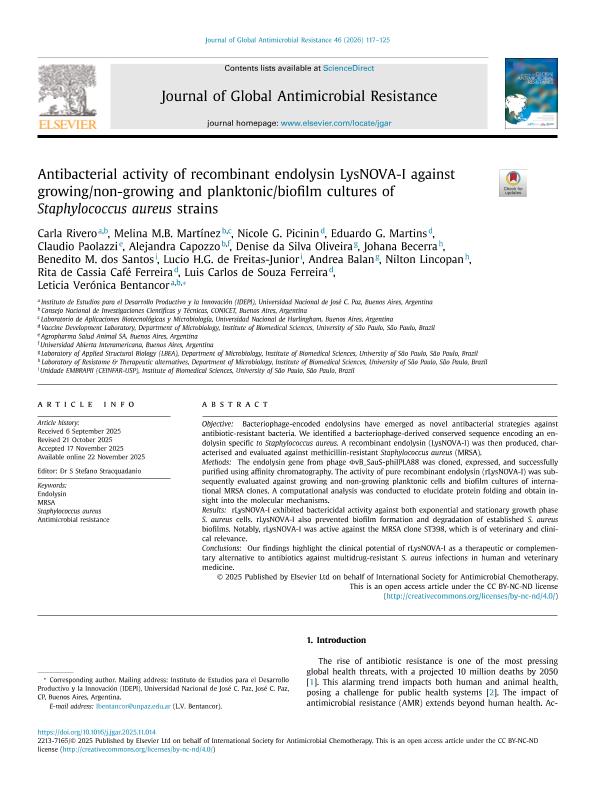
Objective: Bacteriophage-encoded endolysins have emerged as novel antibacterial strategies against antibiotic-resistant bacteria. We identified a bacteriophage-derived conserved sequence encoding an endolysin specific to Staphylococcus aureus. A recombinant endolysin (LysNOVA-I) was then produced, characterised and evaluated against methicillin-resistant Staphylococcus aureus (MRSA). Methods: The endolysin gene from phage ФvB_SauS-phiIPLA88 was cloned, expressed, and successfully purified using affinity chromatography. The activity of pure recombinant endolysin (rLysNOVA-I) was subsequently evaluated against growing and non-growing planktonic cells and biofilm cultures of international MRSA clones. A computational analysis was conducted to elucidate protein folding and obtain insight into the molecular mechanisms. Results: rLysNOVA-I exhibited bactericidal activity against both exponential and stationary growth phase S. aureus cells. rLysNOVA-I also prevented biofilm formation and degradation of established S. aureus biofilms. Notably, rLysNOVA-I was active against the MRSA clone ST398, which is of veterinary and clinical relevance. Conclusions: Our findings highlight the clinical potential of rLysNOVA-I as a therapeutic or complementary alternative to antibiotics against multidrug-resistant S. aureus infections in human and veterinary medicine.
Palabras clave:
NEW ANTIMICROBIAL
,
MULTIDRUG RESISTANT BACTERIA
,
BIOLFILM
,
PLANKTONIC CELLS
Archivos asociados

Tamaño:
2.204Mb
Formato:
PDF
Licencia
 Excepto donde se diga explícitamente, este item se publica bajo la siguiente descripción:
Atribución-NoComercial-SinDerivadas 2.5 Argentina (CC BY-NC-ND 2.5 AR)
Excepto donde se diga explícitamente, este item se publica bajo la siguiente descripción:
Atribución-NoComercial-SinDerivadas 2.5 Argentina (CC BY-NC-ND 2.5 AR)
Identificadores
Colecciones
Articulos(SEDE CENTRAL)
Articulos de SEDE CENTRAL
Articulos de SEDE CENTRAL
Citación
Rivero, Carla Ivanna; Martínez, Melina María Belén; Picinin, Nicole G.; Martins, Eduardo G.; Paolazzi, Claudio Carlos; et al.; Antibacterial activity of recombinant endolysin LysNOVA-I against growing/non-growing and planktonic/biofilm cultures of Staphylococcus aureus strains; Elsevier; Journal of Global Antimicrobial Resistance; 46; 1-2026; 117-125
Compartir


Altmétricas