Artículo
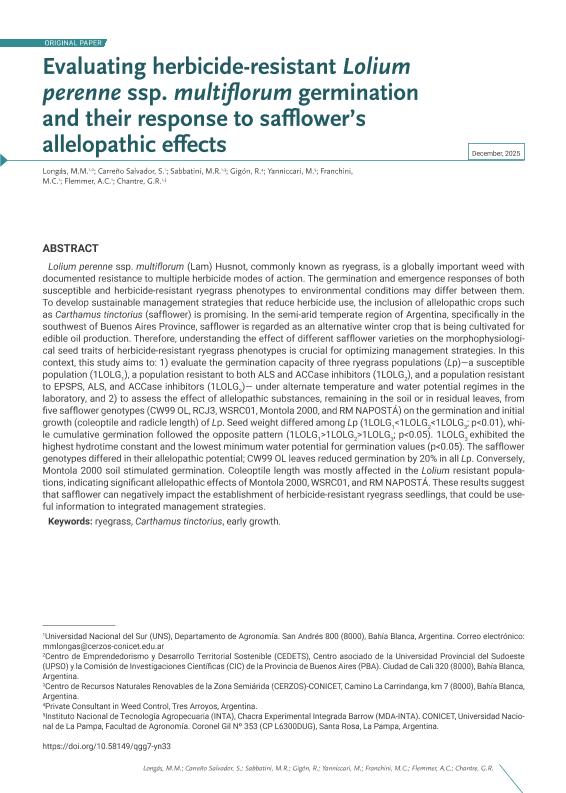
Lolium perenne ssp. multiflorum (Lam) Husnot, commonly known as ryegrass, is a globally important weed with documented resistance to multiple herbicide modes of action. The germination and emergence responses of both susceptible and herbicide-resistant ryegrass phenotypes to environmental conditions may differ between them. To develop sustainable management strategies that reduce herbicide use, the inclusion of allelopathic crops such as Carthamus tinctorius (safflower) is promising. In the semi-arid temperate region of Argentina, specifically in the southwest of Buenos Aires Province, safflower is regarded as an alternative winter crop that is being cultivated for edible oil production. Therefore, understanding the effect of different safflower varieties on the morphophysiological seed traits of herbicide-resistant ryegrass phenotypes is crucial for optimizing management strategies. In this context, this study aims to: 1) evaluate the germination capacity of three ryegrass populations (Lp)—a susceptible population (1LOLG1), a population resistant to both ALS and ACCase inhibitors (1LOLG2), and a population resistant to EPSPS, ALS, and ACCase inhibitors (1LOLG3)— under alternate temperature and water potential regimes in the laboratory, and 2) to assess the effect of allelopathic substances, remaining in the soil or in residual leaves, from five safflower genotypes (CW99 OL, RCJ3, WSRC01, Montola 2000, and RM NAPOSTÁ) on the germination and initial growth (coleoptile and radicle length) of Lp. Seed weight differed among Lp (1LOLG1<1LOLG2<1LOLG3; p<0.01), while cumulative germination followed the opposite pattern (1LOLG1>1LOLG2>1LOLG3; p<0.05). 1LOLG3 exhibited the highest hydrotime constant and the lowest minimum water potential for germination values (p<0.05). The safflower genotypes differed in their allelopathic potential; CW99 OL leaves reduced germination by 20% in all Lp. Conversely, Montola 2000 soil stimulated germination. Coleoptile length was mostly affected in the Lolium resistant populations, indicating significant allelopathic effects of Montola 2000, WSRC01, and RM NAPOSTÁ. These results suggest that safflower can negatively impact the establishment of herbicide-resistant ryegrass seedlings, that could be useful information to integrated management strategies. Lolium perenne ssp. multiflorum (Lam) Husnot, comúnmente conocido como raigrás, es una maleza de importancia mundial con resistencia documentada a múltiples modos de acción de herbicidas. Las respuestas de germinación y emergencia de los fenotipos de raigrás susceptibles y resistentes a herbicidas pueden diferir entre sí. Para desarrollar estrategias de manejo sostenibles que reduzcan el uso de fitosanitarios sintéticos, la inclusión de cultivos alelopáticos como Carthamus tinctorius (cártamo) es prometedora. En la región templada semiárida de Argentina, concretamente en el sudoeste de la provincia de Buenos Aires, el cártamo se considera un cultivo alternativo de invierno que se cultiva para la producción de aceite comestible. Por lo tanto, comprender el efecto de las diferentes variedades de cártamo sobre atributos morfofisiológicos de las semillas de los fenotipos de raigrás resistentes a herbicidas es fundamental para optimizar las estrategias de manejo. En este contexto, el objetivo de este estudio es: 1) evaluar la capacidad de germinación de tres poblaciones de raigrás (Lp) —una población susceptible (1LOLG1), una población resistente a los inhibidores de ALS y ACCasa (1LOLG2) y una población resistente a los inhibidores de EPSPS, ALS y ACCasa (1LOLG3)— bajo temperaturas alternas y un gradiente de potenciales hídricos en laboratorio, y 2) evaluar el efecto de las sustancias alelopáticas, que permanecen en el suelo o en las hojas, de cinco genotipos de cártamo (CW99 OL, RCJ3, WSRC01, Montola 2000 y RM NAPOSTÁ) sobre la germinación y el crecimiento inicial (coleóptilo y longitud de radícula) de Lp. El peso de las semillas difirió entre Lp (1LOLG1<1LOLG2<1LOLG3; p < 0,01), mientras que la germinación acumulada siguió el patrón opuesto (1LOLG1>1LOLG2>1LOLG3; p < 0,05). 1LOLG3 exhibió la constante de hidro tiempo más alta y el menor potencial agua base medio (p < 0,05). Los genotipos de cártamo difirieron en su potencial alelopático; las hojas de CW99 OL redujeron la germinación en un 20% en todos los Lp. Por el contrario, el suelo de Montola 2000 estimuló la germinación. La longitud del coleóptilo fue afectada principalmente en las poblaciones resistentes de Lolium, lo que indica efectos alelopáticos significativos de Montola 2000, WSRC01 y RM NAPOSTÁ. Estos resultados sugieren que el cártamo puede tener un impacto negativo en el establecimiento de plántulas de raigrás resistentes a herbicidas, lo que podría ser de utilidad al implementar estrategias de manejo integrado de malezas.
Evaluating herbicide-resistant Lolium perenne ssp. multiflorum germination and their response to safflower’s allelopathic effects
Longás, María de Las Mercedes ; Carreño, Santiago S.; Sabbatini, Mario Ricardo
; Gigón, Ramón; Yanniccari, Marcos Ezequiel
; Franchini, María Clara; Flemmer, Andrea Cecilia; Chantre Balacca, Guillermo Ruben
; Carreño, Santiago S.; Sabbatini, Mario Ricardo
; Gigón, Ramón; Yanniccari, Marcos Ezequiel
; Franchini, María Clara; Flemmer, Andrea Cecilia; Chantre Balacca, Guillermo Ruben
; Carreño, Santiago S.; Sabbatini, Mario Ricardo
; Gigón, Ramón; Yanniccari, Marcos Ezequiel
; Franchini, María Clara; Flemmer, Andrea Cecilia; Chantre Balacca, Guillermo Ruben
Fecha de publicación:
12/2025
Editorial:
Instituto Nacional de Tecnología Agropecuaria
Revista:
Revista de Investigaciones Agropecuarias
ISSN:
0325-8718
e-ISSN:
1669-2314
Idioma:
Inglés
Tipo de recurso:
Artículo publicado
Clasificación temática:
Resumen
Palabras clave:
RYEGRASS
,
CARTHAMUS TINCTORIOUS
,
EARLY GROWTH
Archivos asociados

Tamaño:
1002.Kb
Formato:
PDF
Licencia
 Excepto donde se diga explícitamente, este item se publica bajo la siguiente descripción:
Creative Commons Attribution-NonCommercial-ShareAlike 2.5 Unported (CC BY-NC-SA 2.5)
Excepto donde se diga explícitamente, este item se publica bajo la siguiente descripción:
Creative Commons Attribution-NonCommercial-ShareAlike 2.5 Unported (CC BY-NC-SA 2.5)
Identificadores
Colecciones
Articulos(CERZOS)
Articulos de CENTRO REC.NAT.RENOVABLES DE ZONA SEMIARIDA(I)
Articulos de CENTRO REC.NAT.RENOVABLES DE ZONA SEMIARIDA(I)
Citación
Longás, María de Las Mercedes; Carreño, Santiago S.; Sabbatini, Mario Ricardo; Gigón, Ramón; Yanniccari, Marcos Ezequiel; et al.; Evaluating herbicide-resistant Lolium perenne ssp. multiflorum germination and their response to safflower’s allelopathic effects; Instituto Nacional de Tecnología Agropecuaria; Revista de Investigaciones Agropecuarias; 51; 3; 12-2025; 140-151
Compartir


Altmétricas