Artículo
Carbon and nutrient release from anaerobic digestate solids applied as a soil amendment
Villarino, Sebastián Horacio ; Potter, S. W.; Hall, S. J.; Blauwet, M.; Miguez, F. E.; McDaniel, M. D.
; Potter, S. W.; Hall, S. J.; Blauwet, M.; Miguez, F. E.; McDaniel, M. D.
Fecha de publicación:
04/2025
Editorial:
Soil Science Society of America
Revista:
Soil Science Society of America Journal
ISSN:
0361-5995
Idioma:
Inglés
Tipo de recurso:
Artículo publicado
Clasificación temática:
Resumen
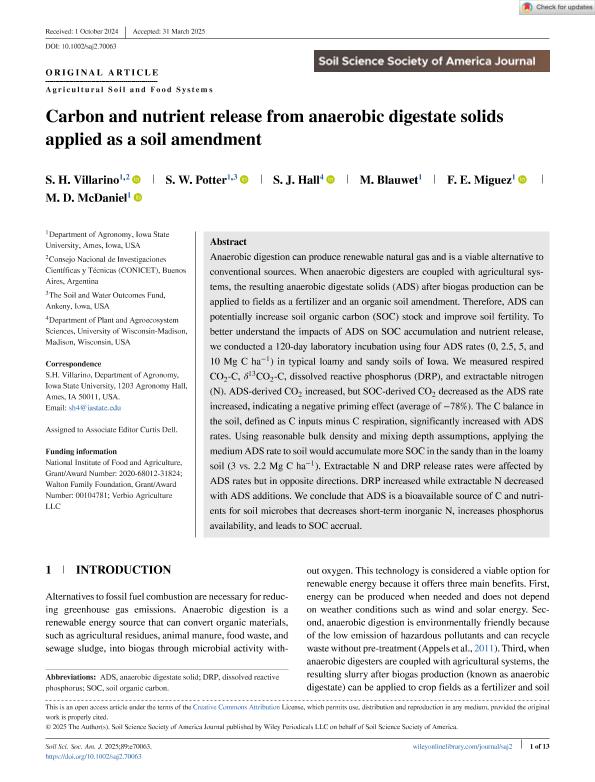
Anaerobic digestion can produce renewable natural gas and is a viable alternative to conventional sources. When anaerobic digesters are coupled with agricultural systems, the resulting anaerobic digestate solids (ADS) after biogas production can be applied to fields as a fertilizer and an organic soil amendment. Therefore, ADS can potentially increase soil organic carbon (SOC) stock and improve soil fertility. To better understand the impacts of ADS on SOC accumulation and nutrient release, we conducted a 120-day laboratory incubation using four ADS rates (0, 2.5, 5, and 10 Mg C ha-1) in typical loamy and sandy soils of Iowa. We measured respired CO2-C, δ13CO2-C, dissolved reactive phosphorus (DRP), and extractable nitrogen (N). ADS-derived CO2 increased, but SOC-derived CO2 decreased as the ADS rate increased, indicating a negative priming effect (average of -78%). The C balance in the soil, defined as C inputs minus C respiration, significantly increased with ADS rates. Using reasonable bulk density and mixing depth assumptions, applying the medium ADS rate to soil would accumulate more SOC in the sandy than in the loamy soil (3 vs. 2.2 Mg C ha-1). Extractable N and DRP release rates were affected by ADS rates but in opposite directions. DRP increased while extractable N decreased with ADS additions. We conclude that ADS is a bioavailable source of C and nutrients for soil microbes that decreases short-term inorganic N, increases phosphorus availability, and leads to SOC accrual.
Palabras clave:
SOIL ORGANIC MATTER
,
BIOGAS
,
ORGANIC AMENDMENT
Archivos asociados

Tamaño:
1016.Kb
Formato:
PDF
Licencia
 Excepto donde se diga explícitamente, este item se publica bajo la siguiente descripción:
Creative Commons Attribution-NonCommercial-ShareAlike 2.5 Unported (CC BY-NC-SA 2.5)
Excepto donde se diga explícitamente, este item se publica bajo la siguiente descripción:
Creative Commons Attribution-NonCommercial-ShareAlike 2.5 Unported (CC BY-NC-SA 2.5)
Identificadores
Colecciones
Articulos(CCT - MAR DEL PLATA)
Articulos de CTRO.CIENTIFICO TECNOL.CONICET - MAR DEL PLATA
Articulos de CTRO.CIENTIFICO TECNOL.CONICET - MAR DEL PLATA
Citación
Villarino, Sebastián Horacio; Potter, S. W.; Hall, S. J.; Blauwet, M.; Miguez, F. E.; et al.; Carbon and nutrient release from anaerobic digestate solids applied as a soil amendment; Soil Science Society of America; Soil Science Society of America Journal; 89; 2; 4-2025; 1-13
Compartir


Altmétricas