Mostrar el registro sencillo del ítem
dc.contributor.author
Entringer Júnior, Hilton
dc.contributor.author
Srbek Araujo, Ana Carolina
dc.date.available
2026-01-06T11:58:50Z
dc.date.issued
2025-12
dc.identifier.citation
Entringer Júnior, Hilton; Srbek Araujo, Ana Carolina; Trophic Duality: Taxonomic Segregation and Convergence in Prey Functional Traits Driving the Coexistence of Apex Predators; MDPI; Biology; 15; 1; 12-2025; 1-19
dc.identifier.issn
2079-7737
dc.identifier.uri
http://hdl.handle.net/11336/278793
dc.description.abstract
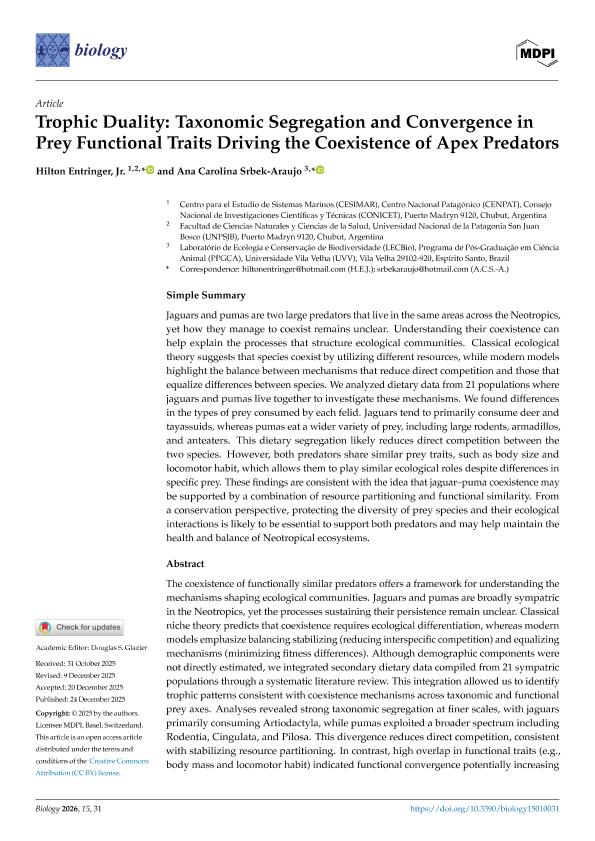
The coexistence of functionally similar predators offers a framework for understanding the mechanisms shaping ecological communities. Jaguars and pumas are broadly sympatric in the Neotropics, yet the processes sustaining their persistence remain unclear. Classical niche theory predicts that coexistence requires ecological differentiation, whereas modern models emphasize balancing stabilizing (reducing interspecific competition) and equalizing mechanisms (minimizing fitness differences). Although demographic components were not directly estimated, we integrated secondary dietary data compiled from 21 sympatric populations through a systematic literature review. This integration allowed us to identify trophic patterns consistent with coexistence mechanisms across taxonomic and functional prey axes. Analyses revealed strong taxonomic segregation at finer scales, with jaguars primarily consuming Artiodactyla, while pumas exploited a broader spectrum including Rodentia, Cingulata, and Pilosa. This divergence reduces direct competition, consistent with stabilizing resource partitioning. In contrast, high overlap in functional traits (e.g., body mass and locomotor habit) indicated functional convergence potentially increasing fitness equivalence, consistent with equalizing mechanisms. These dynamics suggested that jaguar–puma macroecological coexistence may be maintained by a dynamic balance between patterns consistent with stabilizing and equalizing mechanisms expressed within trophic niche axes. From a conservation perspective, strategies should move beyond species-specific approaches; preserving both taxonomic and functional prey diversity is essential to sustain the trophic requirements of predators and the ecosystems they regulate.
dc.format
application/pdf
dc.language.iso
eng
dc.publisher
MDPI
dc.rights
info:eu-repo/semantics/openAccess
dc.rights.uri
https://creativecommons.org/licenses/by-nc-sa/2.5/ar/
dc.subject
Carnivore conservation
dc.subject
Coexistence mechanisms
dc.subject
Functional convergence
dc.subject
Panthera onca
dc.subject
Puma concolor
dc.subject
Resource partitioning
dc.subject
Trophic ecology
dc.subject.classification
Ecología
dc.subject.classification
Ciencias Biológicas
dc.subject.classification
CIENCIAS NATURALES Y EXACTAS
dc.title
Trophic Duality: Taxonomic Segregation and Convergence in Prey Functional Traits Driving the Coexistence of Apex Predators
dc.type
info:eu-repo/semantics/article
dc.type
info:ar-repo/semantics/artículo
dc.type
info:eu-repo/semantics/publishedVersion
dc.date.updated
2026-01-05T09:40:11Z
dc.journal.volume
15
dc.journal.number
1
dc.journal.pagination
1-19
dc.journal.pais
Suiza
dc.description.fil
Fil: Entringer Júnior, Hilton. Consejo Nacional de Investigaciones Científicas y Técnicas. Centro Científico Tecnológico Conicet - Centro Nacional Patagónico. Centro para el Estudio de Sistemas Marinos; Argentina
dc.description.fil
Fil: Srbek Araujo, Ana Carolina. Universidade Vila Velha; Brasil
dc.journal.title
Biology
dc.relation.alternativeid
info:eu-repo/semantics/altIdentifier/url/https://www.mdpi.com/2079-7737/15/1/31
dc.relation.alternativeid
info:eu-repo/semantics/altIdentifier/doi/https://doi.org/10.3390/biology15010031
Archivos asociados

Tamaño:
4.173Mb
Formato:
PDF