Artículo
Developmental and neurobehavioral effects of perinatal exposure to diets with different ω-6:ω-3 ratios in mice
Santillan, Maria Emilia; Vincenti, Laura María; Martini, Ana Carolina ; Fiol, Marta Haydee
; Ruiz, Ruben Daniel
; Mangeaud, Arnaldo Pedro; Stutz, Graciela
; Fiol, Marta Haydee
; Ruiz, Ruben Daniel
; Mangeaud, Arnaldo Pedro; Stutz, Graciela
; Fiol, Marta Haydee
; Ruiz, Ruben Daniel
; Mangeaud, Arnaldo Pedro; Stutz, Graciela
Fecha de publicación:
06/2010
Editorial:
Elsevier Science Inc.
Revista:
Nutrition
ISSN:
0899-9007
Idioma:
Inglés
Tipo de recurso:
Artículo publicado
Clasificación temática:
Resumen
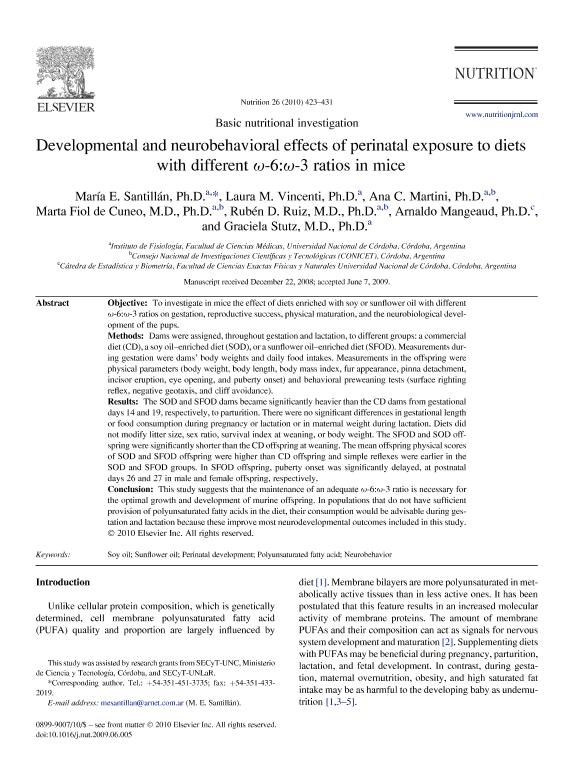
Objective: To investigate in mice the effect of diets enriched with soy or sunflower oil with differentm ω-6:ω-3 ratios on gestation, reproductive success, physical maturation, and the neurobiological development of the pups. Methods: Dams were assigned, throughout gestation and lactation, to different groups: a comercial diet (CD), a soy oil?enriched diet (SOD), or a sunflower oil?enriched diet (SFOD). Measurements during gestation were dams? body weights and daily food intakes. Measurements in the offspring were physical parameters (body weight, body length, body mass index, fur appearance, pinna detachment, incisor eruption, eye opening, and puberty onset) and behavioral preweaning tests (surface righting reflex, negative geotaxis, and cliff avoidance). Results: The SOD and SFOD dams became significantly heavier than the CD dams from gestational days 14 and 19, respectively, to parturition. There were no significant differences in gestational length or food consumption during pregnancy or lactation or in maternal weight during lactation. Diets did not modify litter size, sex ratio, survival index at weaning, or body weight. The SFOD and SOD offspring were significantly shorter than the CD offspring at weaning. The mean offspring physical scores of SOD and SFOD offspring were higher than CD offspring and simple reflexes were earlier in the SOD and SFOD groups. In SFOD offspring, puberty onset was significantly delayed, at postnatal days 26 and 27 in male and female offspring, respectively. Conclusion: This study suggests that the maintenance of an adequate u-6:u-3 ratio is necessary for the optimal growth and development of murine offspring. In populations that do not have sufficient provision of polyunsaturated fatty acids in the diet, their consumption would be advisable during gestation and lactation because these improve most neurodevelopmental outcomes included in this study.
Archivos asociados

Tamaño:
349.5Kb
Formato:
PDF
Licencia
 Excepto donde se diga explícitamente, este item se publica bajo la siguiente descripción:
Creative Commons Attribution-NonCommercial-ShareAlike 2.5 Unported (CC BY-NC-SA 2.5)
Excepto donde se diga explícitamente, este item se publica bajo la siguiente descripción:
Creative Commons Attribution-NonCommercial-ShareAlike 2.5 Unported (CC BY-NC-SA 2.5)
Identificadores
Colecciones
Articulos(INICSA)
Articulos de INSTITUTO DE INVESTIGACIONES EN CIENCIAS DE LA SALUD
Articulos de INSTITUTO DE INVESTIGACIONES EN CIENCIAS DE LA SALUD
Citación
Santillan, Maria Emilia; Vincenti, Laura María; Martini, Ana Carolina; Fiol, Marta Haydee; Ruiz, Ruben Daniel; et al.; Developmental and neurobehavioral effects of perinatal exposure to diets with different ω-6:ω-3 ratios in mice; Elsevier Science Inc.; Nutrition; 26; 4; 6-2010; 423-431
Compartir


Altmétricas