Mostrar el registro sencillo del ítem
dc.contributor.author
Perez, Adriana del Valle
dc.contributor.author
Centeno, Viviana Andrea
dc.contributor.author
Tolosa, Nori Graciela
dc.date.available
2026-01-02T11:05:23Z
dc.date.issued
2010-12
dc.identifier.citation
Perez, Adriana del Valle; Centeno, Viviana Andrea; Tolosa, Nori Graciela; Molecular mechanisms involved in the enhancement of mitochondrial malate dehydrogenase activity by calcitriol in chick intestine; Elsevier Science Inc.; Journal of Nutritional Biochemistry; 21; 12; 12-2010; 1232-1237
dc.identifier.issn
0955-2863
dc.identifier.uri
http://hdl.handle.net/11336/278552
dc.description.abstract
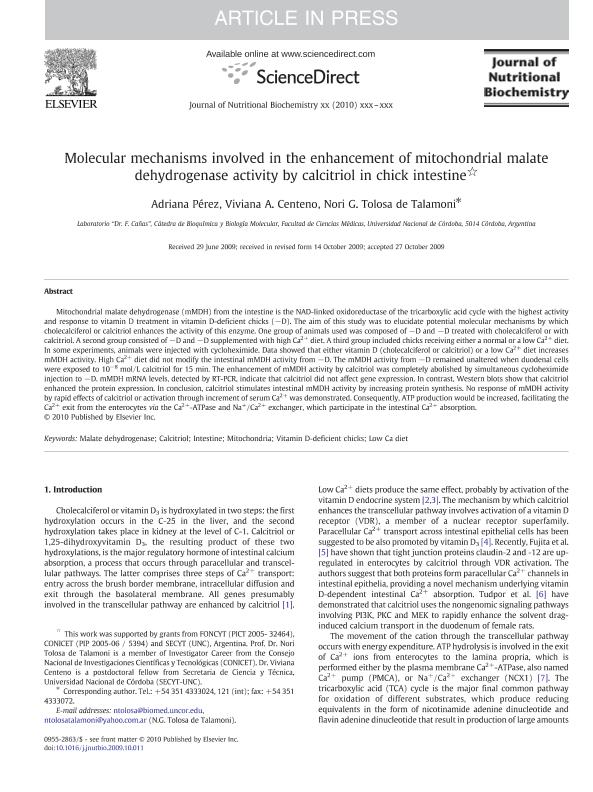
Mitochondrial malate dehydrogenase (mMDH) from intestine is the NAD-linked oxidoreductase of the tricarboxylic acid cycle with the highest activity and response to vitamin D treatment in vitamin D deficient chicks (-D). The aim of this study was to elucidate potential molecular mechanisms by which cholecalciferol or calcitriol enhances the activity of this enzyme. One group of animals used was composed of ?D and ?D treated with cholecalciferol or with calcitriol. A second group consisted of ?D and ?D supplemented with high Ca2+ diet. A third group included chicks receiving either a normal or a low Ca2+ diet. In some experiments, animals were injected with cycloheximide. Data showed that either vitamin D (cholecalciferol or calcitriol) or a low Ca2+ diet increases mMDH activity. High Ca2+ diet did not modify the intestinal mMDH activity from -D. The mMDH activity from ?D remained unaltered when duodenal cells were exposed to 10-8 mol/L calcitriol for 15 min. The enhancement of mMDH activity by calcitriol was completely abolished by simultaneous cycloheximide injection to -D. mMDH mRNA levels, detected by RT-PCR, indicate that calcitriol did not affect gene expression. In contrast, Western blots show that calcitriol enhanced the protein expression. In conclusion, calcitriol stimulates intestinal mMDH activity by increasing protein synthesis. No response of mMDH activity by rapid effects of calcitriol or activation through increment of serum Ca2+ was demonstrated. Consequently, ATP production would be increased facilitating the Ca2+ exit from the enterocytes via Ca2+-ATPase and Na+/Ca2+ exchanger, which participate in the intestinal Ca2+ absorption.
dc.format
application/pdf
dc.language.iso
eng
dc.publisher
Elsevier Science Inc.
dc.rights
info:eu-repo/semantics/openAccess
dc.rights.uri
https://creativecommons.org/licenses/by-nc-sa/2.5/ar/
dc.subject
Mitochondria
dc.subject
Malate
dc.subject
Calcitriol
dc.subject.classification
Bioquímica y Biología Molecular
dc.subject.classification
Medicina Básica
dc.subject.classification
CIENCIAS MÉDICAS Y DE LA SALUD
dc.title
Molecular mechanisms involved in the enhancement of mitochondrial malate dehydrogenase activity by calcitriol in chick intestine
dc.type
info:eu-repo/semantics/article
dc.type
info:ar-repo/semantics/artículo
dc.type
info:eu-repo/semantics/publishedVersion
dc.date.updated
2025-12-22T10:00:44Z
dc.journal.volume
21
dc.journal.number
12
dc.journal.pagination
1232-1237
dc.journal.pais
Estados Unidos
dc.description.fil
Fil: Perez, Adriana del Valle. Universidad Nacional de Córdoba. Facultad de Medicina. Cátedra de Bioquímica y Biología Molecular; Argentina
dc.description.fil
Fil: Centeno, Viviana Andrea. Universidad Nacional de Córdoba. Facultad de Medicina. Cátedra de Bioquímica y Biología Molecular; Argentina
dc.description.fil
Fil: Tolosa, Nori Graciela. Consejo Nacional de Investigaciones Científicas y Técnicas. Centro Científico Tecnológico Conicet - Córdoba. Instituto de Investigaciones en Ciencias de la Salud. Universidad Nacional de Córdoba. Instituto de Investigaciones en Ciencias de la Salud; Argentina
dc.journal.title
Journal of Nutritional Biochemistry
dc.relation.alternativeid
info:eu-repo/semantics/altIdentifier/url/https://www.sciencedirect.com/science/article/abs/pii/S0955286309002320
dc.relation.alternativeid
info:eu-repo/semantics/altIdentifier/doi/http://dx.doi.org/10.1016/j.jnutbio.2009.10.011
Archivos asociados

Tamaño:
310.1Kb
Formato:
PDF