Artículo
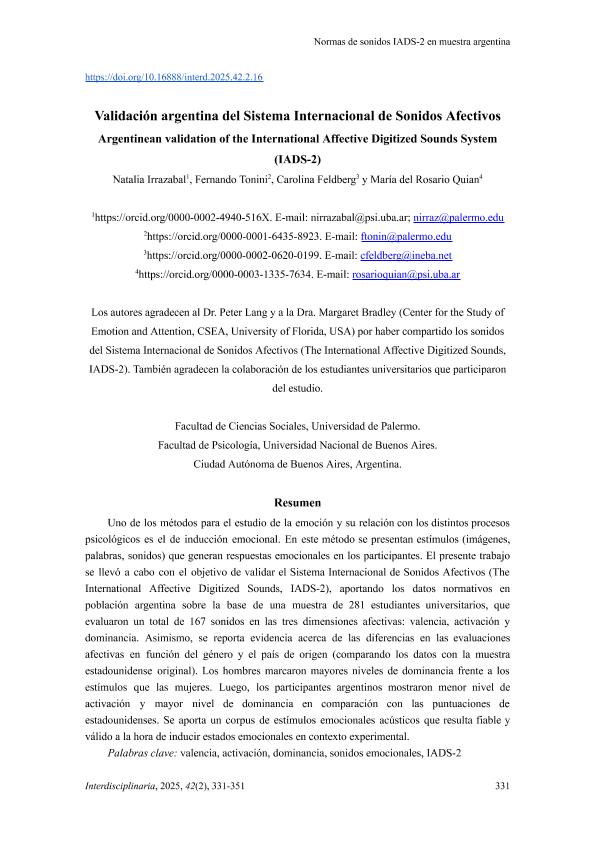
Uno de los métodos para el estudio de la emoción y su relación con los distintos procesos psicológicos es el de inducción emocional. En este método se presentan estímulos (imágenes, palabras, sonidos) que generan respuestas emocionales en los participantes. El presente trabajo se llevó a cabo con el objetivo de validar el Sistema Internacional de Sonidos Afectivos (The International Affective Digitized Sounds, IADS-2), aportando los datos normativos en población argentina sobre la base de una muestra de 281 estudiantes universitarios, que evaluaron un total de 167 sonidos en las tres dimensiones afectivas: valencia, activación y dominancia. Asimismo, se reporta evidencia acerca de las diferencias en las evaluaciones afectivas en función del género y el país de origen (comparando los datos con la muestra estadounidense original). Los hombres marcaron mayores niveles de dominancia frente a los estímulos que las mujeres. Luego, los participantes argentinos mostraron menor nivel de activación y mayor nivel de dominancia en comparación con las puntuaciones de estadounidenses. Se aporta un corpus de estímulos emocionales acústicos que resulta fiable y válido a la hora de inducir estados emocionales en contexto experimental. Emotions have become one of the phenomena of greatest interest to researchers from different disciplines from the beginning of the 20th century to nowadays. Its study includes both theoretical and methodological aspects. Researchers have been using different methods to study emotion. One of those is emotional induction, in which the participants are presented with stimuli (images, words, sounds) that generate emotional responses. In Argentina, the normative data for the IAPS images, ANEW words and films are available, but there’s not yet a base of acoustic stimuli validated in the local population. That is why the objective of this article is to present the results of the Argentine validation of the IADS-2 stimulus sets. The present work was carried out with the aim of validating the International Affective Digitized Sounds System (IADS-2), providing normative data in the Argentine population based on a sample of 281 Argentine university students, who evaluated a total of 167 sounds in the three affective dimensions: valence, arousal and dominance. In order to find evidence of the internal consistency of the instrument scores, reliability analyzes were carried out through Cronbach's alpha coefficient. Coefficients between .84 (set 1 valence) and .95 (set 2 arousal) were found, indicating that the reliability results obtained can be interpreted as between moderate and high. Regarding the distribution of the scores, a statistically significant associative relationship is observed between the two variables (r = -.77, p < .01) CI [-0.82, -0.71] only in the scores located in the lower quadrant (negative valence and high arousal), in which a lower level of pleasantness of the sound would indicate a greater activation by the participant. This relationship between valence and arousal in the case of pleasant sounds was not significant (r = -.01, p = .96). Finally, when valence is taken as the main variable of the two-dimensional space, it is observed that it explains 59 % of the variation in the arousal dimension (R 2 = .59, p < .01). No significant differences were found between the scores of men and women in Argentina in particular. Nevertheless, evidence is also reported on the differences in affective evaluations according to sex and country of origin. Males showed higher levels of dominance to the stimuli than females. On the other hand, Argentines showed lower levels of arousal and higher levels of control compared to Americans. Significant differences were found when the scores were evaluated based on the sex of the participants from each country. In this sense, the differences among the group of women are found in the arousal dimension (MEEUU: 5.89, MArg : 5.40; p < .01; d = .40) and dominance (MEEUU: 4.58, MArg : 5.02; p < .01; d = .34), and in the valence (HEEUU: 4.88, HArg : 4.42; p < .01; d = .29), arousal (HEEUU: 5.77, HArg : 5.42; p < .01; d = .30) and dominance dimensions (HEEUU: 4.88, HArg : 5.34; p < .01; d = .42) for men. A corpus of acoustic emotional stimuli is provided that is reliable and valid when it comes to inducing emotional states in an experimental context. The main limitation to take into account is that most of the sample resided in the metropolitan area of Buenos Aires. At the same time, it is relevant to continue investigating the relationship between valence and arousal. Although the boomerang-shaped structure has been replicated in most of the validations, the variability present in the two-dimensional structure made up of these two dimensions makes it necessary to study other possible structures. It is encouraged that new normative data be provided both in other areas of Argentina and in other Latin American countries.
Validación argentina del Sistema Internacional de Sonidos Afectivos
Título:
Argentinean validation of the International Affective Digitized Sounds System (IADS-2)

Fecha de publicación:
12/2025
Editorial:
Centro Interamericano de Investigaciones Psicológicas y Ciencias Afines
Revista:
Interdisciplinaria
ISSN:
0325-8203
Idioma:
Español
Tipo de recurso:
Artículo publicado
Clasificación temática:
Resumen
Palabras clave:
VALENCIA
,
ACTIVACION
,
SONIDOS EMOCIONALES
,
IADS-E
Archivos asociados

Tamaño:
1.973Mb
Formato:
PDF
Licencia
 Excepto donde se diga explícitamente, este item se publica bajo la siguiente descripción:
Creative Commons Attribution-NonCommercial-ShareAlike 2.5 Unported (CC BY-NC-SA 2.5)
Excepto donde se diga explícitamente, este item se publica bajo la siguiente descripción:
Creative Commons Attribution-NonCommercial-ShareAlike 2.5 Unported (CC BY-NC-SA 2.5)
Identificadores
Colecciones
Articulos(SEDE CENTRAL)
Articulos de SEDE CENTRAL
Articulos de SEDE CENTRAL
Citación
Irrazabal, Natalia Carolina; Tonini, Fernando; Feldberg, Carolina; Quián, Maria del Rosario; Validación argentina del Sistema Internacional de Sonidos Afectivos; Centro Interamericano de Investigaciones Psicológicas y Ciencias Afines; Interdisciplinaria; 42; 2; 12-2025; 331-351
Compartir

